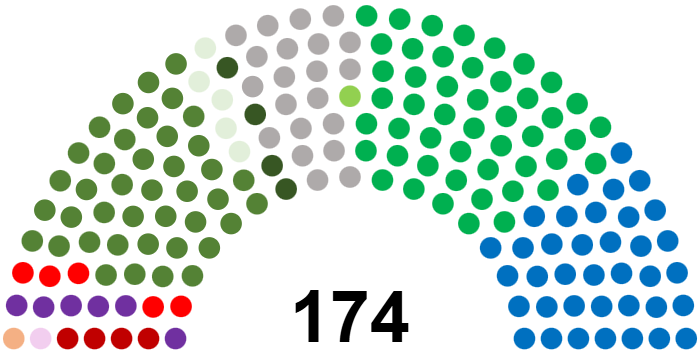
Seat totals
Fianna Fáil 48
Sinn Féin 41
Fine Gael 37
Independents 21
Social Democrats 6
Labour 5
Independent Ireland 5
PBP/Solidarity 4
Aontú 4
Green Party 1
Right2Change 1
Independents4Change 1
Workers & Unemployed 0
Changes since Nov 2nd 2024
Fianna Fáil +5
Sinn Féin +8
Fine Gael -11
Independents nc
Social Democrats nc
Labour nc
Independent Ireland nc
PBP/Solidarity -2
Aontú +2
Green Party nc
Right2Change nc
Independents4Change -1
Workers & Unemployed -1
Seat Map
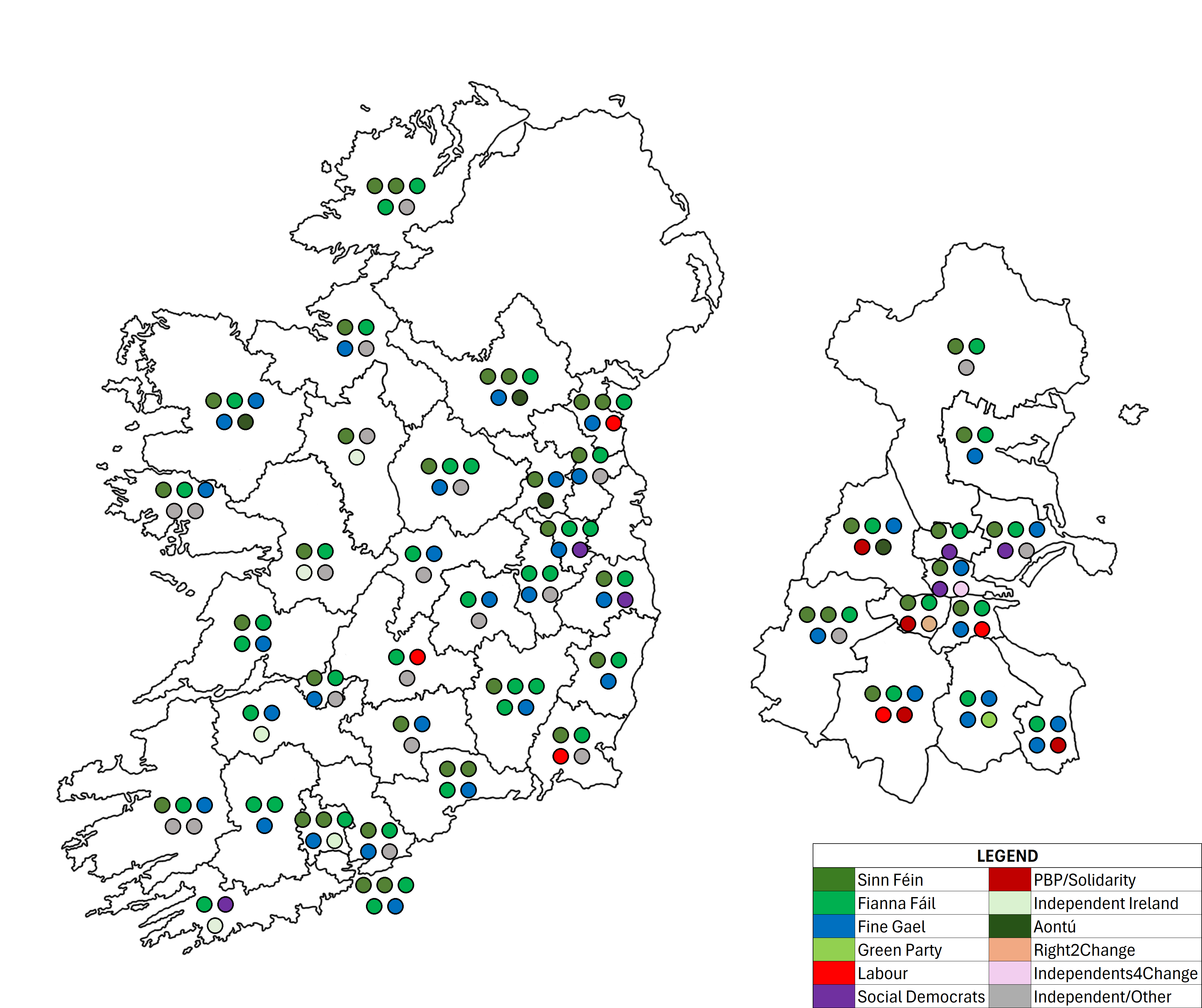
Hello. Polling has finished, but the polls are open. This is the final set of projections before the 2024 general election. I won’t spend too long on the preamble, but a few technical notes – I have dropped some tail data owing to polling movements, incorporated the four constituency polls, updated for the latest national polls and tried to make the transfer patterns make a little more sense.
The only comment I will make is that if these projections reflect where we end up, Simon Harris is going to owe Micheál Martin big time, because right now it’s Fianna Fáil who are poised to save the government. If past patterns and the data are anything to go by, they stand to benefit a fair bit from Fine Gael’s struggles, which will limit the potential net losses of the government, if things go in line with the current polling and the model’s expectations.
But, as you will see as you read through each constituency, there are plenty of places where even small movements could result in under- or over-performance for any of the big parties, let alone the smaller ones. The trend is clear that government support has declined, but not enough to put FF and FG in a difficult position when it comes to forming a new government. But things can change, those marginal things can break oddly and the unexpected will, inevitably, be loudly proclaimed as obvious in retrospect. While we should view some form of FF-FG led coalition as the most probably outcome, the key word here is “uncertainty”.
Below, I want to include a note on how to read and interpret these results. I would strongly advocate reading it to avoid taking the wrong impression, but if you are already familiar and would prefer to skip straight to the projections, click here.
How to read these results
It’s important to note that these are projections not predictions. They are not an attempt to prognosticate how people will vote; rather, they are an interpretation of polling data to try to give a more tangible sense of how polling numbers convert to seats.
The projections reflect, and always have reflected, most likely outcomes. So if a final seat is more likely for candidate X over Y, the model will show X winning the seat. This does not mean the scenario where Y wins doesn’t exist, or even is necessarily unlikely. A projected result merely means that the model thinks X winning is the most likely outcome as indicated by the polling data currently available.
And this data is not infallible, and nor is the modelling. First and foremost, things can shift even between the polls in the last week and the outcome of the votes. On top of this, there will be local misses where nuance or specific situations can’t be fully captured by data we have. This could be somebody beating their party’s general trend (like Duncan Smith), coming out of nowhere to win a seat (like Holly Cairns), or simply an extremely marginal race where the probability is essentially 50/50, and a few small variations, or things breaking one way or the other will decide it (like Anne Rabbitte vs Louis O’Hara). Even with that in mind, the model does account for and show a lot of stuff beyond just the most likely outcome it spits out. I will make an effort to highlight these various alternative potentials in the constituency reviews below.
There are, of course, further complications. Transfers, although included in the model, can be much less predictable. Vote management is also modelled historically; a party suddenly improving or worsening its vote management between multiple candidates can change outcomes. And, of course, most importantly of all – the polls do have a cut off point. While the scope for movement is relatively limited, there may still be plenty of people who have not yet made up their mind, or may change it. That, naturally, can create a gap between the data used in the projection and the actual result on the day.
This is all to say, do not mistake this for a crystal ball. This process is experimental and will be iterative – there is lots we will learn in terms of future modelling from this election. It is merely a way of interpreting the information we have available to us and showing what that signals to be most likely. And these numbers are very close, the model has a lot of seats as marginal, and there is a ton of uncertainty. Bear this in mind when reading the below, and if my language accidentally implies something different, please refer back to this section to understand the intent.
Final Projection for General Election 2024
This update includes an update for every constituency. You can click the appropriate link in this table to jump to each constituency:
PROJECTION: 1 SF, 3 FF, 1 FG
This is one of Fianna Fáil’s strongest constituencies, and with all three parties neck-and-neck, things favour them. They were extremely close to winning three seats here in 2020, falling less than 600 votes short as the Green Party’s Malcolm Noonan TD accumulated left-wing transfers to squeak ahead.
With the Greens polling poorly, left-wing parties maybe more cautious of transfer due to the their time in government, and increased competition in the county town from the Social Democrats, Labour and Independent Cllr Eugene McGuinness, it’s hard to see a repeat here.
It’s not a sure thing for FF though – winning three seats anywhere is a big ask on current polling numbers, and requires careful vote management, not to mention factors not directly within control such as transfers and elimination order. And current polling has it close: if Fine Gael don’t decline further from their current position, they should in theory have the capacity to win a second seat here, though running three candidates has certainly made that harder for them. Sinn Féin would need a significant late movement to be competitive for a second seat.
Worth noting that while have heard some buzz around the SD’s Patricia Stephenson, there’s nothing in the data that indicates this – and while people certainly can come out of nowhere, if she does, it will be exactly the kind of thing this model can’t detect.
PROJECTION: 2 SF, 1 FF, 1 FG, 1 AON
Fine Gael’s decline in polling has moved them away from being projected to win a second seat here. With Fianna Fáil looking pretty pedestrian across the province, and Sinn Féin having not seen the kind of movement they did in 2020, it is instead Aontú who are for the first time favoured by the model to win a seat they’ve been flirting with for years. There’s certainly still movements and vote management outcomes that could tilt the seat to FF (or a third SF or second FG), but Cllr Sarah O’Reilly is in the strongest position right now.
If Aontú don’t manage to pull it off, however, it should not be assumed that the seat goes back to one of the big parties. Independent Ireland’s Cllr Shane P. O’Reilly (formerly of FF) could well be competitive here. They and Aontú should, in theory, transfer well to eachother, so if things end up tight, the elimination order could be crucial. That said, projecting for new parties is very difficult to do with a great degree of confidence, so I would definitely say caution is warranted here.
The natural follow up question is could both Aontú and II win a seat? It’s not likely with the current numbers; it would take a significant underperformance by one of SF, FF or FG to open up this door. All of them are running three candidates however, so the door for bad vote management causing an unexpected result is at least open, if only very slightly.
PROJECTION: 1 SF, 2 FF, 1 FG
I’m not sure about the Sinn Féin seat here, to be honest. I do understand why it’s coming up in the model, and it makes sense from the data, but there’s other factors we need to be aware of. As ever, as these are not part of the model, I will not be putting my thumb on the scale, but I think it needs to be flagged first and foremost that there are local factors in the aftermath of Violet-Anne Wynne TD’s exit from the party, including but not limited to her running as an Independent, working against SF here that the model cannot account for.
Fianna Fáil should be able to win two here without too much fuss, and Fine Gael should on current numbers also be able to get a seat – though again, running three candidates runs the risk of introducing avoidable complications, depending on how efficient their vote management is. Both could, if they have a really good day, push to add another, although the trends are not currently in that direction, particularly for FG.
Outside of the bigger parties, Independent Ireland’s Eddie Punch is probably the candidate with the best chance of crashing the party. There are factors against him though – if he’s hoping to pick up former McNamara voters, he’s based in the wrong part of the county, and two of Independent Ireland’s local election candidates have quit the party and are running against Punch as genuine Independents.
Green Party Senator Róisín Garvey’s vote may prove more resilient than some of her colleagues’ – their local vote held up reasonably well in Ennistymon – but even if it does, it would still take an notable underperformance from one of the big parties, plus a few other things breaking her way, to put her in the picture.
PROJECTION: 1 SF, 1 FF, 1 FG, 1 IND
The modelling for Cork East shows that on current numbers, Sinn Féin, Fianna Fáil and Fine Gael should all be favoured to pick up a seat. What happens with the other seat is where things get interesting. Right now the model favours it going to an Independent; though whether that would be Fermoy-based Cllr William O’Leary or Midelton-based Cllr Mary Linehan Foley is not particularly clear. Caution, as ever, should be applied to Independents, as their support is generally speaking more volatile than that of parties, but I would expect both to be somewhat competitive at least.
However, it should be noted that the model thinks Fianna Fáil should be very competitive to pick up two seats here, more so than I would have expected, indeed this is at the point where the probability between this and an Independent gain is basically a coinflip. Sinn Féin could in theory push for two here if their numbers spike on polling day, but it seems less likely based on what we have at the moment. Fine Gael would need a noticeable outlier overperformance to be looking at a second seat.
Social Democrat Cllr Liam Quaide is also an interesting outside look – not favoured by any means, but not massively distant, and if the Soc Dems are indeed poised to increase their vote in Munster by as much as polls indicate, those votes have to be somewhere, and Cork East is as good a blind bet as any.
PROJECTION: 2 SF, 1 FF, 1 FG, 1 II
The model has been pretty kind to Solidarity TD Mick Barry over the last while, showing him holding on, albeit under tremendous pressure. With things in Munster ticking a bit towards Sinn Féin, and PBPS’s polling not really showing positive movement, the model now thinks that SF’s Cllr Joe Lynch is more likely to get a seat.
Cork North-Central is a tricky one in general at the moment though; there are a ton of candidates, with Fianna Fáil and Fine Gael both running three, and Labour and the Social Democrats both doubling up. Maybe one of these strategies will pay dividends, but based on the polling data they all seem unwise and, crucially, significantly cloud the transfer situation. So while Sinn Féin and Fianna Fáil should clearly be favoured to win seats, it all gets a bit unclear after that.
Fine Gael should be fine, but if they underperform here and make a mess of their vote management, it could cause problems for them – though this isn’t tremendously likely. Independent Ireland Cllr Kenneth O’Flynn should pick up a seat as well; while it’s hard to figure out how II candidates will do in general, his personal support ought be enough in a five seater.
The other seat then, is very unclear. SF are favoured by the model, as above, Barry will certainly be competitive and has a decent chance to hold. Fianna Fáil may push for a second, but three candidates seems suboptimal. The last of the Labour, Green or SD candidates standing could accumulate left-wing transfers at a high rate and enter into the mix. Far-right candidate Derek Blighe will also potentially get a number of votes, and while very unlikely to seriously threaten a seat, he does add more unpredictability.
A lot here is going to come down to transfers, vote management elimination order, and small deviations in FPV from the polling. This is one of those constituencies where it could be close, or, equally, someone could just overperform and blow everyone else away. This is really interesting.
PROJECTION: 2 FF, 1 FG
No disrespect to Cork North-West or its fine people, but there isn’t a lot to say here. It will be a significant shock if some combination of Fianna Fáil and Fine Gael don’t fill all three seats here, with Fianna Fáil in the driver’s seat to pick up two based on current numbers. This is a constituency that has, since its establishment in 1981, never returned a TD from outside those two parties – though there have been or or two others who have come close.
Nothing should ever be taken as completely definitive, of course, and there are scenarios under which Sinn Féin or Aontú are able to pull off the unlikely outcome – but either would be a notable upset. I would not be surprised if one of Becky Kealy and Nicole Ryan, or even both, does well. But well enough to win a seat is an entirely different proposition, as we have seen in the previous three general elections.
PROJECTION: 2 SF, 2 FF, 1 FG
Interesting one here, though not quite the same level of chaos potential as its sister constituency on the other side of the Lee. The model may be being a little generous to Sinn Féin here, but it has pretty consistently shown this even when their polling was worse. If that’s just it knowing better than I do, or a systematic error that will need to be looked at is something we’ll know when the votes are counted.
Fianna Fáil should, based on current numbers, claim two seats, with Fine Gael and Sinn Féin adding one each. And if SF doesn’t win the other seat, who else might? Fine Gael would naturally be pushing for a second but – and stop me if you’ve heard this before – the decision to run three candidates makes this vastly more complicated for them, before we even get into their downward polling trend. Fianna Fáil could in theory push for a third on an excellent day, but it would need to be truly excellent.
Similar to North-Central, there is a chance that another candidate accumulates transfers from left-wing candidates further down the ballot and vaults into competitiveness. This is particularly relevant given the relative lack of confidence in the second SF seat. Labour, the Greens, the Soc Dems, Rabharta, PBP and Independent Mick Finn will all be hoping it’s them, with varying levels of plausibility. It wouldn’t surprise me to see one of them make a push, but barring an overperformance, they would have some ground to make up.
PROJECTION: 1 FF, 1 SD, 1 II
Not an enormous amount to say here – Independent Ireland’s seat looks very safe on these numbers, and beyond that there’s a fight to be had between Fianna Fáil, the Social Democrats and Fine Gael, with the former two favoured on current polling numbers. The model hasn’t liked FG’s chances here for a while, and the current dip in polling is doing very little to change that.
Outside of this it doesn’t feel like anyone else will have much of a say. This is a very hard constituency for Sinn Féin, and running two candidates feels like it runs the risk of doing more harm than good on these numbers. Independent Cllr Alan Coleman might poll better than last time but doesn’t look particularly close. Honestly, this could end up going very similarly to last time.
PROJECTION: 2 SF, 2 FF, 1 IND
Donegal is one of the constituencies where we got a local poll from TG4 and IPSOS/B&A, as well as one from the Tirconaill Tribune, which has a pretty good track record, but didn’t break out a lot of candidates. As such the TG4 one is included in the overall data, while the TT one is used to improve the projection of vote split between the major party candidates.
Both of these made for grim reading for Fine Gael – their FPV is shown in both as enough to be competitive for a seat, but the split between their candidates is brutal – 50/50 is not good when you are on course to be scrapping for a late seat. With this factored in, the model no longer favours them to win back the seat previously held by the now-resigned Joe McHugh. They aren’t completely out of it, but if the vote split shown in both polls manifests on the day they will need some serious breaks to go their way.
Fianna Fáil stand to benefit here – indeed, both local polls were quite nice for them – and the model favours them to win a second seat, albeit not with a particularly comfortable margin, as Charlie McConalogue might be under pressure due to 100% Redress. It should be said that 100% Redress don’t seem in the best position to take a seat right now, but they are not far off and a small bump on the day could benefit them significantly.
Sinn Féin should take two seats comfortably. Thomas Pringle TD (IND) should be okay as well, but keep an eye on Donegal LEA and the southern end of Glenties LEA – if his FPV is down on his 2020 totals, there, he could be in trouble, particularly if 100% Redress overperform. Sinn Féin don’t, from these numbers, look like they can likely push for a third. Aontú will probably scoop up plenty of transfers from the various far-right candidates at the bottom of the ballot, but their FPV doesn’t look high enough to be seriously competitive from the data we have available to us.
PROJECTION: 1 SF, 1 FF, 1 FG, 1 SD, 1 IND
As ever, plenty of intrigue in one of the most volatile constituencies in the country. Sinn Féin TD Denise Mitchell should hold her seat with little bother, and Soc Dem TD Cian O’Callaghan also looks to be extremely comfortable. Behind that, however, things get a bit more interesting in the model.
Fine Gael should be okay to get one or other candidate over the line – it would take a significant underperformance on polling day to put their FPV into the danger zone – but it should be noted that with two candidates, there are certain vote management outcomes that could make things more difficult than they need to be for them. Fianna Fáil are in a similar position with their polling recovering a bit in the capital, albeit with less cushion based on these numbers. Good vote management is a seat; bad vote management puts it in danger.
After that, it gets harder to tell. Independent Cllr Barry Heneghan is still favoured for a seat, and despite some online fracas in the final week, I’m not sure that will have any impact, and the Finian McGrath machine should not be underestimated. Labour are no longer favoured here, but I expect them to be competitive and could swing it if they have an overperformance and some good luck. There are also scenarios in which Sinn Féin can seriously threaten a second seat.
Finally, there’s been plenty of buzz around Independent Left Cllr John Lyons; Lyons is extremely well regarded in his area and despite all the chat around the far-right threat in this area, it should be remembered that he outpolled every single one of them in the locals. However, the model doesn’t give him much of a chance in the broader constituency as a whole. To explain why the model sees a difference between him and Heneghan is straightforward: there are more votes in Clontarf than in Artane-Whitehall. I think this is ultimately correct – though I will say that this is exactly the vote balance between two Independents is exctly the type of thing the model could miss.
In short, a lot of this is going to come down to how closely the FF and FG votes reflect current polling, and how good a job they do at managing their vote split and transfers. If all goes well, only one seat will likely be up in the air. If one or both make a mess of it, things could get very, very interesting.
PROJECTION: 1 SF, 1 FF, 1 FG, 1 LAB
Another constituency that has been a long-term source of volatility, and we’ve had more of it going into the campaign period with the model outcome swinging back and forth on tight margins. And while we do have the final projection here, I would emphasise again that the margins are very tight in the model. One seat is pretty much locked down for Fine Gael – though whether it’ll be Cllr James Geoghegan or Cllr Emma Blain is not something the model can project with any great degree of confidence, particularly as both are based in the same LEA.
Indeed, the model now is suggesting that Fine Gael should not be favoured for a second seat here; which should be taken as a good indicator of more widely disappointing polling, should it come to pass. But honestly, other than the one FG seat, there are uncertainties everywhere.
Labour leader Ivana Bacik is generally well-liked and should hold her seat an I suspect will, possibly even comfortably, but it is always very challenging to interpret by-election data back into a GE. Fianna Fáil incumbent Jim O’Callaghan is vulnerable, but this is a challenging seat for FF at the best of times, and with the current polling patterns the model sees him more likely than not to hold. The other incumbent who is running again, Sinn Féin’s Chris Andrews is also seen as marginally favoured – a lot will come down to how robust the SF support in SEIC proves, and he will need to win over people who abandoned SF in the locals.
Beyond that, Green Party Cllr Hazel Chu should be competitive, and the question is how much of Eamon Ryan’s support base she can hold onto and, perhaps crucially, win back from those who swung to Bacik in the by-election, but being in the same LEA as the two FG candidates poses further challenges. Former FG TD Kate O’Connell, running as an Independent, is also interesting, particularly without an FG candidate based in her end of the constituency – an area that typically has the highest turnout EDs. She could be in the mix if she’s able to peel off the FG vote around Kimmage-Rathmines.
PROJECTION: 1 SF, 1 FG, 1 SD, 1 I4C
From the data we have available to us, Sinn Féin and Fine Gael should be confident of a seat each here, and so should the Social Democrats, barring Clare Daly (I4C) having a disproportionate impact on the latter.
The seat projected for Daly is much lower confidence; it is diffcult to model for a high-profile candidate running in a new constituency, and right now it shows her favoured by a very thin margin and likely to be in a tough race for the final seat. But I would view the variance potential here as high; I would be equally unsurprised if she cruises in or falls well short.
Who might benefit if Daly does fall short? Fianna Fáil’s Mary Fitzpatrick is the next most likely to win a seat under the model, but there are others too. Given the improvement in Sinn Féin’s fortunes, Mary Lou McDonald will be looking to bring in her running mate, and clever vote management – or just Mary Lou’s personal popularity – make this a real possibility. The anti-migrant and far right candidates will have been targeting here, and I expect the likes of Aontú and Cllr Malachy Steenson (IND) to do okay combined, and transfer well to eachother, but Daly’s entry into the race will make it harder to collect the anti-establishment votes. The Greens and Labour both have a chance to be competitive, but would require significantly trend-beating performances to retain or pick up a seat, respectively.
There is of course one total wildcard here as well. I don’t know what impact Gerry “the Monk” Hutch will have on the race, or how he will do, and anyone who says they know is making stuff up.
PROJECTION: 1 SF, 1 FF, 1 FG
Fianna Fáil and Fine Gael should on current numbers be able to hold their seats in the redrawn constituency – both incumbents from the former Fingal constituency are running here, and this was the stronger side of the constituency for both.
The other seat is, however, much more up in the air. Right now the model has moved to favour Cllr Ann Graves to win the seat, but this is very close and there will be fierce competition. Incumbent Labour TD Duncan Smith has proven he can beat Labour’s general trends, and a relatively small improvement above that would see him retain the seat that initially looked lost with the redraw. I4C Cllr Dean Mulligan is also in with a shout – he was incredibly transfer friendly in 2020, and while he did benefit from an SF surplus, there’s a chance he can convert some of those into first preferences this time round, and there’s plenty of scope to accumulate left-wing and anti-establishment transfers. Any one of these three could take it.
PROJECTION: 1 SF, 1 FF, 1 IND
I’d view Sinn Féin as pretty safe here; Louise O’Reilly TD is very popular and despite it at one point showing her losing out, the model has settled back into a pretty confident state about her seat. The model is also very, very high on Independent Cllr Tony Murphy, who put up extremely strong numbers in the constituency in 2020, particularly in Balbriggan and its hinterlands. The caveat here is that he will now be facing more competition based in his areas, and his support may have a cap – something that’s very hard to model for. He should at least be highly competitive, and, if the model is right, should win a seat. But as ever, caution is needed when modelling Independents.
The other seat right now looks to be between Fianna Fáil and Fine Gael on current numbers – with an advantage to FF from both current polling trends and the 2020 performances. Green TD Joe O’Brien has an uphill battle; he did very well in 2020, but a three-seater is a much more challenging prospect, and his vote wasn’t very heavily biased towards this area, with a less than 2-point advantage in the new West versus the new East.
He also might be facing a problem in the form of Labour, who had an extremely strong local election here. The model doesn’t account for that so it doesn’t show them massively close, but their is a ton of buzz around Cllr Robert O’Donoghue. One to watch for a potential upset.
PROJECTION: 2 SF, 1 FF, 1 FG, 1 IND
Sinn Féin TD Eoin Ó Broin will almost certainly walk into a seat here, and Fine Gael, even with declining support, will need to mess something up badly not to have one of Emer Higgins TD or Cllr Vicky Casserly returned. After that things have very suddenly become rather messy.
We are on the day of the election and the model is still showing Independent Cllr and former Green TD Paul Gogarty as favoured for a seat, but it’s closer than it has been in a long time. In a similarly tight situation, the model has swung towards Sinn Féin’s other TD, Mark Ward, holding his seat at the expense of PBP TD Gino Kenny. The gap between these three is really marginal, and any one of them could easily beat out the other two based on current data.
It should also be noted that Fianna Fáil are running two candidates here where they really shouldn’t be. The margins they have in terms of vote management are razor thin, a small underperformance or even slightly suboptimal vote management could end up leaving them behind any or all of the three above.
Finaly, Labour have recruited a popular fomer Independent in Cllr Francis Timmons. Timmons is very much an outside chance at a seat, but he could do well, and the impact he has on other candidates and where his transfers go could be crucial in settling what is, based on current data, a really unclear race for the final three seats.
PROJECTION: 1 SF, 1 FF, 1 SD
This constituency has stabilised quite a bit following the recent polling trends, with the model showing a decent advantage for the two incumbent TDs, Dessie Ellis (SF) and Paul McAuliffe (FF), as well as Rory Hearne (SD), who is seeking to replace the retired Róisín Shortall.
Former Fine Gael TD Noel Rock is a bit further back, and really is only competing directly with McAuliffe, as there is more than likely one centre-right seat to be won here. Rock’s position is not great – he lost to McAuliffe in 2020, and Fine Gael are trending downwards in general, but I would not write him off entirely.
But there are prospects beyond this – if Sinn Féin get a good amount over their trend, they could threaten for a second seat, but I feel that will be difficult. If PBP Cllr Conor Reddy can peel away some of the SF support that came to him via the surplus and convert to first preferences, he has an outside chance. If he manages to get ahead of a second SF candidate at the point at which they are eliminated – which is a big ask – things get interesting. There are also two far right candidates, the National Party and Independent Cllr Gavin Pepper. They will likely transfer extremely well between eachother, and had strong local elections here. It’s an outside shot on current numbers, but it should not be dismissed, particularly as Independents are hard to model for confidently.
PROJECTION: 1 FF, 2 FG, 1 GP
This looks extremely normal, a result one could pick out very easily, but there’s a lot more going on under the surface here. Indeed, I would go so far as to say that beyond one seat assured for Fine Gael, there’s a lot that could move around here.
There are several factors that could have another candidate get ahead of the Greens, Fianna Fáil or even a second Fine Gael candidate. The entry of Independent Cllr Michael Fleming into the race adds a lot of uncertainty (and almost certainly blunts Labour’s ambitions very badly) – Fleming absolutely cleaned up Glencullen-Sandyford in the locals, and if he’s able to expand his appeal to the other parts of the constituency, he’s got a real shot at a seat. Ex-FG TD Alan Shatter is also running as an Independent, and while I think less likely to win a seat (the model can’t really disambiguate well between Independents, so take this with a pinch of salt), if he peels off Fine Gael votes, it could cause problems for them. A strong performance from Shatter could, in theory, take out the second FG candidate, even if he falls short himself.
And beyond this, both Labour and the Social Democrats pose a threat here to Green TD Catherine Martin, if not individually then combined. Neither is particularly likely under the model to win a seat themselves, but if they impact Martin’s support enough, and don’t transfer back well enough, she’s in trouble. If one of them actually manages to leapfrog Martin, you would expect them to do well out of her transfers, and could spring an upset, but this is an outside shot.
Also, Aontú will probably do well here. Hard to see a seat or where they pull substantial transfers from, but they could add further uncertainty to a constituency that has a lot of hidden potential behind the straightforward list of who is favoured.
PROJECTION: 1 SF, 1 FF, 1 PBPS, 1 R2C
Sinn Féin are all but assured of a seat here – Aengus Ó Snodaigh is very popular and has been a stalwart TD for over 20 years at this point. After that, there is once again a lot going on here that isn’t neccessarily immediate from the headline projection.
Similar to some other constituencies around Dublin, Fianna Fáil and Fine Gael likely have a seat between them – as one’s transfers should elect the other – and I emphasise “should”, because that did not happen in 2020! It is very unlikely, though not completely impossible, that both can make it in, but it would require a collapse in votes or transfers on the left. Given the general polling trends, the model favours Catherine Ardagh over Mary Seery Kearney in the battle between the two Senators, but this shouldn’t be viewed as on lock.
After that, the model sees two more left-wing seats, and it’s very close between R2C TD Joan Collins, PBP Cllr Hazel de Nortúin, and one of the two other Sinn Féin candidates. Based on current numbers, the latter will require some good vote management to come out on top, but both Collins and de Nortúin are in unclear positions. Collins is very difficult to model for, and how much of Bríd Smith’s vote de Nortúin can hold is an open question. All three of these have good potential to win a seat, but a loss is very plausible for any of them under the modelling.
Past this, there are some more outisde shots that can’t be ruled out entirely. Labour and the Soc Dems could be pushing to take left votes, and while on the Dublin trends Green TD Patrick Costello is in serious trouble, the local elections might point to this as an area where the Green vote has an outlier level of resilience. These three should all transfer pretty well to eachother, and it could potentially push whoever is last standing into competitiveness.
Finally, Cllr Philip Sutcliffe (on the ballot as Independent Ireland, but expelled from the party after the deadline for changes passed) is unlikely to be near a seat but where he pulls votes from, and where his transfers go, could be impactful.
PROJECTION: 1 SF, 1 FF, 1 FG, 1 LAB, 1 PBPS
The big three parties should all be pretty comfortable here, if the model is interpreting the data correctly. The other two incumbents – PBP’s Paul Murphy and Green Francis Noel Duffy – have a much tougher time, with the model placing Duffy rather distant of being able to hold his seat.
The model favours Labour to take his seat but this is not a clear cut prospect, and the margin is very narrow, with potential by the Social Democrats, an Independent, or even on an strong day for them and with good vote management, a second Sinn Féin or Fianna Fáil candidate to get into the mix. The Independents are hard to measure – there are two well known Cllrs in Alan Edge and Paddy Holohan running, both in very different lanes – so how that shakes out between them is hard to say.
As for PBP, the model does have Murphy a little bit above this scrap, but it wouldn’t take much of a drop for him to fall back into it. Murphy is a popular TD in his area, but he will need to reel back the votes he lost to SF in 2020. With Fettercairn ED out of the constituency, and with no running mate this time (this is a good decision), there’s a bit of a question mark over how his 2020 performance translates, but right now the model gives him a bit of an advantage here. That said, if the data is reflective, he is certainly not in the clear yet.
PROJECTION: 1 SF, 1 FF, 1 FG, 1 PBPS, 1 AON
This is another constituency where the big three parties should all be able to win a seat unless something odd happens – particularly with Fine Gael, who have gone aggressive nearly everywhere else, opting to do the sensible thing and only run one candidate here.
The remaning two seats are a lot more open, with four candidates plainly in the running – Green TD Roderic O’Gorman, Solidarity Cllr and ex-TD Ruth Coppinger, Independent Cllr Tania Doyle and Aontú Cllr Ellen Troy. There’s also potential for Labour or even a second SF candidate to get into the mix if they have a positive outlier here, but the model has them a step behind on current numbers.
Between these four, the model favours Coppinger and Troy at the moment, but the margins here are extremely fine and any combination of two of these four should not be a surprise. The reaons for this, are basically that Aontú are putting up strong polling in Dublin, the Greens are struggling overall, Doyle is extremely strong in Ongar but an unknown quantity outside of it, and Coppinger is best placed to split a lot of these differences and has a good electoral history in the area – and would still be a TD if this was a 5 seater in 2020. But this one is very difficult to have confidence in.
PROJECTION: 1 FF, 2 FG, 1 PBPS
There’s not a lot to say here – this should be a fairly straightforward one. The only thing that’s added some interest is Fine Gael doing a last-minute attempt at vote management to help out their second candidate, Senator Barry Ward. This might indicate there may be something at play they are seeing that a model cannot, but it equally might just be them playing it absolutely safe.
The FF seat here has been wobbly for a while, being variously lost and reclaimed over the last few cycles, but running one candidate here should help on top of the current trends. PBP’s Richard Boyd Barrett should be safe as well; his is the safest PBP seat and if he is in trouble, that would be the harbringer of an extremely bad election for them.
Also in favour of these three is it’s not clear who else can win. Green TD Ossian Smyth will need a significant trend beat, plus a major mess up from one of the others, to be in the mix, although he ought still be the next strongest candidate, and may have a stronger personal vote than we see in the model. If Fine Gael are the ones who somehow mess things up, he’s likely best placed to take advantage, though again, the model has him very much on the outside looking in. Labour and Aontú should, based on current numbers, do okay here, but seem distant from challenging for a seat.
PROJECTION: 1 SF, 1 FF, 1 II, 1 IND
This one is very close, and with a big chunk of former Michael Fitzmaurice voters – 7-8% of FPV! – moving into the constituency from Roscommon-Galway, there’s a ton of uncertainty here. Independent Seán Canney should be fine, but beyond that it gets messy.
The model has always really liked Sinn Féin’s chances here, and I think there’s potential that this is a place they are being overestimated. It also thinks Independent Ireland will be strong enough to win a seat here – but the relative lack of data here means there’s very significant room for error. How he impacts other candidates’ votes will be critical. Fine Gael are currently on the outside from the model, but this is in a large part due to the strange decision to run three candidates – and there are variations in vote management that would give them a seat under current numbers.
I would not be surprised to see any combination of the four favoured in the projection and Fine Gael make it in here, it’s extremely tight. There’s even an outside possibility – and it is very outside – that Fianna Fáil win two seats.
PROJECTION: 1 SF, 1 FF, 1 FG, 2 IND
No change from 2020 in Galway West, with the two incumbent Independents looking very safe. That said, the local poll done by TG4 & IPSOS/B&A does add some intrigue; it showed Fine Gael doing very well and Fianna Fáil having a horrible, seat-risking vote split. The model still favours FF to hold on here, but we should be open to the possibility that bad vote management puts them at risk. The Sinn Féin seat is also not super-secure from current numbers, though the changes we’ve seen since that consituency poll should make them a little more comfortable.
Another potential wildcard is Independent Ireland – interestingly the modelling produces exactly the same result for them that the TG4 poll did – who are running a popular ex-FF Cllr in Noel Thomas. If they can get ahead of FF and start hoovering up right-wing and Independent transfers, he has a chance to pull off a real upset. There’ll also be a good few centre-left transfers floating around, but with Catherine Connolly in the race, it’s not very likely that we see these coalescing behind the Green, Social Democrat or Labour candidate in a way that results in one of them taking a seat.
PROJECTION: 1 SF, 1 FF, 1 FG, 2 IND
This actually might be the most straightforward five-seat constituency in the country at this point. Both Healy-Raes are heavily favoured to hold as their impressive machine swings into action, and Fianna Fáil, Fine Gael and Sinn Féin should all take a seat each. The prospects of this changing are very remove – it would take a massive under- or over-performance for this to change. Of course this is not impossible, but it is very unlikley based on the information we have available to us.
Even the TG4 & IPSOS/B&A poll, which indicated a significantly better performance for Fianna Fáil than the regional level polling, doesn’t make enough of a difference to change this. Not much else to say here.
PROJECTION: 1 SF, 2 FF, 1 FG, 1 SD
There’s a bit of interest in Kildare North. Fianna Fáil and Fine Gael are on track to comfortably hold a seat each, and Sinn Féin should be fine, although the decision to run a second candidate here is really, really hard to understand and potentially will cause more problems for them than it addresses.
The Social Democrats have a new candidate, and even with this factored into the model, are favoured to hold a seat. However, there is a question mark here in the form of Cllr Bill Clear, who left the party to run as an Independent. If Clear takes a large amount of their votes in Naas, it could make their position a lot more vulnerable than it appears on the surface – and this is the sort of thing that the model can only calculate with fairly low confidence.
The other seat is currently assigned to Fianna Fáil by the model; there was a point where this was extremely close between them and Fine Gael, but current polling trends are favouring FF here. I would not view this as a done deal by any means, but it’s certainly theirs to lose based on current polling numbers.
Outside of FG pushing for a second seat, there isn’t much else the model sees here. The Greens and Labour will likely be fairly distant, and it’s unlikely they mutually transfer in such a way that changes this, given that the Social Democrats will take a good chunk as well.
PROJECTION: 2 FF, 1 FG, 1 IND
As the Ceann Comhairle is running again, Fianna Fáil get a free seat here, and reduce the constituency to effectively a three seater. Fine Gael TD Martin Heydon is heavily favoured to be returned, and Fianna Fáil should win the seat they managed to cost themselves through inept vote-manage in 2020.
The other seat is a little bit interesting – the model favours Independent Cathal Berry, even accounting for his base being drawn out of the consituency. This makes me thing it may be being a little too generous to him here, and there is serious competition from Labour’s Senator Mark Wall. The Social Democrats also have an interesting candidate in Cllr Chris Pender, but he is likely a step behind, and Newbridge is crowded, even with Fiona McLaughlin-Healy opting not to run again.
Sinn Féin’s position is very hard to predict, with incumbent TD Patricia Ryan leaving the party to run as an Independent. Right now the model expects this will make it very difficult for either to win a seat, but again the confidence level is pretty low.
PROJECTION: 1 FF, 1 FG, 1 IND
A short one here – Fianna Fáil and Fine Gael are heavily favoured under the model, and the final seat is really up in the air. Former SF TD Brian Stanley is favoured in his run as an Independent, but how things shake out between him and his former party are really hard to say and the confidence level of the model is very low here. There’s also a bunch of other Independents in the running who should do respectably, and how their transfers go may settle a lot of it.
There is a potential that both Stanley and SF struggle – not a super likely one, but one that must be considered given the gigantic, public mess that accompanied their separation – in which case, the model would favour Fianna Fáil to pick up a second seat. And if somehow Austin Stack manages to be the one to beat Sinn Féin and the Independent Republican, trust me, we are never hearing the end of it.
PROJECTION: 1 SF, 1 FF, 1 FG, 1 IND
Sinn Féin, Fianna Fáil and Fine Gael should all pretty comfortably retain their seats here, but the other seat is extremely tricky. Right now the model favours Independent Cllr Frankie Daly, but all of the three main parties will be seriously seeking to add a second seat here. Right now the model thinks Sinn Féin are most likely to overtake him, with Fianna Fáil not far behind and Fine Gael a bit more distant. It would not surprise me to ultimately see one of these overtake him, and may well end up a question of vote management efficiency.
On the longer shot, the model gives Cllr Elisa O’Donovan of the Social Democrats a good chance here, but it is hard to be confident where the increased SD support in Munster is distributed. If it’s in Limerick, she could do very well, if it isn’t, she’s very much on the outside. Incumbent Green TD Brian Leddin will need an absolute miracle to keep his seat, and Labour Cllr Conor Sheehan, who is projected for a respectable performance, further crowds the centre-left lane even if he most likely won’t threaten for a seat.
There’s been buzz around Aontú Cllr Sarah Beasley here for a while, but there also was before Mayoral race and she didn’t do very well in that. Still, Aontú are going through some good polling at the moment so there is potential, albeit a distant one, for a shock.
PROJECTION: 1 FF, 1 FG, 1 II
This sits with Kerry and Cork North-West as a constituency where it’s very hard to see anything beyond the proejcted result. Sinn Féin might be able to push here – they were close in 2020 – but Independent Ireland’s Richard O’Donoghue is in a stronger position than last time from the data we have. The other two big parties will also fancy getting two seats here, but would need a significant overperformance for this to manifest, or for O’Donoghue to have a disaster of a day. That’s about all there is to this one.
PROJECTION: 1 SF, 2 FF, 1 FG, 1 IND
Once again a constituency where each of the big three are more or less dead certs for a seat – but the model can’t really tell whether these are Westmeath or Longford seats with any great degree of confidence – which is exactly the kind of thing that introduces questions about the other seats. Sinn Féin will take one but are a decent chalk away from pushing for a second. The final seat should be bewteen Fianna Fáil and Fine Gael.
Former Independent TD Kevin “Boxer” Moran will need a significant underperformance against general Independent trends to not win back his seat, but there are secnarios that put him at risk: results for one or more party to be very heavily biased towards Westmeath, or an overperformance from Independent Ireland that eats into his vote share. Their candidate, ex-SF Cllr Paul Hogan, used to be based in the Athlone LEA, so it shouldn’t be ruled out, even if it is unlikely.
As for the last seat, which is currently assigned by the model to FF, the balance here could come down to how votes are distributed between the two counties, particularly as transfers here as are often as much about geography as party. Both parties running three candidates only makes things more complicated, but there are essentially two separate races happening between FF and FG – one in Longford and one in Westmeath.
PROJECTION: 2 SF, 1 FF, 1 FG, 1 LAB
I don’t think I have really talked about this much before, but Louth is politically fascinating in general. For a relatively small county, the polarisation in votes between Dundalk and Drogheda is really striking; it’s at the same kind of level you’d normally expect to see in multi-county constituencies. This introduces a whole host of things that the model cannot, at this stage, account for very well, and that uncertainty should be borne in mind when interpreting the output of the model.
The model is fairly confident in the two Sinn Féin seats, as well as one each for Fianna Fáil and Fine Gael. With Senator John McGahon’s indiscretions finally coming around to bite him and FG kind-of-but-not-really cutting him loose, that should help Fianna Fáil’s Senator Erin McGreehan in Dundalk. But there is a nuance – Fine Gael do not have a Drogheda based candidate, with Cllr Paula Butterly being based in Ardee LEA. With the exception of Imelda Munster, Ardee’s votes were more closely aligned to Dundalk than Drogheda in 2020, but it has in the past split fairly evenly between the two poles. This may add an extra challenge for a first-time GE candidate. It also might not matter at all, but it’s worth looking at.
For what it’s worth, Butterly showed impressive descision making and political instincts and was well ahead of her party leadership in cutting ties with McGahon once the scrutiny really started to come down, so that may end up being a point in her favour.
This is particularly notable because the fight for the other seat will likely be down in Drogheda, between Labour TD Ged Nash and Independent Cllr Kevin Callan. The model has previously favoured Callan but has now moved back towards Nash, but there’s an awful lot of potential for space to open up here for one or the other – or both! – to take advantage.
There is also an outside chance that all of FG’s problems drag them out of a seat entirely, leaving both Nash and Callan with a path, but this is not particularly likely and should be considered an outlier chance more than anything else.
PROJECTION: 1 SF, 1 FF, 2 FG, 1 AON
Four candidates for Fine Gael was always a bit ambitious, but now with their polling trending downwards it is starting to look like a real mistake, even if they have published a vote management map that, to my eye, seems extremely cleverly designed to maximise their chances at multiple seats.
That said, right now the model only favours them for two with their decline in polling during the campaign period. Along with a seat each for Fianna Fáil and Sinn Féin, it would be a surprise if they don’t manage this, but the other seat is very tight to call.
The model favours Aontú here, with the caveat that the model is more generous to them than the TG4 & IPSOS/B&A poll, and there’s a lot of potential for them to do well on transfers from Independents and Independent Ireland. Speaking of Independents, Patsy O’Brien isn’t far off in the modelling, although a recently unearthed scandal around the circumstances of his departure from Fine Gael could definitely hurt him – though this is something the model can’t pick up. Fianna Fáil will also be highly competitive for a second seat here and I would not be surprised at all if they swung it, and FG of course do still have a shot at a third.
PROJECTION: 1 SF, 1 FF, 1 FG, 1 IND
Fianna Fáil, Fine Gael and Sinn Féin should all be able to win a seat here with little difficulty based on current numbers. The other seat is currently assigned to Independent Cllr Gillian Toole (affiliated with Senator Sharon Keogan), but it’s far from secure.
Toole should in theory have a big advantage, having been endorsed by the aforementioned Senator and a number of Independents on the county council, as well the other strong Independent candidate, Cllr Joe Bonner, asking his voters to give her the second preference. But even with Independents being hard to account for at the best of times, there are two challenges.
Firstly, if Fine Gael reverse their trends, or even have an outlier performance here, they could very well take a second seat. And while the model doesn’t pick it up, there is a lot of talk about Aontú overperforming here. They should be very strong in the Navan hiterlands, and from an ideological point of view, will be targeting exactly the same kind of voters Toole is. While this gets too deep into local dynamics for the model to account for, there is a real possibility that Aontú end up eating Toole’s lunch and snatching a seat for themselves. I would expect a lot of transfer-friendliness between the two as well.
PROJECTION: 1 SF, 1 FG, 1 AON
Aontú are about as safe as safe can be here, and Fine Gael and Sinn Féin are in pretty good positions. There’s not a ton to discuss here, but if anyone is likely to be at risk it’s Fine Gael – if their support drops further, it could open the door for Fianna Fáil. This is compounded by ex-FG Independent Cllr Noel French entering the race; while unlikley to threaten a seat, he could siphon votes from FG. How French’s transfers break could be very important; one would expect them to favour FG, but in this situation you never really know.
The Social Democrats might have another nice election here, but it would be a massive ask for them to threaten in a three seater.
PROJECTION: 1 FF, 1 FG, 1 IND
Indpendent TD Carol Nolan looks comfortable here, and Fianna Fáil are all but gauranteed a seat. There is some intrigue at this point around the final seat. A few weeks ago this looked pretty solid for Fine Gael – and they are still favoured here – but with their polling trending down, it’s now a bit more in question. Fianna Fáil might have a push for a second seat here, and Sinn Féin are capable in theory of competing if they have a slight overperformance.
But the presence of ex-FF Cllr Eddie Fitzpatrick as an Independent makes things harder for FF; Fitzpatrick dominated Edenderry in the locals. He himself could compete although it’s something of a long shot, but his potential impact on other candidates ought not be underestimated. So a lot that could happen here, but the model still thinks Fine Gael have a pretty good chance.
PROJECTION: 1 SF, 1 II, 1 IND
This one is total chaos with the entry of Senator Eugene Murphy into the race. After failing to get selected for Fianna Fáil, he left the party and entered the race as an Independent, throwing a huge spanner into the works and making this really, really hard to project. On top of this, despite the constituency losing a chunk of East Galway EDs and adding more Roscommon EDs, most of the candidates are from Galway, so heaven knows what effect geography will have here.
Let’s start with what we know for sure – Independent Ireland’s Michael Fitzmaurice TD will be re-elected with little trouble. After that, things are clear as mud and will depend to a large extent on what impact Murphy has on both FF and the wider Roscommon vote. The two other seats are between him, Sinn Féin, Fianna Fáil and Fine Gael, and the model gives incumbent SF TD Claire Kerrane and Murphy the edge here. Fine Gael’s decision run two here looks questionable on current numbers, and FF are extremely vulnerable to Murphy.
That said, theres a huge number of unknowns at play here, so we should be prepared for a wide range of possible outcomes bewteen these four.
PROJECTION: 1 SF, 1 FF, 1 FG, 1 IND
This constituency ought to be pretty straightforward, with no change in the result from 2020 projected, albeit with a change of personell from Fianna Fáil. The only potential wrinkle here is their decision to run three candidates – it doesn’t endanger a seat, but it makes the whole thing less predictable overall.
There isn’t much potential for a surprise under the model, the best chance of it would come from Independent Marie Casserly or Independent Ireland’s Michael Clarke, but these are fairly distant prospects, although of course we should never rule out capacity to surprise.
PROJECTION: 1 FF, 1 LAB, 1 IND
This seems fairly settled, and it would be a surprise to see a different outcome. Labour TD Alan Kelly is in a weird position in general, but his base is geographically concentrated and hard to crack, so although the model has had him in and out of a seat throughout the years, I feel it landing with him holding on is more likely than not correct. Michael Lowry TD (IND) is obviously safe, and Fianna Fáil should be able to win a seat here, although I’m not sure about the two candidate strategy being pursued.
Nobody else is particularly close based on current polling – Cllr Jim Ryan (IND) and Fine Gael could in theory be competitive but would both need to overperform polling by quite a bit to threaten. Sinn Féin won’t be in the mix with two candidates unless they have a truly significant last minute improvement here.
PROJECTION: 1 SF, 1 FG, 1 IND
This is definitely the more interesting of the two Tipp constituencies, in terms of potential for outcomes beyond the most likely projection. While Mattie McGrath should be pretty safe, it’s a bit less clear behind him. Sinn Féin and Fine Gael are favoured, but Fianna Fáil could also compete, particularly if FG’s downward polling trend gets worse at the ballot box. Séamus Healy (running as and Independent, not WUA – my bad previously) should also be competitive and if the main parties are struggling, he could take advantage. Another Independent, Cllr John O’Heney, is significantly more distant.
But what makes this even more complicated is the geography of the area – McGrath’s base is Cahir, as is O’Heney’s, SF’s base is Cashel, Healy’s is Clonmel, FG’s is also Clonmel, FF’s is Carrick-on-Suir, and it’s reasonable to expect this to dictate the distribution of votes to a large extent. The margins candidates can rack up in their own areas, plus how much they can extend outside of them, is going to be really important in shaping the outcome.
PROJECTION: 2 SF, 1 FF, 1 FG
If we didn’t already have suspicions from polling data that Independent TD Matt Shanahan might be in a bit of bother, his decision to project his name onto the exterior wall of a cancer ward points to a campaign that knows it is in trouble and is making desperate decisions. Shanahan isn’t out of it, of course, but he’s not favoured under the model, and stunts like that won’t help much.
Sinn Féin are very safe to return TD David Cullinane here, and Fianna Fáil also look good with improving polling in Munster. Fine Gael ought be in better shape than in 2020 due to not running two candidates this time, but this is certainly a place where their downward polling trend could be felt – the model is pretty close between them, Shanhan and the second Sinn Féin candidate, Cllr Conor McGuinness. The model favours FG and McGuinness, and while it’s not directly captured, McGuinness may have a pretty free hand in the west of the county; he’s the only major candidate west of Portlaw.
The same should also benefit Fianna Fáil TD Mary Butler to some extent, while all the other major players are concentrated in the city and Tramore. Green Party TD Marc Ó Cathasaigh’s chances of holding on are exceedingly slim, and he’ll be facing increased competition from Labour and the Soc Dems – but neither of them look particularly likely to take a seat either. It would require a big outlier for this constituency to return something outside of some configuration of SF, FG, FF and Shanahan.
PROJECTION: 1 SF, 1 FF, 1 LAB, 1 IND
Wexford had just about settled down into something relatively stable when former TD and MEP Mick Wallace (I4C) decided to throw his hat into the ring and the last minute, bringing a huge amount of uncertainty to proceedings. We do have some historic data from Wallace to work with, but it’s very hard to have confidence in how he will do, although the model does not favour him from what data we can try to put together. He remains a complete wildcard in all of this, and his influence makes a lot of this race very unclear.
Independent TD Verona Murphy should be returned fairly comfortably, and showed during the local elections that she has built an impressive political machine in the county in a relatively short space of time. The only real problem for her is Wallace – her strongest areas overlap quite a bit with where he used to get his vote from. If he can win a pile of that back, it could pose a problem. This is getting into local dynamics that we can’t effectively model for, however.
Sinn Fein should be able to hold their seat here, as should Fianna Fáil. Labour’s George Lawlor is favoured by the model at this stage, but it’s rather narrow between him, Fine Gael, and, on their best day, a second Fianna Fáil candidate. Of course, given how concentrated Labour’s support is geographcially, he’s a prime candidate to be underestimated. Fine Gael’s position is interesting – their FPV should make them competitive, but running two candidates looks problematic and they will need to vote manage well. It’s within the realms of possibility that they do, but they have made this unneccessarily difficult for themselves. Wallace, of course, has plenty of potential to compete too and a seat for him isn’t implausible, though it’s not clear at whose expense it would be.
There’s some buzz around Aontú candidate Jim Codd, but this is a crowded race and his party have no presence in the county outside of his LEA, plus he’s bang in the middle of territory Wallace will be targeting heavily. He probably still will do well – he had a great local election and Independent Cllr Ger Carty isn’t running again, so he should get a good chunk of his votes, but it would take a significant outlier for him to win a seat, even in a positive polling environment for Aontú.
PROJECTION: 1 SF, 1 FF, 1 FG, 1 SD
Wicklow has lost a seat, but the model favours the top four from 2020 to repeat, and it’s honestly fairly likely that they do. This was the sort of place where Fine Gael will have been looking to put pressure on Fianna Fáil, but recent developements and the entry of Shay Cullen into the race as an Independent make that look pretty unlikely.
Cullen is just one of a number of Independents running here who will do respectably but will probably not be in the final conversation for a seat. There is in theory a chance that one of them accumulates transfers, but they all have quite concentrated geographic support, so that makes it rather unlikely overall. Green TD Steven Matthews has an almost impossible task to hold on to his seat under neutral circumstances, and even if he does well, it’s likely that the cut to four is fatal to his aspirations.
PROJECTION: 1 SF, 1 FF, 1 FG
This should be a fairly straightforward one for the main three parties, but there is one person who will be looking to play spoiler here – Independent Cllr Peir Leonard. It’s difficult to reliably project first time GE campaign from strong Independents, let alone in an entirely new constituency, and it will come down to whether or not Leonard can break out of her Arklow base and get support from the rest of the constituency.
The model doesn’t favour her to do so, but it’s not beyond the realms of possibility on the tails. If she does overperform enough to take a seat, it’s anyone’s game as to who loses out. Fianna Fáil are running two candidates, which we know can cause problems, Sinn Féin have the weakest base vote in the constituency of the three big parties, and Fine Gael are seeing a downward poll trend. It’s still an outside shot, but if it happens, I’m really not sure whose expense it is at.
Other notes
Hey, did you skip the note on how to interpret these results? I would strongly recommend going back and reading it – it’s really important to understanding what this model and projection is and isn’t showing.
***********
Thanks so much for reading! This website is done entirely in my spare time and run without ads, so if you want to donate, please do so via Patreon or Ko-Fi – any support is greatly appreciated and 100% of any donations received are invested into the costs of running and improving the site.
 Irish Election Projections