Well now.
The new Electoral Commission published its report with recommendations for new constituency boundaries at the end of August, and since then I have been working to update the seat projection based around the changes. This post is very long due to the number of constituencies to discuss, so I will keep this intro and the overview brief.
First off though I want to give thanks to Ireland Votes (twitter) and Dr. Ian Richardson (twitter) who did all the hard work putting the 2020 tally numbers into the new constituencies (here and here); both also helped me with a number of queries over the last few weeks. Without their work not only would this post not have been possible, but I’d have been lost trying to make projections for the next election entirely. They are brilliant and you should bookmark their sites and follow them on social media.
Please note that for a while after publication, parts of the website will be restructured to account for the redraws, hence the constituency pages may not be updated or have working links if you are reading this shortly after release. (Edit: All links should now be functional)
Contents
- Overview and map
- Constituencies with no boundary change
- Constituencies with boundary change but no change in projected result
- Projected changes and new constituencies
Overview and map
The commission opted to try to align as much as possible with local authority boundaries, favouring this over more equal population shares. This has been moderately controversial – and people in Donegal and Waterford might have a point – but ultimately it had to be one or the other. The problem with this is a lack of future-proofing; with minimal seats added, and population shares skewed more than is ideal in some places, there’s going to have to be a substantial redraw again before the election subsequent to the next. This will result in a lot of those administrative boundary alignments having to be breached again; the relative “neatness” of this redraw is a very temporary measure.
Anyway, a summary of the new projections here. The Fianna Fáil figure includes the Ceann Comhairle:

As you can see, Fianna Fáil are the big winners here, with Sinn Féin, People Before Profit-Solidarity and Independents also benefitting. Labour actually manage to lose a seat – see below in the Dublin Fingal East write-up for more on this. Of course, its not just about raw changes – some seats have got a lot safer, others have got a lot more vulnerable and so on, you can see these in the individual constitunecy write-ups below.
Also worth noting that overall the redraw does nothing to change the balance of seats between government (+7) and opposition (+7); government formation is still looking very difficult on current polling numbers.
Also here’s a map of the new projection:
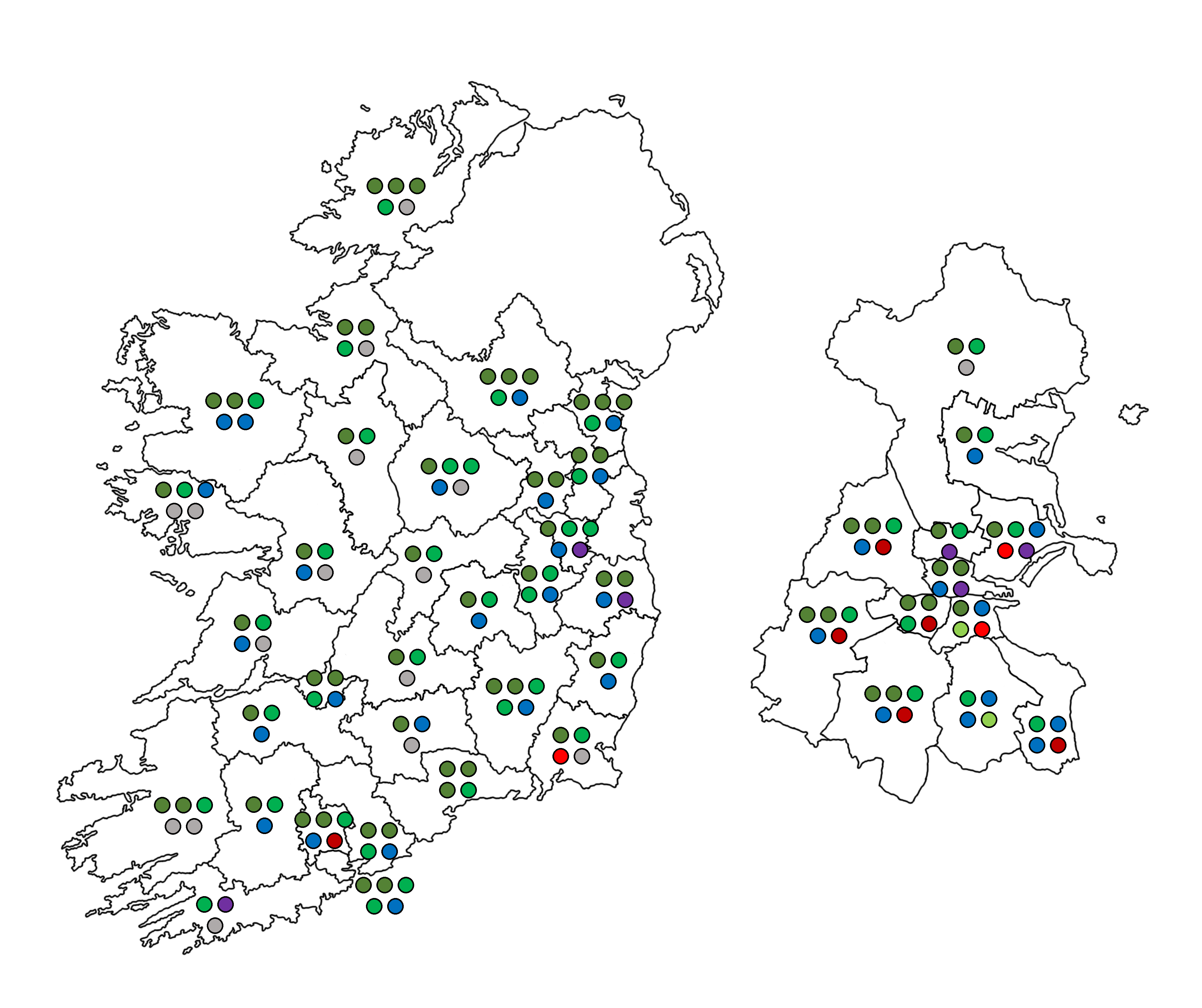
Constituencies with no boundary change
- Clare – 1 SF, 1 FF, 1 FG, 1 IND
- Cork South-West – 1 FF, 1 SD, 1 IND
- Donegal – 3 SF, 1 FF, 1 IND
- Dublin Central – 2 SF, 1 FG, 1 SD
- Kerry – 2 SF, 1 FF, 2 IND
- Limerick County – 1 SF, 1 FF, 1 FG
- Waterford – 3 SF, 1 FF
Constituencies with boundary change but no change in projected result
A lot of the constituencies fall into this bucket, so I will only offer a brief note for each.
- Carlow-Kilkenny – 2 SF, 2 FF, 1 FG
- The redraw in Carlow-Kilkenny sees a large area of Kilkenny carved off into the new Tipperary North constituency. Fianna Fáil’s John McGuinness and Sinn Féin’s Kathleen Funchion are the strongest sitting TDs in the area, and Fine Gael’s unsuccessful candidate Patrick O’Neill also did quite well. While the overall impact on party votes is minimal, it may end up affecting how things are split up between FF candidates if they decide to run three (which they really shouldn’t do); a south Kilkenny candidate could be in a relatively stronger position.
- Cavan-Monaghan – 3 SF, 1 FF, 1 FG
- The northern parts of County Meath that were in Cavan-Monaghan move to Meath East; the 2020 vote in these EDs was fairly evenly divided between Sinn Féin, Fianna Fáil and Fine Gael. This represents a fairly small number of voters and is quite evenly contested ground; losing it should have almost no impact on the overall result here.
- Cork East – 2 SF, 1 FF, 1 FG
- The removal of Mallow form Cork East is pretty impactful; it basically kills any chance Séan Sherlock (Labour) had of holding his seat in this constituency. It may not be a bad move for him to follow Mallow into Cork North-Central, but parts of the hinterland where he is also strong is either staying in Cork East or moving to Cork North-West. The big three – Sinn Féin, Fianna Fáil and Fine Gael – benefit the most from this move.
- Cork North-West – 1 SF, 1 FF, 1 FG
- Cork North-West gains areas from North-Central and East, but more interestingly, loses the heavily populated Ballincollig ED to North-Central. Consequently, this redraw is likely to hurt Sinn Féin and the Soc Dems – whose candidate should probably move to North-Central – and help Fine Gael and Fianna Fáil. The model still thinks SF can take a seat here, although data is deficient as they had no candidate in 2020. But it does become more difficult for them with the loss of a big ED that should provide them a significant chunk of votes.
- Dublin Bay North – 1 SF, 1 FF, 1 FG, 1 LAB, 1 SD
- Dublin Bay North loses a chunk of EDs to the now extremely arbitrarily-shaped Dublin North-West and takes the more lightly-populated Balgriffin ED from the dismembered Dublin Fingal. This does disadvantage Sinn Féin and advantage Fine Gael very slightly, but half a percentage point or so is not tremendously material under current polling conditions. That said, it ought come as a small relief to the candidates from Fianna Fáil, the Soc Dems and Labour, who are under pressure from a theoretical 2nd SF candidate – especially the latter of those three, who also stands to lose out a little under this redraw. Of course, Richard Bruton (FG) announcing this month that he will not seek re-election is a substantial wild card.
- Dublin Bay South – 1 SF, 1 FG, 1 GP, 1 LAB
- A fairly minimal change here as Kimmage C moves to South Central. While this ED was pretty strongly Sinn Féin in 2020, with the Greens a solid second, its small size means that this change has marginal impact on the projections, even in a very closely contested constituency.
- Dublin North-West – 1 SF, 1 FF, 1 SD
- While the two new Fingals clearly have the hands-down ugliest boundaries imaginable, Dublin North-West has suffered from losing its northern perimeter. Although this makes sense in terms of local administrative boundaries, it’s a bit weird given the physical geography of the city. These losses to Fingal West and Dublin West plus the addition of EDs from Bay North move the constituency overall to the right, making a Fianna Fáil hold more likely and second Sinn Féin seat further away.
- Dublin South-Central – 2 SF, 1 FF, 1 PBP
- Dublin South Central takes Kimmage C from Bay South and gives three EDs to South-West, mostly around Terenure. Some other EDs on the west side of the the constituency also move but I do not think there are any residential zones in those areas. This doesn’t affect the overall projection at the moment but hurts Fianna Fáil and Fine Gael mostly, plus the Greens to a lesser extent. Sinn Féin, Right2Change and People Before Profit stand to benefit the most from the move – although Bríd Smith’s (PBP) not seeking re-election is, of course, a wild card here.
- Dublin South-West – 2 SF, 1 FF, 1 FG
- The moving of Tallaght Fettercairn ED into Mid-West was one of the more controversial recommendations of the boundary commission as it seemed to make very little geographic or community sense. It does hurt People Before Profit. However, with some left-wing voters coming in from South-Central, it’s offset enough that doesn’t change the calculus much here, although it certainly makes it tricker for them. Honestly it hurts Sinn Féin more, but no-one gets major benefit, as this ED was 80%+ SF or PBP in 2020. Also, everyone running here has probably been helped by Green incumbent TD Francis Duffy deciding to publicly immolate whatever remained of his re-election hopes.
- Dún Laoghaire – 1 FF, 2 FG, 1 PBP
- A number of EDs around Foxrock move to Rathdown, but the Fine Gael vote in Dún Laoghaire is so strong that it barely matters. It does push them a little further away from chasing a 3rd seat, and will make People Before Profit more comfortable, but it doesn’t meaningfully change anything, as on current polling numbers, the seats here are very settled.
- Galway West – 1 SF, 1 FF, 1 FG, 2 IND
- The Mayo EDs move back to their home county and out of Galway West. Although the area is mostly Fianna Fáil and Fine Gael voters, it means almost nothing for the overall constituency results as it’s a small group transferred between two massive five seaters. It did however, give Mayo TD Alan Dillon a chance to do one of the most Irish politics things I have ever witnessed; he was down in Shrule with his poster within hours of the commission releasing its report.(Although amusingly I believe he is standing a couple of meters on the Galway side of the border for this photo op, and thus technically in the wrong constituency…)
- Kildare South – 1 SF, 2 FF, 1 FG (note: 2 FF includes Ceann Comhairle)
- Kildare South sees a reasonable chunk of population move out as the EDs around Portarlington return to Laois and Offaly, as well as a smaller area between Naas and Newbridge move to Kildare North. The latter has minimal impact, but the former is devastating for Cathal Berry (IND), significantly diminishing his chances of holding his seat. Even under a situation where the Ceann Comhairle retires, the model has him dropping not just below Labour, but also a theoretical second Sinn Féin candidate. He’s in big trouble; however if Fiona McLaughlin-Healy (IND) opts not to run following her resignation from local politics he may get some hope back – she transferred to him very well last time. But for now, he looks done.
- Limerick City – 2 SF, 1 FF, 1 FG
- A geographically relatively large but relatively lightly populated area around Newport and Birdhill moves to Tipperary North; this is a plurality Fianna Fáil area but owing to its small population size, it has almost no impact on the projections.
- Louth – 3 SF, 1 FF, 1 FG
- Julianstown ED moves to Meath East; it’s a fairly big population for a single ED, but on current numbers things in Louth are quite stable and this doesn’t change much bar putting Peter Fitzpatrick (IND) a little further ahead of Ged Nash (LAB) as they both try to beat the odds and hold their seats.
- Meath West – 2 SF, 1 FG
- Meath West sees a substantial geographic area leave to go to Longford-Westmeath as all of the Westmeath EDs return to their parent constituency, though the population moved is much lower than the size of the area would imply. These areas are plurality Sinn Féin with Fianna Fáil and Fine Gael not far behind, as such the balance doesn’t change much between these three, although it does disadvantage SF. The big winner from this is Aontú, who move up to just a hair behind a theoretical second SF candidate in the projections.
- Roscommon–Galway – 1 SF, 1 FF, 1 IND
- Roscommon-Galway loses a vast swathe of Galway EDs to Galway East, while taking on the remaining Roscommon EDs previously in Sligo-Leitrim; this results in a net loss of population and a fair amount of uncertainty. Of the incumbents this is likely to hurt Michael Fitzmaurice (IND) the most, but with Denis Naughten (IND) not running again, there’s a far bigger vote to be won that what he has lost. The main beneficiary will likely be north Roscommon based Claire Kerrane (SF), though this could be fertile ground for Fine Gael given their performance here in 2020. Again, a lot of uncertainty here with so many changes, but the redraw does not change the model’s projection.
- Sligo–Leitrim – 2 SF, 1 FF, 1 IND
- The part of Roscommon in Sligo-Leitrim moves out of the constituency; this was far and away Frank Feighan’s (FG) strongest area. While the model already had him projected to likely lose his seat, this change makes it even more difficult for him to hold on, though it’s certainly not a dead cert either way at this point.
Projected changes and new constituencies
Cork North-Central: +1 Seat
Previous projection: 2 SF, 1 FF, 1 FG
New projection: 2 SF, 1 FF, 1 FG, 1 PBP
Change: +1 PBP
Cork North-Central gets a fair bit bigger, taking on Mallow and Ballincollig while losing lightly populated EDs in the east and all Cork City EDs north of the Lee. This is potentially a significant change to the constituency’s, well, constituency. As a result, it gains a fifth seat which the model projects to be held by incumbent Mick Barry (Solidarity, categorised here as PBP for convenience).
This seems fairly straightforward, giving the extra seat to an under-pressure incumbent, but things are much more complicated than that, and this constituency is going to be fascinatingly unpredictable. Colm Burke (FG) is not in great shape here, and the redraw probably doesn’t help. On current numbers, Kenneth O’Flynn (IND) is unlikely to win a seat (though it would not take a huge change in polling to make him competitive), but is a strong enough candidate to play spoiler, particularly in the northern suburbs of the city.
Then there’s a substantial Labour vote arriving with Mallow – a bigger one than Labour are losing from the city-centre EDs – and possibly incumbent TD Séan Sherlock coming along with it. As neither SF nor PBP contested Ballincollig in 2020, how it will fit into the constituency is an unknown, and my projection figures are by necessity speculative. Also, it will likely bring with it a Ciarán McCarthy (SD) who did very strongly in Cork North-West in 2020. Overall, this means that while there’s an easier seat for PBP to hold, their FPV % will likely decline, as will FG’s. Relative to PBP, the SDs and Labour are not far behind, with FG’s not far ahead either. The model thinks with five seats that Barry and Burke will hold, but both look very vulnerable.
I have to emphasise again that Ballincollig is a massive ED – containing over 14% of the population of the new Cork North-Central, while the EDs around Mallow are a touch over 10%. How both vote will almost certainly be critical in deciding the fifth seat. Indeed, under quite a few specific scenarios, these new areas may also dictate the fate of the fourth seat.
Cork South-Central: +1 Seat
Previous projection: 2 SF, 1 FF, 1 FG
New projection: 2 SF, 2 FF, 1 FG
Change: +1 FF
Cork South-Central is an interesting one. It picked up a significant chunk of urban Cork from North-Central, all EDs south of the Lee, accounting for about 14% of the population of the new constituency. It is, however, important to note that with the exception of Bishopstown B, C and Glasheen A, these are relatively low-turnout EDs.
The redraw here looks fairly simple, similar to North-Central. The addition of an extra seat helps an under-pressure incumbent, projecting that Fianna Fáil holding both their seats is now the most likely outcome. You could easily make the case that this was always a likely outcome and that unseating Micheál Martin or Micheal McGrath was a huge ask for Sinn Féin (assuming neither retires). And I think that would be fair in many ways – as I have discussed before, modelling for candidate quality and personal votes is essentially impossible.
So, the opposite of North-Central then, without hidden complexity? Mostly yes, but there is one thing to consider – Lorna Bogue (An Rabharta Glas) finished 5th for the Greens in 2020. Despite a huge FPV gap, she cut McGrath’s lead on transfers by over 2,200 votes. If Sinn Féin or Fianna Fáil underperform here, and her vote proves more personal than party-based, Bogue has spoiler potential and could compete, albeit as a long shot. There is no polling on ARG, so this is highly speculative and I am not able to model their inclusion, but it’s the main point of interest in a constituency that otherwise looks fairly tied up.
(Disclosure: I am, at the time of writing, a member of An Rabharta Glas, as mentioned here)
Dublin Fingal East: New Constituency
Previous projection: 2 SF, 1 FF, 1 FG, 1 LAB (Dublin Fingal)
New projection: 1 SF, 1 FF, 1 FG
Change: -1 LAB
Rather than move parts of Fingal in Dublin North-West or Meath East and add seats, the comission opted to split the five seater into two three-seaters with the ugliest boundary possible. The East constituency seems built very specifically around Swords, Portmarnock, Malahide and Donabate, and moves the Balgriffin ED to Bay North. This constituency is super-spicy because it contains four of the five sitting TDs for the old Fingal constituency: Alan Farrell (FG), Darragh O’Brien (FF), Duncan Smith (LAB) and Louise O’Reilly (SF). One of these is going to lose out and spoiler alert: It’s Duncan Smith.
While the Labour candidate keeps most of his base around Swords, and will likely increase is overall FPV, the drop from two to 5 seats will likely be fatal to his chances. This is the stronger new constituency for both Fianna Fáil and Fine Gael, and their incumbents will likely re-run.
Sinn Féin’s position is a bit weirder, as despite being Swords-based, O’Reilly actually did better in the areas in the new Fingal West, largely because of relative SF weakness in Malahide and the addition of new areas inside the M50 to West. However, I don’t expect her to move; she’s really strong in Swords and, as an incumbent, seems to me to be better placed to hold in the less-SF friendly constituency than a new candidate might be.
Dublin Fingal West: New Constituency
Previous projection: 2 SF, 1 FF, 1 FG, 1 LAB (Dublin Fingal)
New projection: 1 SF, 1 FF, 1 IND
Change: +1 FF, +1 IND
On the other side of the deeply aesthetically unpleasing boundary is Dublin Fingal West. This is a diverse constituency, hinged on the commuter towns of Rush, Lusk, Skerries and Balbriggan, but also taking in a swathe of more rural towns and a new heavily urban/suburban area within the M50, moved from Dublin North-West. This latter area is particularly important as it will make up around 17% of the population new constituency and is heavily left-wing. All three EDs voted well over 50% for Sinn Féin and the Soc Dems in 2020, although turnout here is quite low compared to most Fingal EDs. This should lock in seat for SF, who are already strong in this part of Fingal.
If Fingal East is spicy because it has four incumbents scrapping for three seats, West has its own piquancy in trying to work out who will run there, with only one incumbent. As above, SF should be fine regardless. Fianna Fáil appear to be running first-time candidate Sinéad Lucey Brennan, founder of their Disability Network. FF’s base vote here is pretty solid, and the model favours them to win a seat. Regina Doherty (FG) might not have any choice but to run here for Fine Gael, but I don’t know if everyone will be happy with that, least of all her.
And what of that lone incumbent, Joe O’Brien (GP)? It’s not looking good, honestly. While he keeps his very strong base around Skerries, the rest of the EDs that moved into West are much less favourable for him than the ones in East. Incumbency may be an advantage, and the quality of candidates fielded by other parties will matter a lot, but on raw numbers, it looks very tough for him right now, particularly because there’s another candidate who will absolutely love this redraw.
Tony Murphy (IND) topped the poll in Balbriggan in the 2019 LE and has unsuccessfully contested the GE twice in Fingal. Almost all of his votes a concentrated in this new constituency and he has an excellent chance at making it stick this time. There is some uncertainty introduced by both him and the FF candidate being Balbriggan-based, but right now the model favours him to pick up the final seat here.
Dublin Mid-West: +1 Seat
Previous projection: 2 SF, 1 FF, 1 FG
New projection: 2 SF, 1 FF, 1 FG, 1 PBP
Change: +1 PBP
Dublin Mid-West gains a seat and adds a chunk of population with Tallaght Fettercairn joining the constituency from South-West. Electoral Commission member John Curran (ex-FF) lost his seat in Mid-West in 2020 following a marathon transfer race against Gino Kenny (PBP), and now has given his old sparring partner an improved chance at keeping a seat that was due to come under massive pressure.
Kenny isn’t out of the woods entirely though – Sinn Féin of course benefit from the move as well, and this should make it an easy decision to run three candidates. While the model doesn’t favour them to win three seats, there are absolutely scenarios where, with precise vote management, they can pull it off on current numbers.
And of course, how SF strategise and what result they get will have knock-on effects further down – how many transfers they give up, surpluses, stages of eliminations all matter hugely. While SF can be sure of two seats here (and FG should hold as well, unless they do something very silly), the final two seats could ultimately be any combination of SF, PBP and FF.
Dublin Rathdown: +1 Seat
Previous projection: 2 FG, 1 GP
New projection: 1 FF, 2 FG, 1 GP
Change: +1 FF
Dublin Rathdown gains a seat, and also absorbs a number of EDs around Foxrock with a relatively decent population. These areas are heavily Fine Gael, with Fianna Fáil a distant but still strong second. Accordingly, these boundary changes don’t do much to change the likely outcome in Rathdown – indeed, they calcify it.
Combined with the addition of an extra seat, on current numbers this makes Josepha Madigan and Neale Richmond (both FG) nigh-unassailable. It also ends the relevance of the question of if FF could overtake Catherine Martin (GP). These four, in some order, should be the ones to take the seats according to the model.
Sinn Féin aren’t completely out of it, but the addition of deeply conservative Foxrock makes their task much more daunting and increases the gap between them and the Greens/FF. It is also worth noting that Labour aren’t massively far behind – if they have a very good day and the Greens have a woeful one, they have an outside shot at a seat – but the new EDs do very little to help them either.
Dublin West: +1 Seat
Previous projection: 1 SF, 1 FF, 1 FG, 1 PBP
New projection: 2 SF, 1 FF, 1 FG, 1 PBP
Change: +1 SF
Dublin West gains two lightly populated EDs from North-West and gains an extra seat. The EDs add such a small amount of people that it makes near-as no difference, but the extra seat is very interesting. Dublin West was already facing a tight race for the final seat between Green Party incumbent Roderic O’Gorman, Solidarity (listed as PBP here for convenience) candidate and former TD Ruth Coppinger, and a theoretical 2nd Sinn Féin candidate.
The model had previously projected Coppinger in the fourth seat, and gives the additional seat to SF. However, it must be pointed out that this isn’t a slam-dunk by any means. The model has O’Gorman very, very close to both Coppinger and SF candidate, and this could right now easily produce any combination of two from those three. With an extra seat here, there are certainly many more circumstances under which he can hold his seat, so don’t write him off entirely yet.
It’s also worth noting that the addition of a seat here could potentially create surpluses where there weren’t any before even without vote levels moving. This might have interesting implications for Fine Gael, in particular if their polling in Dublin moves positively.
Galway East: +1 Seat
Previous projection: 1 SF, 1 FG, 1 IND
New projection: 1 SF, 1 FF, 1 FG, 1 IND
Change: +1 FF
Galway East gets an extra seat as a ton of EDs move from Roscommon-Galway, bringing with them a load of Michael Fitzmaurice (IND) voters. And I mean a load – we’re talking something like 8% of 2020 turnout. This introduces a ton of uncertainty, and while I have attempted to project where those go based on Fitzmaurice’s transfers, it’s highly speculative.
The saving grace here however is that there’s right now only four plausible candidates to take seats here – incumbents Séan Canney (IND), Ciarán Cannon (FG) and Anne Rabbitte (FF), plus whoever Sinn Féin opt to run (probably Louis O’Hara, who came very close in 2020).
The model for three seats projected SF taking Rabbitte’s seat – a feat O’Hara was only 338 votes away from last time – but with the addition of a fourth she should hold comfortably. Fianna Fáil or Fine Gael might try for a second seat, like they did last time, but on current numbers that looks futile, and no other party is within any reasonable distance of being competitive.
Kildare North: +1 Seat
Previous projection: 1 SF, 1 FF, 1 FG, 1 SD
New projection: 1 SF, 2 FF, 1 FG, 1 SD
Change: +1 FF
Kildare North gains a handful of EDs around Naas from Kildare South, with a relatively small population. The constituency also gains a seat, which I expect will be fiercely contested based on current polling numbers.
If you saw my preliminary projections, I had the Social Democratss in a second seat here. After revisiting the numbers I found the error that led to this – but I don’t think it’s implausible; Catherine Murphy will cruise past a quota, they have several councillors and are transfer friendly. Of course there are arguments against as well – how much of this is down to Murphy’s personal support, and how a party with almost zero experience of managing a vote split (as far as I’m aware their only experience of this was the North Inner City LEA debacle in 2019) pulls it off, especially where the margins will be very fine.
However, the fact is Fianna Fáil should be favoured to take this seat, but there are some things to consider. Firstly, there’s no guarantee Frank O’Rourke – who came fifth in 2020 – runs again; a less established candidate may prove weaker. Both the Soc Dems (as above) and Sinn Féin (perhaps more realistically) could contend with a second candidate – and the balance would ultimately come down to transfers, which as I have said many times, are very hard to project.
Laois: New Constituency
Previous projection: 2 SF, 1 FF, 1 FG, 1 IND (Laois-Offaly)
New projection: 1 SF, 1 FF, 1 FG
Change: +1 FF
Laois splits off from Laois-Offaly and forms its own constituency again, including taking back a decent chunk of voters with the return of the EDs south of Portarlington from Kildare South.
Currently there are three incumbent TDs in Laois – Brian Stanley (SF), Séan Fleming (FF) and Charlie “My Father’s Footsteps” Flanagan (FG), and on current numbers all should hold; I don’t see any party having a reasonable shot at picking up a second seat in this three seater; although Flanagan is the most vulnerable, he should be fairly comfortable. The model previously had Fleming losing out to SF, but with the redraw, he looks to be in a pretty safe position.
The main interest here comes from Independent/Other votes. There will be a bit of leftover votes from Carol Nolan, John Leahy and Ken Smollen (all Offaly based, so presumably wouldn’t run in Laois), plus a chunk of Cathal Berry voters migrating from Kildare South. Not enough on its own to make up a seat, but enough to potentially change the race if they can be picked up disproportionately by one party or the other. There’s also the possibility that Berry – who is actually based in Laois – moves here. I have no idea how such a move would pan out, but it would make things very, very interesting.
Longford-Westmeath: +1 Seat
Previous projection: 1 SF, 1 FF, 1 FG, 1 IND
New projection: 1 SF, 2 FF, 1 FG, 1 IND
Change: +1 FF
Longford-Westmeath takes back the eastern part of Westmeath that was previously in Meath West (imagine trying to explain all these names to someone who isn’t familiar with Ireland…) and becomes a five-seater. Previously, the fourth seat was incredibly close and adding a seat doesn’t do much to clarify things – there are now two seats here that will be very, very hard to call.
Overall the addition of the new EDs tips the balance marginally towards Sinn Féin and away from Fine Gael and Independents, but it’s still a fairly small amount of movement overall. SF, FG and FF are all more or less guaranteed one seat here. Beyond that, things get very interesting.
All three big parties will on current numbers be able to run up in the range of 1.5 to 1.75 quotas, and thus will have second candidates well in range of being elected. Independent Kevin “Boxer” Moran should also poll well. The last two seats are incredibly tight between these four. A huge amount will come down to how votes are divided (typically here it’s one candidate in Westmeath and one in Longford), and of course transfers – which are dictated as much by geography as by party lines in this constituency.
For example, look at Michael Carrigy’s (FG) transfers in 2020. More of his transfers broke party lines to go to fellow Longford man Joe Flaherty (FF) than went to his Mullingar-based Fine Gael running mate.
This creates significant unpredictability in an element that is already very hard to project. On top of that, I have these four separated by less than a percentage point. The model does assign marginal favour to Moran and a second FF candidate at this stage, but this is fundamentally a coin-flip.
Mayo: +1 Seat
Previous projection: 1 SF, 1 FF, 2 FG
New projection: 2 SF, 1 FF, 2 FG
Change: +1 SF
Mayo is reunited with the reasonably small part of it that was previously in Galway West, and gains a seat. This has pretty minimal impact on the overall balance in the county as there’s not a huge amount of votes moving over.
On current numbers the additional seat is likely to go to Sinn Féin. There’s not a ton of intrigue in this right now – Fine Gael may consider going for three, and Fianna Fáil will likely go for two (although former FF TD for Mayo Lisa Chambers has apparently declined to run and is going for Europe instead. But on current polling, SF should be able to beat them out to pick up the 5th seat.
Meath East: +1 Seat
Previous projection: 1 SF, 1 FF, 1 FG
New projection: 2 SF, 1 FF, 1 FG
Change: +1 SF
Meath East has undergone a fair bit of expansion, adding the Meath EDs that were previously in Cavan-Monaghan, plus the Julianstown ED from Louth. That’s a decent chunk, just under 14% of the new constituency’s population, the vast majority of it in Julianstown.
These are most beneficial to Sinn Féin. SF would, under current polling conditions, have been favoured to take the 4th seat regardless. However the additions certainly look like they will help them in that. Fianna Fáil don’t really have a hope of a second seat and while Regina Doherty (FG) could come crawling back because there’s no space for her in Fingal with the redraw, she also finished 5th here in 2020.
There are still some questions however – Seán McCabe did very well for the Greens here last time. He won’t run for them again and the Green vote will likely disintegrate; where that goes will be important. I also wouldn’t be surprised to see Sharon Keogan (IND) run here again – her time in the Seanad has raised her profile, but also exposed her as a professional crank with some truly vile opinions. Whether that helps or hinders her, depressingly, is an unknown, and there’s equal potential for her to be a dark horse as there is for her to fall flat on her face.
Offaly: New Constituency
Previous projection: 2 SF, 1 FF, 1 FG, 1 IND (Laois-Offaly)
New projection: 1 SF, 1 FF, 1 IND
Change: no change
Similar to Laois, Offaly splits off from Laois-Offaly and forms its own constituency again. Portarlington North ED returns to the area, but brings with it an insignificant amount of voters in the grand scheme of things.
Two of the Laois-Offaly incumbents hold seats here – Barry Cowen (FF) and Carol Nolan (IND). The model had also projected previously that the second Sinn Féin seat in Laois-Offaly would be Offaly based; that follows here as well, giving a change from current incumbents but not from the prior projection.
There’s almost no intrigue in this constituency on current numbers. The three above should comfortably walk into seats, and Fine Gael don’t look like much of a threat – in 2020, both their candidates combined (one of whom is an Offaly-based ex-TD) got less votes in Offaly than SF, whose candidate was based in Portlaoise. An actual Offaly-based SF candidate should have an easy time of it, though they do have no councillors.
Tipperary North: New Constituency
Previous projection: 1 SF, 1 FF, 1 FG, 2 IND (Tipperary)
New projection: 1 SF, 1 FF, 1 IND
Change: +1 SF
Tipperary is split once more, with Tipp North gaining EDs previously in Limerick City, as well as a chunk of Carlow-Kilkenny. Given the small size of the new constituency, these combine to have a relatively significant population impact – around 12.5%. There’s currently three incumbent TDs in Tipp North – Micheal Lowry (IND), Jackie Cahill (FF) and Alan Kelly (LAB), but the model doesn’t think all three are safe.
Lowry certainly is, and Cahill should be okay. Previously, Kelly was shown losing his seat in the old five-seater, and this redraw definitely benefits him. He would have more than likely come third here in 2020, but right now the model doesn’t think he’ll hold off Sinn Féin. There’s a few factors in this – firstly, Labour are polling poorly in Munster and have been ever since Kelly was deposed as leader, while SF continue to significantly outperform their 2020 result in polls in the province. Secondly, SF ran a Cashel-based candidate in 2020, a North Tipp candidate could pull more votes away from Kelly. Finally, the new areas added to the constituency are much more SF-friendly than the average ED in the old parts of North Tipp.
I had suspected Kelly would retire, but the redraw should certainly give him an incentive to stick around. While still not favoured by the model, he has a much better chance of holding now. But there are other unknowns to also consider in addition to the new EDs, for example what happens to the 3.5% of FPV that went to South Tipp-based McGrath or Healy (both INDs) in 2020? Who will the SF candidate be, where will they be based and will they be any good? What if John Hannigan (IND) opts not to run again, freeing up around 10.5% of FPV? If the bulk of this goes to Lowry, and he gets a huge surplus, how does that transfer? There’s a lot that can happen here that will change how the last seat falls.
Tipperary South: New Constituency
Previous projection: 1 SF, 1 FF, 1 FG, 2 IND (Tipperary)
New projection: 1 SF, 1 FG, 1 IND
Change: no change
The other side of Tipperary split is Tipp South, which has two incumbent TDs – Independent Mattie McGrath and Sinn Féin’s Martin Browne. Both should be able to cruise to defending their seats. The final seat here ought to be Fine Gael’s, a pick-up the model was projecting them to make anyway under the old five-seater, hence the “no change” listed above.
However, it’s far from an easy win for FG. Fianna Fáil will likely be strong here and the model doesn’t have them far behind, especially if they can get a stronger candidate and strategy for South Tipp than last time.
This did look fairly simple but then something happened when I was in the middle of writing this. Clonmel based former TD Séamus Healy of the Workers and Unemployed Action Group, who I had erroneously believed to have retired, announced his plans to run. In terms of this post I don’t have time to fully account for the impact of this – though a cursory glance has him as competitive but not favoured for a seat – but I will in the next set of projections.
Wexford: -1 Seat
Previous projection: 2 SF, 1 FF, 1 FG, 1 LAB
New projection: 1 SF, 1 FF, 1 LAB, 1 IND
Change: +1 IND
Wexford loses the northern end of the constituency to the new Wicklow-Wexford constituency and drops from five seats to four. This is good news for some incumbents but poses tremendous challenges to others, as all none of them are based in the new area.
Firstly, the winners – this puts Brendan Howlin (LAB) in an extremely strong position. His seat had looked insecure beforehand but this removes part of the constituency that is much less supportive of him; he should have zero problems now. Similarly, Independent Verona Murphy gets a huge boost as she was very weak in North Wicklow. The model had her losing her seat under the old boundaries, now it favours her to keep hold of it.
For the other three, things are less simple. Johnny Mythen (SF), Paul Kehoe (FG) and James Browne (FF) are all based in Enniscorthy and lose large parts of their hinterland with the redraw. Mythen will be fine, as his votes were fairly evenly distributed geographically. Sinn Féin would have been hoping to add as second seat here, that seat now likely moves to the new constituency. Browne should be fine too, as Fianna Fáil should still be able to get around a quota here. However, in 2020 they ran a bizarre, doomed four-candidate strategy so it’s hard to tell how those votes will compress into one or two candidates.
Kehoe, on the other hand, is in serious trouble. Murphy really hurt FG in south Wexford last time round, and there’s no reason to assume she won’t do the same again; it’s more likely that the Fine Gael seat moves to Wicklow-Wexford. Kehoe could try to follow it, but ex-TD Michael D’Arcy would almost certainly be a stronger candidate here. Overall then, Fine Gael are poised to suffer no net loss – but a change of personnel.
Wicklow: -1 Seat
Previous projection: 2 SF, 1 FF, 1 FG, 1 SD
New projection: 2 SF, 1 FG, 1 SD
Change: no change
Wicklow has the southern part of its constituency carved off and added to the new Wicklow-Wexford constituency, and consequently loses a seat. As all the incumbent TDs are based in either Bray or Greystones, none of them are in much of a position to move. Three of them – Fine Gael’s Simon Harris, Sinn Féin’s John Brady and the Social Democrats’ Jennifer Whitmore, should be fine.
One of those incumbents, Steven Matthews (GP) is almost guaranteed to lose his seat to Sinn Féin and the redraw does nothing to change that. However, a similar situation emerges here as the one in Wexford – one of the parties here, rather than lose a seat, will see it go to the new constituency. In this case, it’s Fianna Fáil.
It’s been a while since we had a “Zero Steves” projection for Wicklow, but the redraw has Stephen Donnelly as the odd man out here. Now, I hear you say, that doesn’t make sense, how does losing south Wicklow hurt a Greystones-based TD? The answer is simple – Donnelly was helped massively in 2020 by transfers from his running mate Pat Casey. Although not actually South Wicklow based, Casey ran far, far ahead of Donnelly in the area, and Donnelly needed his transfers (and a dismal FG vote management strategy) to finish fourth in 2020.
That said, he’s not out of it yet – the gap between him and theoretical second SF candidate is small and certainly within a normal polling error. He is up against it, make no mistake (and I know some people in FF who think he could retire) but don’t take this as an indication that he’s done and dusted. If he’s up for it, he could make a fight of this and end up holding.
Wicklow-Wexford: New Constituency
Previous projection: 2 SF, 1 FF, 1 FG, 1 LAB (Wexford), 2 SF, 1 FF, 1 FG, 1 SD (Wicklow)
New projection: 1 SF, 1 FF, 1 FG
Change: no change
The new Wicklow-Wexford constituency is made up of the northern part of Wexford and the southern part of Wicklow. About 58% of the population is from the Wexford end with 42% from Wicklow. Currently there are no incumbent TDs in the area, but the projection here is less intriguing than you might think.
Essentially, we will see seats projected to be lost in the two old constituencies shunted here – the Fianna Fáil seat in Wicklow and the Fine Gael seat in Wexford. However, these are likely to have different TDs. I suspect Michael D’Arcy will be the candidate for Fine Gael, and Malcolm Byrne the one for Fianna Fáil. The only potential wrinkle here is that both are Wexford-based, in or near Gorey. This leaves the Wicklow side, and Arklow, without a natural candidate. So I wouldn’t write off the potential of someone emerging here as the “Wicklow Candidate”.
Regardless, the model sees FF and FG taking seats, as well as Sinn Féin. SF don’t have an immediate candidate – they have no councillors in the area – but even on 2020 votes they were the strongest party across the EDs that make up this constituency. It’s difficult to see any of the big three getting in a second candidate, or anyone else challenging here, but this is a new area with no current representation in the Dáil, so that does leave the door open for something to change the dynamics here.
***
Thanks so much for reading! This website is done entirely in my spare time and run without ads, so if you want to donate, please do so via Patreon or Ko-Fi – any support is greatly appreciated and 100% of any donations received are invested into the costs of running and improving the site.
 Irish Election Projections