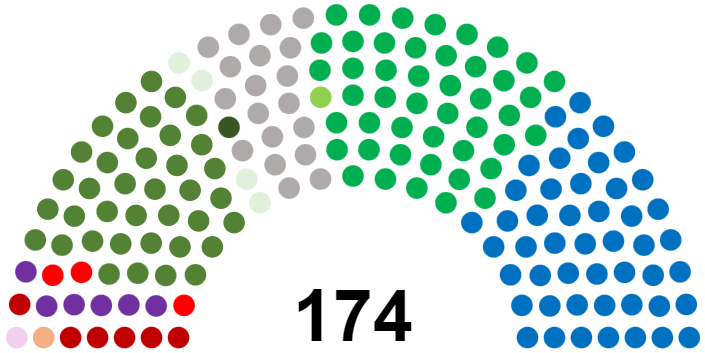
Seat totals
Fine Gael 48
Fianna Fáil 46
Sinn Féin 38
Independents 19
Social Democrats 6
PBP/Solidarity 6
Independent Ireland 4
Labour 3
Green Party 1
Aontú 1
Right2Change 1
Independents4Change 1
Changes since May 2024
Fine Gael +9
Fianna Fáil +6
Sinn Féin -21
Independents +1
Social Democrats -3
PBP/Solidarity +2
Independent Ireland +2
Labour +3
Green Party nc
Aontú nc
Right2Change nc
Independents4Change +1
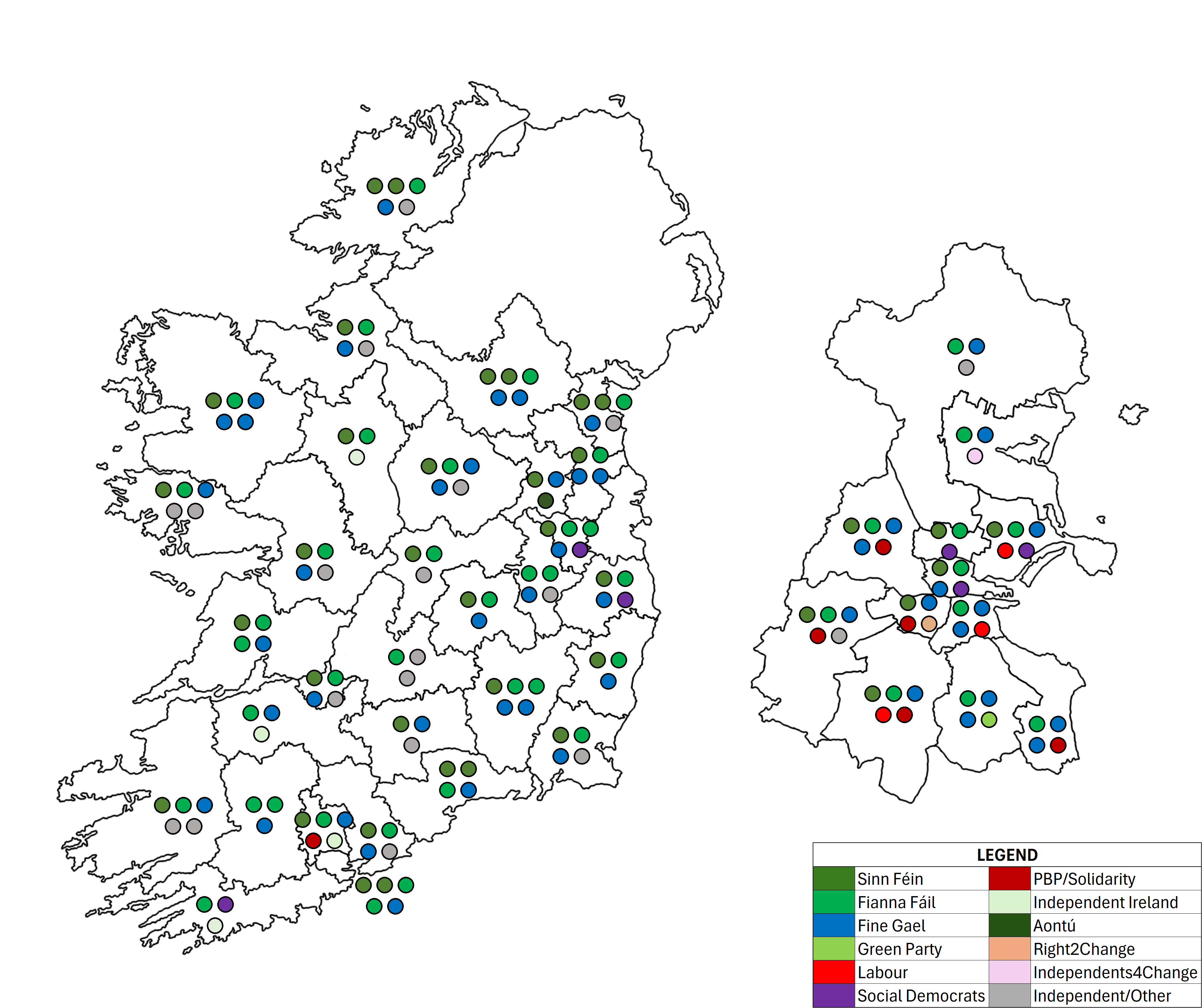
Seat Map
It’s been a long summer without an update, and I’ve been working on some changes to the model, which I’ll touch on further down – ones that should allow me to return to monthly updates. An awful lot has changed over that period, and between polling shifts and the model changes, there’s an awful lot of constituencies to write up. I’m not going to spend too long on this intro or the initial analysis paragraphs, so let’s get straight into it.
One note, since this is the first full update since the European elections: Where seats have been vacated due to TDs being elected to the European Parliament, I am counting them as being held by the prior incumbent. This is to allow for a relevant comparative in seat changes and because the government has said they will not be doing any by-elections.
If you would prefer to skip straight to the seat changes, click here.
Nothing Ever Happens
After a tumultuous few years in politics, it seems we are right back where we started. For the first time since June 2021, we have the government parties projected to win a majority – 95 seats. Indeed, the Green Party may well be superfluous, as on current numbers Fianna Fáil and Fine Gael have enough between them to form an overall majority without any help. There’s been, as I have talked about many times, a long trend of stagnation for these two parties, but this has changed notably over the summer, with both rising noticeably in the polls.
For Fine Gael, this rise has been sharper than anything we have seen for them in a long time – even surpassing the much ballyhooed 2022 “budget bump” that as I correctly suggested here, would amount to nothing. Their polling average on the RPA is the highest it has been since October of 2021, and they moved ahead of Sinn Féin in August to take what is now a fairly substantial polling lead.
For Fianna Fáil, things have been less dramatic but still notably positive, they have moved back ahead of Independents and are realistically one poll away from also overtaking SF. Their polling average is the best it has been since this time last year, three points ahead of where it was in April.
It’s as ever tough to pinpoint what’s causing this. The media narrative is very much focused on the new Taoiseach Simon Harris. As I wrote before, judgement on this was premature, but there is some evidence to support this. This is a more appropriate timeframe, after a few months with him as leader, and his personal ratings have improved a lot since he took over. However, there is as always more to it than this – FG support is up 4 points on the polling average, but FF have risen around 3 points in the same timeframe (Green Party support has not moved significantly).
It genuinely seems that the government as a whole has become more popular over the summer, something supported of course not just by polling, but by the local and European elections in June. It seems that these also provided a turning point in support for both those parties, as support that they appeared to have shed started to come home and gave them more to build on.
And note that this is with about half the FG parliamentary party and a few FF TDs retiring. I have accounted for this as best I can in the model – though there is naturally some uncertainty. So this figure with Fine Gael taking the most seats is with vote losses from retirements factored in. We are going through an extremely meaningful shift in polling figures at the moment as long-term trends culminate, and while I know some people will understandably be looking to rationalise things, but the government’s position is unquestionably the strongest it has been in a long time.
So let’s talk now about the other side of this – what has happened to Sinn Féin?
Sinn Féin’s implosion
If the trend for Fianna Fáil and Fine Gael has been stagnation followed by a sudden rise, for Sinn Féin it has been one of slow decline that has become sharper and shows no signs of letting off. They are below 20% on the polling average for the first time since before the 2020 General Election. Their coalition, which was always a fragile one, appears to be disintegrating. A lot has been talked about SF supporters moving to Independents, or in Dublin to left-wing parties, but the recent trend, in line with the above section, is seeing voters who moved their support from FF and FG go back to those parties.
SF are seeing drops across the board, but there are two things that really stand out – genuinely atrocious polling in Dublin, and a very sharp drop among 35-54 year old voters. The former reflects sharply in the model, as ten Dublin seats are in line for change, while the latter reflects more across the board. SF are now on track, if polling is accurate, to lose some seats they won in 2020 – this is no longer just a question of erasing theoretical gains, but now an active challenge to incumbent TDs.
The question now for Sinn Féin is where the floor is. In the local elections they managed just 11.8% of FPV, and while an LE should not be taken as predictive of a GE, we can possibly take that as an indication of a potential worst-case scenario. If it were to come to pass, it would see SF relegated to being a minor party once again. On the other hand, in the run up to the last GE they were at one point polling below 15%, and we know how that ended up.
But an election is at most six months away – possibly sooner – and SF are running out of time to show they can rebuild support. It’s not impossible they repeat what they did last time, as we know many voters make up their minds late but they won’t want to be left in a position where they are relying on bottling lightning a second time. And it must also be noted here that their candidate selection so far has been rather conservative – understandable in light of the polling trends – so even if something like that were to happen, there’s a distinct possibility that we would see something akin to 2020, where there simply aren’t enough SF candidates to take full advantage of their vote share.
Modelling revisions
Before moving on to the seat changes, let’s talk briefly about the revision work done on the model. I won’t go into great detail, but here’s some outlines:
- Small swings in vote share were disproportionately impacting small parties, both positively and negatively (mostly resulting in overinflated results for the Social Democrats), this should now be mostly resolved
- Complete overhaul of the transfers system to stop disproportionate out-of-party transfers, which was I think the most impactful of the changes, resulting in more reasonable patterns particularly for the big three parties and Indos
- Experimental method in place to allow for national polls to be integrated into the regional averages – I am tracking this side-by-side with the old method to make sure it doesn’t output anything crazy and it looks to be working so far.
- Polling error adjustments completely re-calculated; were causing inaccuracies for a few parties, particularly Aontú.
- System in place to distribute votes of retiring Independents who were over a certain vote %, rather than just assuming they will go to the next Indo candidate up, more reflecting historical patterns.
- Better calculation of likely FPV % of parties contesting new constituencies; old model was over-generous in many places
- More minor parties now accounted for, although significant caution should be exercised as these had very, very small support numbers in 2020.
Finally, not a model change per se, but worth noting that since we now have partially complete candidate lists, the model is now able to account for these too which should give more accurate outcomes as we move away from theoretical candidate strategies and into actual ones. There are a handful places where I still assign second candidates (for example Fianna Fáil in Kildare North, Sinn Féin in Cork South Central) because I think there is a distinct possibility of someone being added to the ticket. If this doesn’t emerge by the time an election is called (which is looking like it will be soon) I will revise them downwards.
Seat Changes
There are an absolute ton of changes since May, partially attributable to the model revisions but mostly due to the swing we have seen from Sinn Féin towards Fianna Fáil and Fine Gael.
Clicking on the linked name for each constituency should jump to the relevant section of this page. Changes on this page indicate changes from May 2024’s projections; changes on constituency pages indicate changes from current composition.
Note: The projections reflect, and always have reflected, most likely outcomes. So if a final seat is more likely for candidate X over Y, the model will show X winning the seat.
This does not mean the scenario where Y wins doesn’t exist, or even is necessarily unlikely (there’s a lot of marginal calls!). It also does not mean that every single “most likely” scenario will come true; statistically that in and of itself is probably not going to happen. This is true from from a simple probability point of view, even if we ignore deficiencies in underlying data. A projected result merely means that the model thinks X winning is the most likely outcome.
As there are so many changes I have replaced the usual index list with a table:
With Sinn Féin on the decline and the government parties rising, this sort of shift from SF to Fine Gael (as in this case) or Fianna Fáil (as with others) should not come as a surprise, and is replicated broadly this month. There’s nothing particularly remarkable here, with the national trends dictating the change in likely winner.
Worth noting that SF are running two candidates, one from each county, whereas FG are going very aggressive and are running three. Fianna Fáil currently have only announced one but I will be very surprised if they don’t add a second or even a third – right now the model accounts for FF running multiple candidates in what is one of their strongest constituencies.
Indeed, there is an possibility FF could reasonably target returning three candidates here, which they were close to doing in 2020. With their support recovering and with Fine Gael running three candidates, I suspect that is what they will try to do.
The Sinn Féin three-seat constituencies are all gone this month, not just because of polling but also because SF don’t seem to want to run three candidates anywhere, which given current support trends makes an awful lot of sense. While their two incumbents should be relatively comfortable, at least unless their polling gets worse, the absence of a third candidate opens up space here, which the model favours Fine Gael to take. It should be noted that FG have not yet announced candidates here, but with both SF and FF running two, it would seem overwhelmingly likely that FG follow suit.
Aontú remain incredibly close here and on a good day could pull it off, but their polling just still isn’t enough to have them favoured. But I imagine they will be dumping time and resources into this constituency, so it is conceivable that they outperform their polling here. However, the presence of Independent Ireland, whose support base overlaps significantly with theirs, may make this even more of a challenge for them.
Michael McNamara (Independent) winning a European Parliament seat opens up the one he previously held here. As there is right now no clear home for his votes, I have attempted to work out a likely distribution of them based on past patterns, although this should be taken with a pinch of salt as it is hard to have great certainty around this.
Still, it is preferable to making up a guy or assigning them all to, uh, Violet Anne-Wynne, so for now it looks like Fianna Fáil will be the most likely to take that seat – although running three candidates is certainly ambitious. There’s an outside chance that newly minted Green Party deputy leader and incumbent Senator Róisín Garvey does well, but it’s tough to see her taking a seat – there are two more interesting prospects.
Firstly, if Fine Gael continue to advance in the polls, they may consider adding a second candidate, which wouldn’t be non-viable though they’d still be a distance off being favoured right now. Secondly, this could be a prime chance for Independent Ireland, who would seem a natural fit for the same disgruntled, Independent-leaning voters who put the likes of McNamara, and Michael Harty and James Breen before him, into the Dáil. The counterpoint to this is that the II candidate is Eddie Punch, who was by far their weakest candidate in the European Elections, running a campaign that oscillated between bizarre and invisible, and was last seen fangirling over Italy’s far-right Prime Minister. I’m not writing him off, I’m just saying.
Sinn Féin are only running one candidate here and it seems reasonable – with the polling shifts, a second seat looks like a stretch although still in theory viable. The beneficiary here is however a bit speculative – currently the model assigns the seat to an Independent as it assumes Cllr Mary Linehan Foley will run again. This is not confirmed, but until we know one way or the other, the modelling will include her, as it does with other major Independents who ran in 2020.
If she decides not to run, the final seat here is quite open. Both Fianna Fáil and Fine Gael will have a good shot at a second seat, with the former looking in better shape on current numbers. Independent Ireland may also benefit disproportionately from not having a big-name Independent in the race, and Social Democrat Councillor Liam Quaide is potentially interesting as well, particularly as he seemed to retain a good chunk of the Green vote in the last local elections. That said, he is a good bit further back at this stage.
Cork North-Central is the only constituency with two changes this month. This is in part attributable to model changes, as the previous iteration was being far too generous to the Social Democrats, particularly on transfers, and was I believe incorrectly inflating their chances in this constituency. Sinn Féin are running two here, and even with their current polling are not completely out of it for a second seat, but are no longer favoured.
Fine Gael returning to a projected seat here for the first time since February should hardly be a surprise. What is perhaps more interesting is the model showing Kenneth O’Flynn as being the first gain for Independent Ireland under the model. O’Flynn was very close in 2020, and in a positive polling environment for Independents and Others, ought be in a strong spot. Whether the II brand helps or hinders him, I’m not sure – but my instinct is that with his local profile, it won’t matter a huge deal either way.
The wrinkle here, as ever, is that Mick Barry (Solidarity) is such a huge outlier from his party’s general support in Munster that his position is always going to be very, very hard to assess. Comparing his 2016 and 2020 performances, it’s clear Sinn Féin ate a lot of his first preferences. If those come back to him, he should be fine. If they don’t, and he’s not able to overtake SF’s second candidate, Cllr Joe Lynch, he’s in serious trouble.
Yeah, I mean, obviously.
Okay let’s be serious: this was always going to be a bit of a stretch for Sinn Féin, given this was the only constituency they didn’t compete in in 2020, and have had a troubled selection process this time around – I believe they are on their third candidate after the first two pulled out. So the seat here was always more a reflection of regional polling than anything else, and thus carried more uncertainty that usual. Seeing it drop off with SF’s polling struggles is no surprise.
What is intriguing is whether Fianna Fáil or Fine Gael – who are both guaranteed a seat here – can win the final one. Their projected FPV is incredibly close – FG have an edge, albeit a statistically insignificant one – but FF are currently favoured based on historically better vote management and transfers, but this may as well be a coin flip at this stage; I can see this moving back and forth. Bear in mind that while FF haven’t announced candidates, they have two incumbents, who I assume will both run again.
In the absence of SF in 2020, the SDs, the Greens and Aontú put in shocking overperformances here. The Greens are unlikely to be competitive, the SDs will struggle with Ballincollig moved out of the constituency, and Aontú’s Becky Kealy was unable to win a seat in the locals in her home ED. Add in the presence of SF, and right now it doesn’t seem any of them will challenge – though of course this can change.
Sinn Féin probably still could get away with running three candidates here, but appear to have taken the safer option in light of their polling problems and decided to make things as straightforward as possible for incumbent TDs Pearse Doherty and Pádraig Mac Lochlainn. Removing the theoretical third candidate from the model opens up space for Fine Gael to return here.
Both Fine Gael and Fianna Fáil are running two candidates each in Donegal, including a comeback for FF’s Pat “the Cope” Gallagher, but it’s difficult to see either party taking two seats on these numbers, unless SF or Independent Thomas Pringle have a nightmare at the ballot box.
One thing however that should be considered is 100% Redress, who scooped up four council seats at the local election, even winning a plurality in Carndonagh. If they opt to enter the race, things will get very interesting. Naturally one might expect Pringle to come under pressure, but they didn’t even contest his strongest area in Donegal LEA. In his second best LEA (Glenties), they won a seat but far behind another left-wing Independent in Micheál Cholm Mac Giolla Easbuig. Given their strength in the north of the county and the impact they had in locals, they may pose more of a headache for Mac Lochlainn and Fianna Fáil’s Charlie McConalogue.
No way anyone thought there’d be 26 constituency changes this month and Dublin Bay North wouldn’t be among them. Labour have been having positive polling in Dublin recently, and while the 13% they got in the capital in the B&A poll should be very much assumed to be an outlier, the overall movement has been marginally positive. In tight races with small parties, this can have a very significant impact, and that’s the case here as the model now favours them to hold the seat previously occupied by Aodhán Ó Ríordáin.
Naturally, given the recent trend, the theoretical second Sinn Féin seat the the one that is gone, and given their generally conservative approach to candidate announcements, I’m not even sure they will end up running two here. That would have been unthinkable a few years ago given Denise Mitchell’s absolutely dominant performance, but their numbers in Dublin are so bad right now.
Of course, Ó Ríordáin’s departure following his successful European election campaign does create more uncertainty here, and as of the time of writing, Labour have not nominated a successor yet, and I believe they only have one councillor in the constituency. The door here is still very much open if we see improvements for any of the big three parties, Independent Clontarf councillor Barry Heneghan has the potential to make things interesting, and who knows what impact the far-right, who are heavily targeting here, will have. I expect this one to keep moving around.
Despite improvements in Labour’s polling, the change here is more to do with modelling changes, specifically a revisit of how I was factoring in the 2021 by-election, something I had never been happy with how the model was handling. This now shows Ivana Bacik keeping her seat and I believe will make this the most robust Labour seat under the model.
The part that is connected to polling is who loses out – Sinn Féin’s Chris Andrews. Now, this may very well be a limitation of the way provincial polling maps to constituencies, as Andrews has a very clear geographic base and personal appeal, but this is how modelling has to work given the data available to us, and SF’s awful numbers in Dublin at the moment.
The model still assumes Fine Gael will run a second candidate here, even though they have only announced one, as frankly it would be very strange if they didn’t, unless (a) they know something we don’t (b) they think running one candidate will allow their transfers to knock out SF or (c) they are desperate to get current Lord Mayor of Dublin James Geoghegan into the Dáil and are scared he might lose out to a running mate. All of these (none of these are entirely serious suggestions) could be moot as in the current polling environment Fine Gael should be very much favoured to win two seats here.
It’s also worth noting that while the Greens will have a very tough time holding this seat, former Lord Mayor Hazel Chu is not out of this race at all, and could be the beneficiary if Fine Gael only run one and we end up with a ton of transfers circulating around – particularly if she needs to get ahead of Sinn Féin.
In the very first set of projections on this website, back in January of 2021, I described Sinn Féin’s decision to not give party leader Mary Lou McDonald a running mate as “frankly irresponsible”. If you wanted a point to emphasise just how disastrous the polling situation for SF is in Dublin right now, this is it: the model no longer favours Mary Lou being able to bring home a second candidate, in a constituency where she won nearly 1.8 quotas last time out.
Hell, it’s not even clear right now if SF will give her a running mate. On current numbers that might be the right call, though pulling off two seats here is not yet beyond the realms of possibility. If we do see a recovery for SF this is absolutely somewhere they should be looking to make gains. It’s going to be very interesting to see what they do here – particularly because I suspect running Mary Lou alone will be interpreted as SF waving a white flag on the election.
So who benefits? Right now the model thinks Fianna Fáil Senator Mary Fitzpatrick is most likely to grab the seat that has eluded her since 2007. This is pretty straightforward – she’s had a well established base for a while now and has been competitive every time she’s run, but there is more to it than that. Dublin Central has been a traditional stronghold for Independent voters, many of whom swung to SF in 2020. If a candidate can emerge to consolidate those potential voters, things will be very interesting.
Note: Following comment from a local councillor pointing out that Sinn Féin TD Louise O’Reilly is more likely to run in Fingal West, I have moved her out of this constituency.
This is an interesting one, and I would like to start by emphasising that there is a lot more uncertainty around new constituencies than with other projections, so please do bear that in mind. However, with Sinn Féin seriously struggling in Dublin polls, the model shows them being unable to add to their tally in the Fingal area. Instead, the model favours Independents4Change councillor Dean Mulligan.
Mulligan benefits from the redraw as his voter base is well over twice as strong in Fingal East as it was in Fingal West (based on 2020 tally figures), and we saw in the last general election that he is extremely transfer friendly – despite getting less than 4% of FPV, he finished less than 200 votes away from taking the 5th seat. If he is still able to attract transfers at that rate, particularly in a positive environment for Independents/Others, this is a very plausible outcome.
The other person who could potentially benefit from SF’s struggles is Labour TD Duncan Smith, who at the time of the redraw looked doomed. He still has a bit of a mountain to climb but this is the strongest position he’s seen for a long while. If SF really are doing as poorly as the polls indicate, he could very much find himself in a three-way fight with their candidate and Mulligan for the final seat.
Note: Following comment from a local councillor pointing out that Sinn Féin TD Louise O’Reilly is more likely to run in Fingal West, I have moved her into this constituency.
Similar to Fingal East, I advise caution on this one due to increased uncertainty around new constituencies. I would also add that this is marginal as it is, and heavily influenced by SF not being particularly adept at picking up transfers, which can vary a lot depending on the specific constituency. So, again, even more caution should be exercised than normal, and I’m less confident in this being correct than the Dublin Fingal East projection.
More than anything else, this should be read as another interpretation of how badly SF are faring in Dublin, that a sole incumbent TD is projected, albeit marginally, to lose their seat. Individuals can always of course beat trends, but right now this is looking extremely close and the door is wide open for Fine Gael’s Grace Boland and Fianna Fáil Senator Lorraine Clifford-Lee. Green Party TD Joe O’Brien doesn’t look competitive, and the model still assumes Independent councillor Tony Murphy runs – if he doesn’t, the nature of the race will change enormously.
Not the first time we’ve seen the model favour PBP TD Gino Kenny to keep his seat, but certainly the first time we’ve seen him ahead of Sinn Féin TD Mark Ward, although once again this is very marginal, and I would consider Ward a prime candidate to be able to beat SF’s polling trend. Regardless, this is another very bad sign for SF – this is a place where they could at one time have considered running a third candidate; now holding two seats is looking challenging and will require some pretty good vote management.
Fine Gael right now only have one candidate – TD Emer Higgins – but this seems to me to be a spot where, if they are confident in the polling numbers, they could add a second candidate who would have potential to push for a second seat. The model also still has Independent councillor Paul Gogarty taking a seat, for reasons I have discussed a few times, which I’m not entirely convinced about, although his dominant performance in the Lucan LEA in the locals is potentially a point in his favour. The Soc Dems have a interesting candidate as well in the other Eoin Ó Broin (councillor version), but they have no track record from 2020, so it’s hard to say how they will fare.
Given their general increase in the polls over the summer, it might be a bit surprising to see Fine Gael dropping a seat anywhere, but it should not be ignored that Fianna Fáil are also enjoying a notable polling bump. In this case it’s enough for the model to favour incumbent TD Paul McAuliffe over whoever Fine Gael put forward. Dublin North-West, at the time of writing, is one of the few constituencies where Fine Gael do not have a candidate nominated yet, and don’t have a councillor in the LEA that makes up the biggest chunk of the constituency (they do have councillors in other LEAs partially in DNW, but I am not sure if they are in the DNW parts or not).
I expect this race to have quite a different complexion to last time as well. Soc Dem TD Róisín Shortall will be retiring, and Sinn Féin will certainly not be getting 44% FPV again – and their TD, Dessie Ellis, is 71. They haven’t announced a candidate yet, and I have no idea if he will contest again or not. PBP councillor Conor Reddy is in an interesting spot as a result of this – his ability to attract SF transfers in 2020 converted a weak FPV performance into a very respectable 4th place finish. If he can pull disproportionately from SF and SD votes, he could beat the model – a long shot, but one to keep an eye one.
Finally, this is an area the far-right will target heavily; in the local elections they returned a councillor in Ballymun-Finglas, while their rogues gallery combined to pick up around 20% of votes in the LEA. Not enough to meaningfully challenge for a Dáil seat, but absolutely enough to cause chaos and introduce a huge amount of uncertainty on transfers.
Another constituency in Dublin, another theoretical second SF seat disappearing – indeed, this month, the model doesn’t see them winning two seats anywhere in Dublin. However, this, along with Dublin Mid-West is somewhere where is is still very much viable and we are looking at a very thin margin between them being favoured or not. Given that PBP’s incumbent TD Bríd Smith is retiring, there is also more uncertainty over their support level than there would be otherwise, but with all that in mind, the model gives the edge to her successor, Cllr. Hazel De Nortúin.
Fianna Fáil also have a shot at being competitive here, and while this constituency has undergone wild swings in every election since 2007, it would need an increase in the government support numbers, even versus where we are now, to project both FG and FF being able to take a seat here.
It’s been a good summer in Dublin for Labour as they move marginally ahead of the Greens and continue to close the gap on the Social Democrats in the polling average. This results in a change in Dublin South-West – one we have actually seen before not too long ago – where the model thinks that Councillor Ciarán Ahern has the best chance of taking the final seat – albeit with a very slim probability margin.
While right now the first four seats look secure, the last seat in DSW has become very open. As well as the aforementioned Labour and SD candidates, Fianna Fáil are pushing to get a second candidate elected, as are Fine Gael – who are hampered by traditionally worse vote management in the constituency – with Sinn Féin a bit more distant but still in the mix. Incumbent Green TD Francis Noel Duffy is on these numbers almost certainly going to lose the seat, but it’s very unclear as to who will be able to take it from him. But for now, Labour have that very small edge.
More problems for Sinn Féin in Dublin manifest in Dublin West, where they are running two candidates, but will find themselves up against it to bring both of them home, even with an additional seat in the constituency versus 2020. Effectively with Solidarity’s Ruth Coppinger favoured to take the extra seat, the model is looking at who supplants Green Party Minister Roderic O’Gorman, and right now it reckons Fine Gael are best placed to pull it off.
Of course, O’Gorman himself still has a reasonable chance to hold on, but he is going to be under tremendous pressure – the Green vote in Dublin has shown no signs of recovering to 2020 levels. That said, with the additional seat he doesn’t need to be at the same level to keep his place in the Dáil. Aontú and maybe Labour are potentially interesting here, but I would consider those to be very much outside possibilities at the moment.
Sinn Féin’s struggles continue as a the seat they won in 2020 despite their candidate rather famously taking a holiday in the middle of the campaign looks like it might not be successfully defended. It should not be a tremendous surprise to see Fine Gael as beneficiaries once again; Martin Heydon was pretty comfortable in 2020 and a similar support level for FG would see him safe, let alone the increased one they now seem on track for.
I do think the model is, even after revision, still a little generous to Independent TD Cathal Berry, who has seen a large amount of his support base carved off in the redraw. Independents remain challenging to disambiguate as I have talked about many times before, so I would remain cautious here. The gap between FG, FF, SF and Berry is also not particularly significant. Assuming it is only three seats available, this is right now looking very close for all of the seats and nobody is in a completely secure position.
Note that this is still under the model where the Ceann Comhairle runs again and automatically retains his seat. If Seán Ó Fearghaíl (Fianna Fáil) opts to retire, the model favours SF to retain a seat here. Previous caveats around Fiona McLauglin-Healy also still apply.
Model revision on the Social Democrats has an impact here, removing the seat it briefly showed them being favoured for at the start of the summer. While not influencing the model directly, the Mayoral election does indicate that SD support is a lot softer than it calculates in Munster – which does sort of raise the question as to where all these new SD supporters in the province actually are, or if we are looking at a very plausible small-party polling error.
With Sinn Féin’s vote tumbling – and seemingly only running one candidate – Independent councillor Frankie Daly is now given an edge. Daly pushed hard in 2020, finishing fifth, but it is worth noting that his vote declined in the locals and his Mayoral showing was respectable but unspectacular. On the other hand, the Mayoral election did show very strong votes for Independent candidates in general. None of this is factored into the model, of course, because it can’t be directly applied to a GE, but it is informative context.
Daly isn’t a shoo-in of course; Fianna Fáil and Fine Gael will both be looking for a second seat here. Senator Maria Byrne didn’t do particularly well in 2020, but we are looking at a better polling environment for Fine Gael, and honestly their vote management wasn’t amazing. Dee Ryan did reasonably well in the Mayoral election for FF, beating the FG candidate. Neither is super-close right now but if current polling trends continue, both candidates have good profiles and could get more competitive.
This really feels more like things averaging out and correcting themselves than anything else – there isn’t a lot to say here. Limerick County was always going to be tricky for Sinn Féin, despite a surprisingly strong showing in 2020 with a candidate who wasn’t even based in the constituency. With the tide going out and Independents/Others in a stronger spot, it was inevitable that these trends would lead to the model favouring Independent Ireland’s Richard O’Donoghue.
Both Fianna Fáil and Fine Gael are running two candidates and given that both parties are basically guaranteed a seat each, this must be seen as gunning for the II seat. Even with their polling improvements, this looks pretty distant at the moment.
Sinn Féin are once again playing it safe in a strong area, opting to only run two in Louth. Three candidates would be marginally viable even on current numbers, but further decline could make it risky, and there are a few LEAs in Louth where running too many candidates may have cost them a seat. So it makes sense for them to shore up the two incumbents here.
You might wonder what’s with the Independent seat given that Peter Fitzpatrick is retiring. Right now the model thinks that Councillor Kevin Callan will be able to grab his seat, while Fine Gael will slide into what should have been SF’s third seat. I’m always a little cautious about Independents but Callan does not seem like an outrageous call – and an ex-FG Independent retiring so an ex-FG Independent can take his seat is a neat little parallel.
He’s not a sure thing however, as Labour TD Ged Nash is very close behind under the modelling, and further polling improvements could very much put a second candidate from FG or FF right into the mix.
This month there are no Sinn Féin three-seaters under the model, but we have one for Fine Gael in Mayo. The last time Mayo had five seats, they also managed this, so it’s not in any way unprecedented. I will say that it is fairly marginal though – Fianna Fáil senator Lisa Chambers is not far behind at all, and if Aontú and Independent Ireland don’t cancel eachother out, one of them could surprise people.
It’s also worth noting that Fine Gael have only declared two candidates, but this is one of those constituencies where I think there’s a good chance they add a third. If they don’t by the time an election is called, I will remove the theoretical candidate. In that case I would think Chambers is the most likely of the remaining candidates to get elected.
Fine Gael are now looking likely to win the second seat in Meath East which they lost in 2020, albeit in a different configuration. With Regina Doherty now heading off to Europe, it falls to Cllr Sharon Tolan to partner Minister Helen McEntee. While the pure maths does favour her for a seat, it should be noted that Tolan is in her third term in Laytown-Bettystown LEA – which is the same LEA that McEntee is based in. It will be interesting to see how Fine Gael manage this with no candidate at the Ashbourne end of the constituency, and if that geographical overlap results in underperforming polling. I suspect McEntee will focus on the southern part.
The question here is about Independents, as mentioned in the last set of projections – both Senator Sharon Keoghan and Cllr Joe Bonner put in solid performances in 2020, and the good polling environment for Independents indicates likely improvements. As neither have confirmed if they are running or not, the model assumes the 2020 configuration – both running. This likely cancels out and makes it less likely either will get in – a single big name Independent would be projected for a seat. This seat is also a big target for Aontú, with Cllr Emer Tóibín looking to join her brother in the Dáil. If Keogan runs, the odds of that move from unlikely to vanishingly small.
Another seat change that should be no surprise with the polling movement – Sinn Féin no longer in a position to add a second seat, with Fine Gael moving up into a very comfortable looking position. Right now they also haven’t given TD Frank Feighan a running mate, which looks sensible as two seats here would be very difficult for them even on current numbers.
Indeed, a large gap has opened up here between the top four and the rest of the pack, and as a result there doesn’t seem to be much intrigue here at the moment, and little interesting to say. With ex-FF TD Marc MacSharry confirming he will retire from politics instead of making a solo-run as an Independent, and Independent TD Marian Harkin confirming she will run again, there doesn’t seem to be potential for much change here if polling continues as it is.
This one is weird, I’m going to say it. Tipperary is highly idiosyncratic and always difficult to project given the wide and deep distribution of Independent votes. Combining that with being split into two new constituencies introduces a ton more complexity and uncertainty. Right now the modelling shows that an Independent could win a second seat here, based on Cllr Joe Hannigan’s performance in 2020 (the model assumes he will run again until demonstrated otherwise). Hannigan got around 10.5% of FPV in what is now Tipp North in 2020, and with Independents polling well, the model assumes he can beat that score.
As stated at the start though, caution is needed with this; he may not run at all, other Independents running could split support, and there will be competition between Fine Gael councillor Phyll Bugler, whoever Sinn Féin put forward, and, if he runs again, Labour TD Alan Kelly. The dynamic of Bugler and Kelly both being based in the same part of the county could cause outcomes modelling can’t predict. This is doubly true because Fine Gael, in a stroke of unmatched genius, ran two South Tipp candidates in 2020 and nobody in the north of the county. There’s a ton of questions here, and while incumbents Michael Lowry (IND) and Jackie Cahill (FF) should be fine, the final seat is extremely unclear.
Okay, so we are in a good polling period for Independents, the third Sinn Féin seat here disappeared a while ago (and they have since confirmed they are only running two). So why on earth is the model showing incumbent TD Matt Shanahan being more likely to lose his seat than to hold it? There’s a couple of things going on here.
To be blunt, Shanahan won his seat in 2020 based on two things: Sinn Féin getting their candidate strategy wrong and Fine Gael doing… exactly the same thing. If SF ran two and FG ran one, as they should have, it is pretty likely that neither Shanahan nor Green TD Marc Ó Cathasaigh win seats (Ó Cathasaigh is not, on current polling, likely to be relevant in the fight for the final seat). With SF announcing two candidates and FG announcing one, the vote distribution is looking to be much more efficient.
On top of this, Fianna Fáil’s polling is looking up, and Mary Butler did comfortably outpoll Shanahan in 2020. Combine all of this and you have a situation where the Independent’s position is squeezed, but as usual I will note it’s pretty close overall and this could move around again fairly easily, particularly if SF can’t stop their nosedive.
Other notes
- No additional notes this month. After finding twenty different ways to say “Sinn Féin’s polling is bad” without causing everyone to lose interest, I don’t think I can find a way to write a twenty-seventh!
Thanks so much for reading! This website is done entirely in my spare time and run without ads, so if you want to donate, please do so via Patreon or Ko-Fi – any support is greatly appreciated and 100% of any donations received are invested into the costs of running and improving the site.
 Irish Election Projections