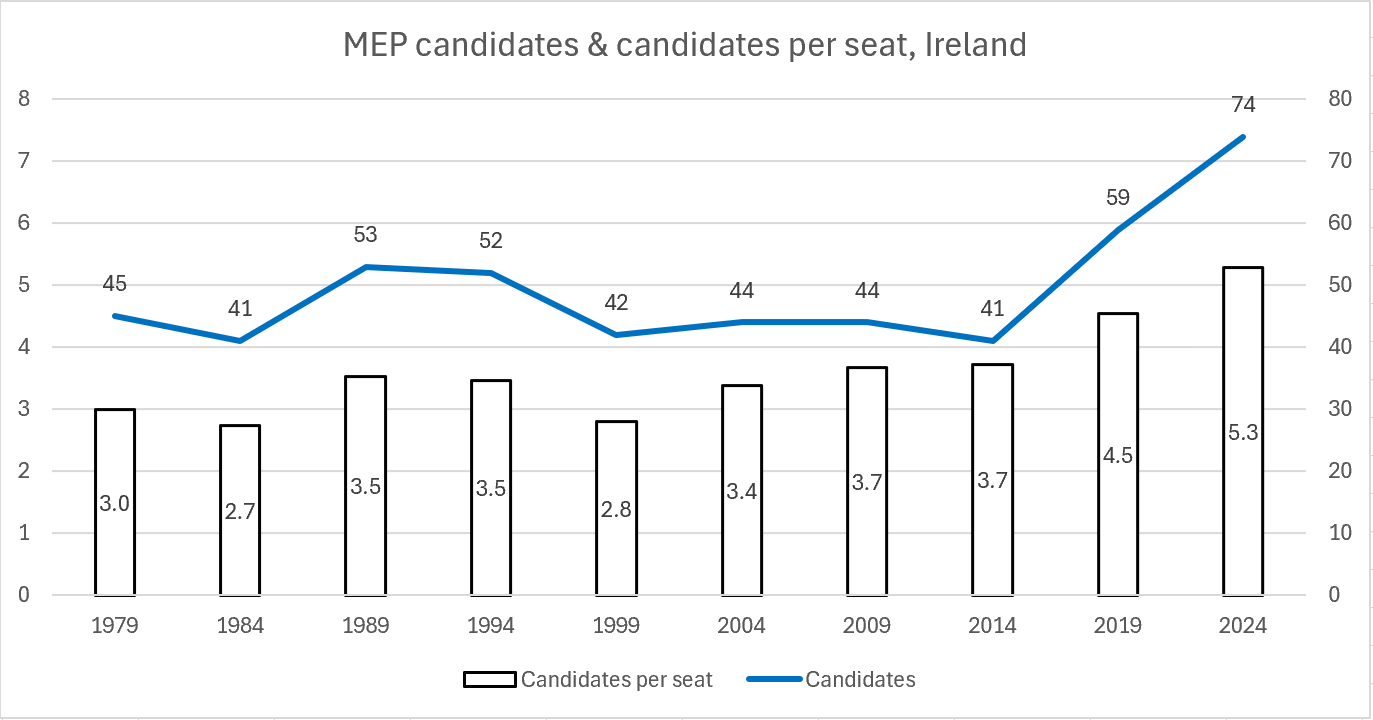
With the usual general election piece and the local elections covered this month, it’s time to turn attention towards the European election, which will be held the day after this post is published.
This has been a strange, chaotic campaign marked by an extremely high number of candidates, and then even more bizarre output from those candidates. We’ve had everything from utterly mortifying campaign videos, to baffling online beefs, to whatever on earth Niall Blaney thought this would achieve, to one candidate posting and then hastily deleting topless selfies on his social media – and that’s just what’s been coming out of the parties who are actually in government, let alone the dozens of, shall we say, less decorous individuals further down the ballot.
I could go on further – a lot further – on how surreal the European election has been, but suffice to say it’s been a mess, and the general sentiment among many politically engaged people I have spoken to seems to be that they just want this whole confusing, embarrassing affair to be over so they can regroup and move onwards. None of this bodes well for the conduct of an upcoming general election, where distrust and apathy among voters are shaping up to be significant problems. But I am getting off topic: let’s talk about the polls.
If you read my local election piece, you’ll have seen that owing to uncertainty and limitations around polling data, I described the approach as benchmarking rather than a projection. It is important to note that while the issues with constituency size and other confounding factors are far less than they were there, we also have, compared to the general elections, extremely limited data for European elections. I don’t think it’s fair to call this a benchmarking, but I wouldn’t know if I would call it a projection either, based on what we have. I spoke a bit about this in my analysis of the Ireland Thinks poll back in April, and while I will not repeat them, the caveats expressed there still very much apply here.
I suppose this is more about polling indication than anything else, but you can call it whatever you want – but as long as you understand that this all comes the very important caveat that it is based on data that is much less comprehensive and robust than for general elections. Therefore it must be remembered that the potential for error is much higher. To illustrate – my GE projections work off of a weighted average of 10 polls. This dataset only uses three, only two of which have individual candidate breakouts. It is extremely important to bear that in mind when looking at this analysis.
Contents
Dataset and Methodology
This will just be a short note. This dataset uses three polls – the Ireland Thinks poll published on June 2nd, the RedC poll published on May 28th, and the B&A/IPSOS poll published on May 18th. All of these polls contained questions exclusively relating to voting intention in the European elections, which is what was used here. Note that while the Ireland Thinks and B&A polls did feature all candidates, the RedC poll only asked for party support and broke down by province rather than constituency, so I have weighted that data accordingly.
The methodology is not dissimilar to usual, but there is one significant difference – this does not use swing from historical performance like was done for the general and locals, it instead is straightforwardly based on the level of support for candidates and parties across that polling data. Transfers are incorporated, based on 2019 transfer rates, with some gaps needing to be filled. As usual caution is required with this – more on this below.
There is also a huge question on transfers – specifically, how “ideological” will they be? Given what can be politely described as “increasing polarisation” in political discourse, this is a very real prospect. If that is more of a factor this time round, then the composition of them will be very different to 2019. That is also worth considering when looking at the figures accounting for transfer patterns.
Bear in mind that as ever, all polls come with margins of error, and these races are on paper very tight. Even relatively. small variations in the actual votes versus the polling could make small gaps suddenly very big, reverse outcomes or generally blow things wide open. I have included a section that replicates the 2019 polling error, not because I think an identical error will occur, but because it’s a really good demonstration of the impact that can have.
Polling indications
So what exactly do these polls tell us? There’s a a couple of ways to look at the data. The first is the most straightfoward and most reliable, but also in many ways the least informative – assessing what they suggest the first preference vote will be. This gives us a pretty good idea of where the candidates stand overall, and for some people will see them safely elected regardless of what happens as we go through the counts.
While FPV is naturally the most important thing, but it is not the whole picture because, of course, we need to think about transfers as well. While this is critical in close races, and particularly in an election like this where there will be a vast amount up for grabs, it also must be noted that we don’t have any polling data around these. Further to them being generally difficult to predict, we must also bear in mind that there are a ton of new parties and candidates compared to last time, which makes the shape of transfers even less certain, as there are more gaps in the data.
On that basis I have produced two pieces from a combined analysis of the three polls. The first one shows who the polls indicate will be the winning candidates only factoring in FPV; the second shows who the polls indicate will be the winning candidates if transfer patters are the same (or sufficiently close to) what they were in 2019.
I will show the headline names here and get more in depth in the closing section. I guess if you insist on take a misleading, decontextualised screenshot (yes, that means you, Aontú social media intern), here is the place to do it:
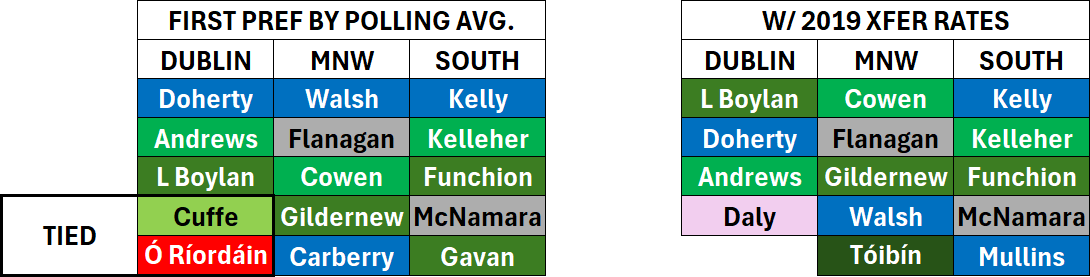
Let’s talk about this a bit; we will start with Dublin. Sinn Féin’s Lynn Boylan should be comfortable enough, as should Fianna Fáil’s Barry Andrews and Fine Gael’s Regina Doherty, although there are more scenarios under which the latter two could still potentially miss out – more on this later. Although the polls have the Green Party’s Ciarán Cuffe and Labour’s Aodhán Ó Ríordáin tied for the fourth and final position on FPV, when we apply the historic transfer data, they both get overhauled.
Incumbent MEP and unlikely celebrity endorsement magnet Clare Daly (Independents4Change) was extremely transfer-friendly in 2019. If she is able to replicate that this week – which is far from guaranteed – she will be in a position to hold her seat, even if her currently diminished FPV figures turn out to be accurate. If she is ahead of Bríd Smith (PBP) and Smith is eliminated, that should give her a significant boost.
But there is a wild-card here in Independent Ireland’s Niall Boylan. Despite their wildly divergent politics, Daly pulled a surprising amount of transfers from people whose politics are very far from hers, on the basis of her anti-establishment politics. Boylan, who is rabidly “anti-establishment” in the way only a man as deeply embedded into the establishment as he is can be, could potentially eat into that, particularly as his politics align much more with the sort of right-wing candidates who transferred surprising amounts to Daly in 2019. That dynamic could end up being critical.
It is, of course, also worth noting that Cuffe was transfer-friendly too, but polling indicates that balance between the types of candidates who transferred more heavily to Daly has shifted in her favour. Things are more difficult for Ó Ríordán; Labour have struggled for transfer friendliness in European elections for a while, though his strong personal brand may give a chance at beating that trend. The two should also transfer well to each other, but based on the historic data it wouldn’t be well enough to have them favoured for a seat, though it’s not a million miles off. Suffice to say the final seat here is really quite open, even if the historical transfer data gives an edge to Daly.
Midlands North-West is a bit less intriguing on the face of the headlines above, but there’s still plenty going on here – not least because, with declining support levels, there’s potential for Sinn Féin to really mess themselves up if their vote split goes wonky. Fianna Fáil, despite apparently hamstringing themselves with a three-candidate strategy, will probably be fine to return Barry Cowen, unless Niall Blaney has some kind of unlikely last-minute surge. Independent Luke “Ming” Flanagan should be absolutely fine on these numbers, and his support was polled extremely accurately in 2019. Fine Gael’s support level is sufficient that Maria Walsh looks comfortable; unless the polls are off they have enough support to survive even a bad vote split. Carberry would come 5th on FPV on these numbers, but the historical data does not give her the best chance of holding that position through transfers.
But let’s go back to Sinn Féin for a second. Generally speaking, they have good transfer discipline between their candidates, but this is untested on the scale of a European election, so it will be very interesting to see how that holds up. And it could be critical as well – there are a number of scenarios where even a relatively small polling underperformance, a poor split between Gildernew and MacManus, or a drop in their internal transfers could catch them out. It’s more likely that this doesn’t happen, but the fact that such a scenario is mathematically viable is a sign of their general struggles.
Oh and Peadar Tóibín (Aontú) is here too, or at least for the five minutes before he inevitably resigns the seat and hands it over to his sister. I’ll talk a bit more about the dynamics around him – particularly in relation to Independent Ireland’s Ciaran Mullooley – in the closing section.
Finally, on South. Fine Gael’s Seán Kelly is the only candidate in the country who polling indicates could beat the quota in the first round. Fianna Fáil’s incumbent MEP Billy Kelleher and Sinn Féin TD Kathleen Funchion would also be fine across these figures, transfers included or not. Independent Michael McNamara appears to have eaten swathes of Mick Wallace’s (Independents4Change) polling support and is in a decent position as well.
It’s with the final seat here that things get weird. There’s a whole bunch of candidates clustered up behind the top four. Sinn Féin’s Paul Gavan is polling the best on FPV, but if past patterns play out, will struggle badly for transfers. Fianna Fáil’s Cythnia Ní Mhurchú is in a similar position with regards transfers and a worse position when it comes to FPV, as is Labour’s Niamh Hourigan. Ireland First’s Derek Blighe is also in the same range, and it’s very hard to know what to make of that with potentially plenty of transfers from other fascists, as we have very little data on this, but there’s no indication from what we do have that he starts overtaking people. Mick Wallace, as above, also has a problem in the form of McNamara.
This leaves incumbent Green MEP Grace O’Sullivan and Fine Gael’s John Mullins. And based on the historic transfer patters, Mullins, who is near the bottom of this ranking, would overtake her, and everyone else in this pool for that matter. This feels unlikely, and indicates well the challenges with utilising transfer data. But as ever I will not delete a result due to personal opinion; I think it is important to show what the data shows, regardless of my personal opinion. All of the margins in this, it must be said, are extremely fine, and there’s high potential for the final seat here to be really chaotic.
Polling gaps
I want to put a short section in here about polling errors – or, as the case may be, polling misses within the margin of error, but aren’t really errors at all. I suppose it’s more about the gaps between polls and reality, be they errors in the statistical sense or not. This is purely illustrative of the kind of impact that can be had. It is not a claim that the 2019 polling gaps will necessarily replicate.
With that in mind, if we apply the polling gaps from 2019 to the polling numbers from 2024, it shows us this:
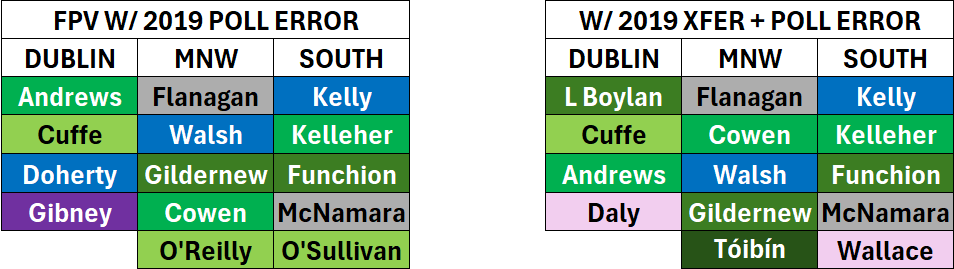
How does that happen? Well, in 2019, there were notable misses on the Green Party across the board, and on the Soc Dems in Dublin. An error of similar magnitude would catapult these candidates up in terms of FPV, and I think that level of change is worth illustrating. Of course, transfers do swing some of this back, but again, there are a lot of unknowns and potential changes in those.
And of course, Mick Wallace was underpolled too. While the raw numbers we have seen look grim, if he’s able to replicate his transfer patterns, he could hold onto his seat – even with a smaller error than during the last election.
It’s also worth noting that while those were underpolls, Fine Gael were overpolled prior to the 2019 election. If that were to be replicated, Regina Doherty in particular might be in trouble. And leaving aside the 2019 numbers, if Sinn Féin find themselves dealing with a similar situation – a leading party underperforming the polls on election day – things could get very interesting indeed.
It may be the same parties, or different ones, or nobody at all who gets over- or under-polled enough to make a difference. But this serves as a useful demonstration of the type of thing that can potentially occur.
Final assessment and analysis
“Alright” I hear you say “I’ve read over 2,000 words of this, are you actually going to make a projection or not? Or will you be renaming the website Irish Election Equivocations?”. And I get it, but, this is a question of sufficient data – and, as laid out at the start, I don’t believe we have sufficient data to make a definitive most likely call, particularly with so many fine margins, reliance on transfer data, new candidates/parties, and so many other variables. But what I will do is provide this ranking:
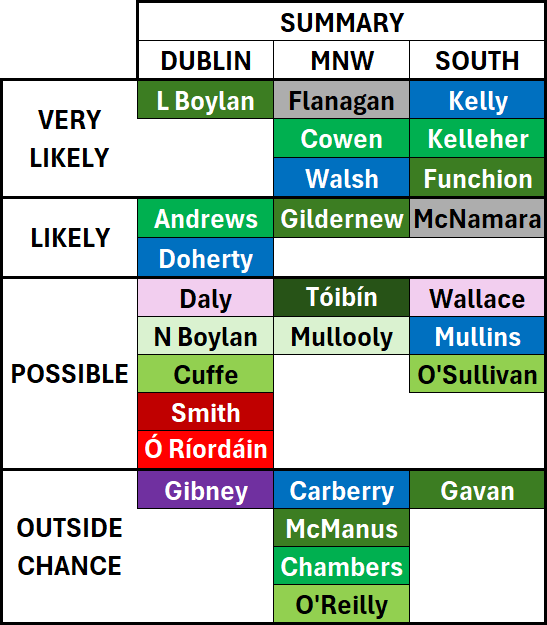
There are a lot of variables at play, most but not all of which I have covered above, and I’m aware this visualisation isn’t the cleanest, so I’ll provide a few more closing thoughts and explanation around this.
- Dublin (4 seats)
- Lynn Boylan should, barring a very substantial polling error or an even more severe last-second collapse in the Sinn Féin vote, be comfortably elected.
- Barry Andrews and Regina Doherty are in strong positions. There is precedent from last time for both FF and FG underperforming their polls.
- The last seat is unclear. Daly’s transfer strength enduring is key for her, but as above this is not a guarantee.
- Cuffe and Ó Ríordán have a chance if one transfers very strongly to the other.
- Niall Boylan has a real shot here, particularly if his performance is closer to the Ireland Thinks poll than the B&A one, and if he accumulates a large amount of right-wing and/or anti-establishment transfers.
- I haven’t discussed Bríd Smith (PBP) much yet, but if she manages to get ahead of Daly and stay there, she could be in the running, though transfers may be a challenge.
- If there’s a massive SD polling error like last time, Gibney enters the mix, but it’s a long shot this happens, and even if it does, it’s still a challenge for her to hold 4th place
- Midlands North-West (5 seats)
- Ming should be pretty safe regardless of the permutations, his polling has been historically accurate and he seems to have kept most of his core vote even with more Independents emerging
- Cowen and Walsh are in solid positions, and although FF’s candidate strategy still could cause some volatility, it does seem that they have got a handle on it. There are plausible scenarios under which they could bring in running mates (specifically Chambers in Cowen’s case), but that would either require a noticeable underpoll, or something unusual happening.
- Gildernew should be okay, but the way SF’s polling and vote distribution is going here introduces some uncomfortable questions. McManus needs the polling to be flat-out wrong about his position relative to his running-mate, and it would take a substantial error for both SF candidates to make it.
- Tóibín is in a good position given the ideological bent of many of those below him in the polling. The one spanner in the works is Mullooley – if he gets ahead of Tóibín, he’s suddenly in a position to capitalise. It is possible that neither of them get in, but it is more likely than not from these figures that one or the other does. Both of them? Much less likely, but not utterly impossible.
- If the polls are as off for the Greens this year as in 2019, O’Reilly enters the mix, but similar to Gibney in Dublin, it’s a long shot it happens. Indeed, even more so given that it’s fair to attribute the Green overperformance here in 2019 to Saoirse McHugh as much as to the party; and she’s running as an Independent.
- South (5 seats)
- Unless polling is off by a historically large amount, Seán Kelly is the safest man in this election (the same cannot be said, sadly, for his shirt).
- Kelleher and Funchion are in strong positions as well, it is difficult to see them missing out if polling is even fairly accurate; they both have a fair bit of cushion they can squander before they start feeling any heat.
- McNamara has a good shot here; it’s always tough to tell with Independents, particularly with such a broad field and with Wallace there, but he should pick up a rake of transfers along the way, and if Wallace gets eliminated at any stage I expect him to do pretty well out of that.
- Speaking of Wallace, it’s tough to know where he sits. It would only take these polls being off by a point or two to get him right back into contention, he’s been underpolled before, and it’s not like there is a standout 5th candidate. I would be hesitant to write him off, but this will be much more of a struggle than last time.
- O’Sullivan and Mullins are not as far out as it might seem – again there’s a lack of a clear standout in polling terms in this position of the field, and both have viable paths, even if it’s not easy. Both have potential to do well on transfers, looking at what the Greens and Fine Gael have managed here in the past.
- Gavan is in an interesting spot, his FPV is far from terrible – stronger than people I have above him – but it’s really hard to see where the transfers come from. He may end up finishing above some of them in the end, but beating all of them? That’s not something the data shows is very likely.
And with that, we are done with the final of the three parts of the analysis, just in time for the election. I hope this was interesting and informative for people, even if it wasn’t really a projection. I hope it demonstrates some of the dynamics we are facing, and what the latest polling data shows us. Things are changing rapidly in politics and polling at the moment, and we should expect more changes and surprises – perhaps in this election, even if not in the final seat count, but further down the ballot as well.
I plan on live-tweeting the local and European counts over the weekend, so be sure to follow on my Twitter if you are interested in that.
Democracy is flawed, beautiful, messy, vital, and far more fragile than we realise. Vote early, vote often, and don’t vote for men who kick dogs in the head. I’ll see you at the count.
*****
Thanks so much for reading! This website is done entirely in my spare time and run without ads, so if you want to donate, please do so via Patreon or Ko-Fi – any support is greatly appreciated and 100% of any donations received are invested into the costs of running and improving the site.