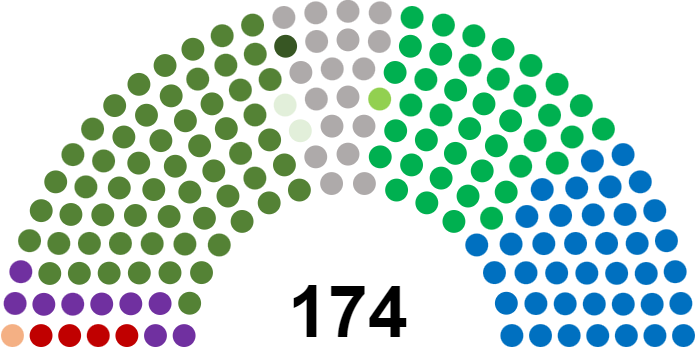
Seat totals
Sinn Féin 59
Fianna Fáil 40
Fine Gael 38
Independents 18
Social Democrats 9
PBP/Solidarity 4
Independent Ireland 2
Green Party 1
Aontú 1
Right2Change 1
Labour 0
Changes since Feb 2024
Sinn Féin -1
Fianna Fáil +1
Fine Gael +1
Independents +1
Social Democrats +1
PBP/Solidarity nc
Independent Ireland nc
Green Party -2
Aontú nc
Right2Change nc
Labour -1
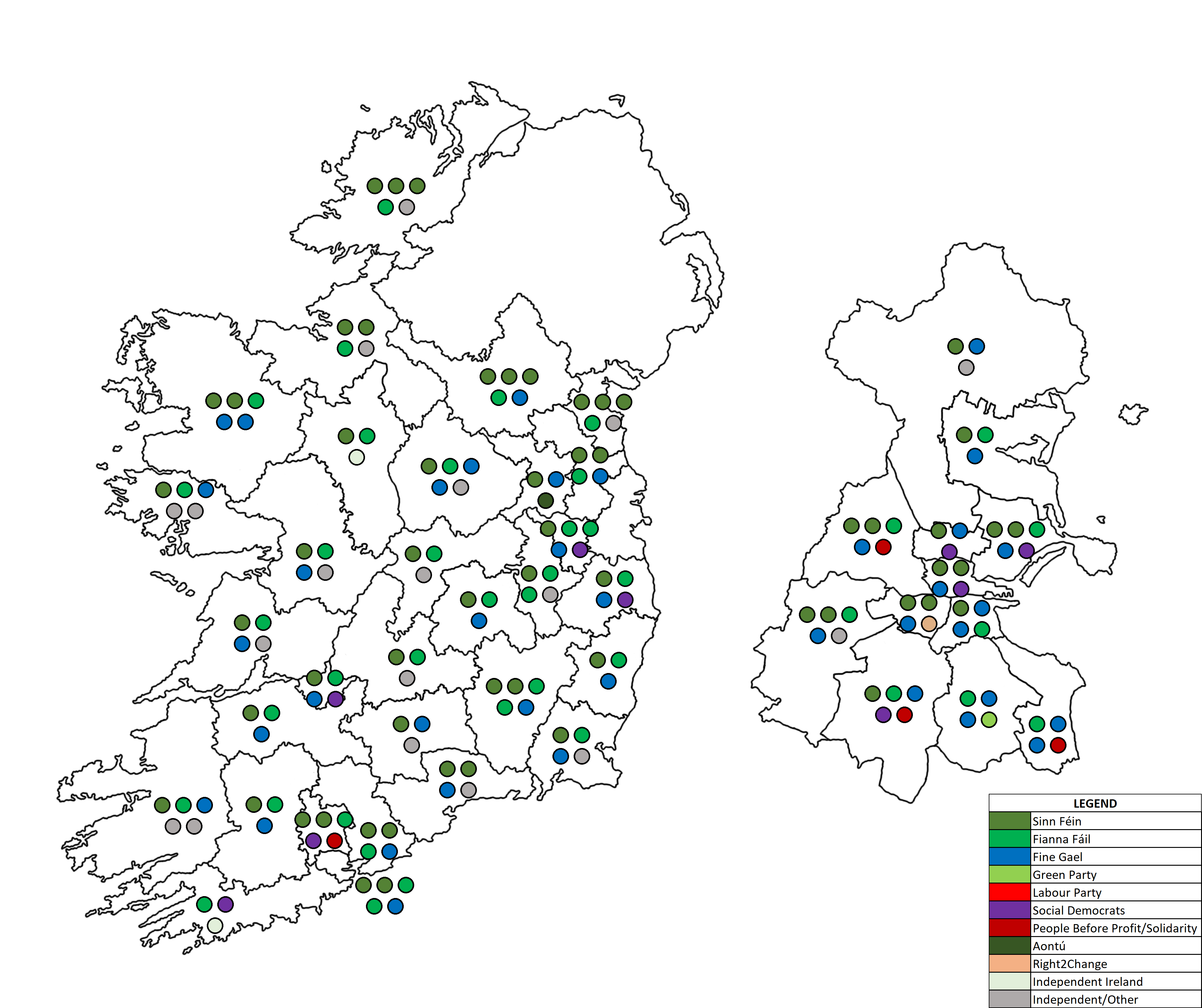
Seat Map
Hello all, it’s nice to be back, and we’ve multiple elections just around the corner, too! Owing to the slow-down in polling cadence (or at least the cadence of polls with regional breakdowns), there has been a longer gap between these posts to allow sufficient data to be fed into the model. Our last update was in February of this year, and since then there have been 9 polls – four from Ireland Thinks, two from RedC, two from newcomers Opinions, and one from B&A/IPSOS. Unfortunately, only the RedC polls have had full regional breakdowns (the B&A/IPSOS one only had breakdowns for SF, FG and FF – thanks, Irish Times, for another absolutely baffling editorial decision!) so only these are factored into the modelling.
This poses, naturally, a bit of an issue – having the projections based almost entirely on a single polling company is not particularly healthy, but I’m reluctant to revert to national polling because it’s far less nuanced. Regardless, if this is the way we are moving forward, I may need to make significant revisions to the model to incorporate that, and also modify the amount of polls used for the average. It’s something I will have to weigh up after the local and European elections.
NOTE: the day this post was due to be published, RedC published a new poll that closely aligned with the B&A poll. In the interests of avoiding delays, this is not factored into this post’s seat calculations, (and I also do not yet have regional data for it so I couldn’t factor it in anyway right now). It will be referenced in some of the sections below, but bear in mind that parts of this were written before this further data point was available.
As for the polls themselves, it’s been interesting if not earth-shattering, despite one poll (and now two, with the RedC poll coming out today) causing quite a stir, which I’ll come to in the first subsection below. By and large the trends have been relatively stable since the last update, with Fine Gael very steady, Sinn Féin and Fianna Fáil ticking down, while Independents tick up – although these movements are incremental and inconsistent across regions, so the effect on seat projections is slow and uneven. If we take a long lookback at the national polling average, it looks like this:
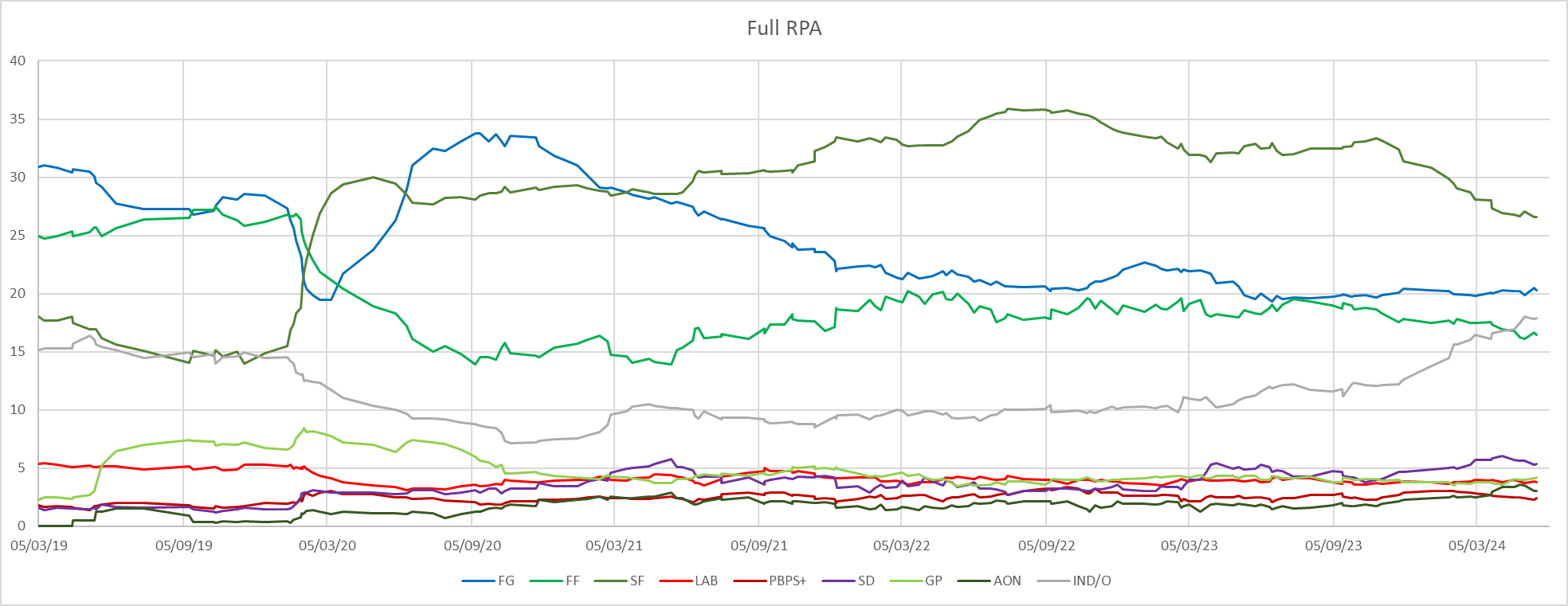
As you can see, the current trend for the big parties and Independents that set in in late 2023 is continuing. Fine Gael’s stability – or stagnation, depending on what way you want to look at it – is particularly remarkable. There is a possibility that this represents a “floor” in their support levels; that this is the core FG vote stripped down to its bare minimum and that it will take a major shift for it to break through to a lower level. This tracks with this being in line to be FG’s worst election result ever in terms of FPV. On the other hand, this much time without any kind of real growth ought be worrying, and their seat projection is to a large extent only holding up because Sinn Féin and Fianna Fáil are overall declining.
Both Sinn Féin and Fianna Fáil are continuing to see a drop in support in this timeframe – SF’s has been more pronounced, so it’s got more coverage, but the FF one has been fairly consistent as well. I’ve mentioned before that there’s reason to believe a good amount of this is a result of GE2020 FF voters (or even pre-GE2020) switching support around between SF, FG and Independents over the last four years, but that is of course not going to be everything, and data on party-support switchers is overall limited – B&A used to publish a little, but this has been gone since the IPSOS merge and the Irish Times taking over publication.
SF’s continuing attempts to pull to the centre across a variety of issues seems to have borne very little fruit in terms of polling, and I believe there’s a case to be made that Independent vote share’s steady increase is driven by complete disillusionment. But then of course, the question is, why haven’t Fine Gael, the party leading government, suffered from “anti-establishment” sentiment? Perhaps, as above, they are already at a “floor”, but we don’t have much data on this. FF continue to struggle as well; it has felt for a long while that this is a party without a clear identity or direction, and bickering in front of TV cameras at their EE campaign launch won’t have helped much.
A natural question for this is why isn’t the model showing commensurate Independent gains? Aside from the usual problems modelling Independents that I have talked about many times before, right now we don’t know who will run and where, so the model is mostly based on the 2020 GE Independent candidates. So that poses a limitation on the number of prospective seats, and while not perfect, it is probably preferable to inventing candidates – particularly because individual attributes matter so much for Independents.
Finally, I want to apologise for two things – you may have noticed that much of the text on the website is appearing very small. This is a WordPress issue where it appears the font size associated with a certain preset changed. This appears to have retroactively changed most of the text on the site. I am very sorry to anyone who has visual impairment or even anyone who simply doesn’t like reading small text; I will be trying to resolve this once I have time.
Secondly, it appears in my notes on the two new Fingal constituencies I may have got the locations of some of the incumbent candidates incorrect in terms of their distribution between the two new constituencies. Thanks to Fine Gael councillor Tom O’Leary for pointing this out; I’ll be checking and correcting those in the near future. Note that this does not affect vote totals, which are assigned geographically between Fingal East and West, rather than by candidate, or projection outcomes.
A couple of thoughts to follow, but if you would prefer to skip straight to the seat changes, click here.
The B&A and RedC polls
So, let’s talk about the controversial polls this month – first, there was the B&A/IPSOS poll that showed Sinn Féin and Fine Gael tied on 23%. This is the best polling result for Fine Gael since March 2023, and the worst one for Sinn Féin since February 2020, just before the last general election. Contemporaneous polls from Ireland Thinks and Opinions indicated this was an outlier, until today where RedC published a poll that was very closely aligned – having SF on 23% and FG on 22%.
This is a surprise. The Fine Gael figure is less so; they were averaging around 20% so while certainly a positive sign for them, this is a movement within the MoE range and is normal. Whether this is the start of a meaningful upward trend or not will become apparent with more data, but they will certainly be encouraged by these figures, particularly with them coming so close together. But it’s certainly less significant than what we are seeing with SF.
Sinn Féin’s polling hit a peak in 2022 of just under 36%. Their polling average as of today, including the RedC poll, sits below 26%, and if these polls are indicative, is at serious risk of dropping even further. I’ve covered here a few times that SF’s apparent strategy of pulling to the centre has not benefitted their polling, and this appears to continue to be the case. They are sliding back towards their totals from the last GE – a result that would still net them seats as they significantly under-ran candidates in that election – but if we see the polling average drop below that, the alarm bells will become deafening. If they don’t want to squander this opportunity entirely, something has to change. I can’t say for certain what that is – far outside my field of expertise – but it is readily apparent from the numbers that the current approach isn’t working.
It is worth noting that the polls do significantly disagree on Fianna Fáil; B&A have them at 20% and RedC at 15%, this is in line with a long-running gap between these two specific polling companies on Fianna Fáil’s support levels. As, at the time of writing, RedC have not published a breakdown, we can’t explore this in more depth, though historically speaking the biggest polling gaps between the two on FF have been in Munster and Connacht-Ulster. There is no question that their polling averages are continuing to decline, however, and B&A/IPSOS stand alone as the only polling companies to have them on 20% or above since the last general election.
Are Labour actually going to get no seats?
Having talked about the big three and Independents above, I want to discuss some of the smaller parties a bit in this post – specifically Labour, the Social Democrats and Aontú. First I want to turn attention to Labour, because it’s a consistently notable feature of this modelling that they are frequently very low and – as is the case this month – get shown at zero seats on a semi-regular basis. I’m going to use this as an example to illustrate some broad things about interpreting the projections.
To immediately answer the question posed in the title of this section, no, probably not. Based on polling numbers, there may be no single seat in isolation that they are favoured to win or hold, but I would personally be surprised if it turns out to be the case. There’s a few reasons for this. Broadly in the abstract, there’s three connected things. First if you have (for example, and I am oversimplifying this somewhat) a candidate has a 40% chance of winning a seat, the model will show them as not winning. But that does not mean the chance is zero. Secondly, if you then have ten constituencies where there’s a 40% chance of winning, you have a greater number of possible combinations of results at varying probabilities that can occur. Thirdly, the events are not truly independent of eachother in the way that flipping a coin or rolling a die is; a polling error or a change in support would likely reflect across multiple constituencies.
More specifically to Labour, there are a few additional factors to consider. Ivana Bacik is one of them – given that she was elected in a by-election, there’s no great way to determine how she would do in a GE. An overperformance relative to the model in Dublin Bay South would not be a surprise. Then, as with all small parties, there’s the question of geographical distribution – Labour has some relatively isolated and compact areas of strength in Wexford, Kildare South, Tipperary North and others; these may end up going against broader polling trends, but it can’t be seen from the polling data itself. Indeed, regional polling will never map precisely at the constituency level, and this is more pronounced for smaller parties with these compact geographical support areas.
Finally, it’s also worth noting that Labour are potentially the most volatile of the smaller parties, from a data perspective. If they outperform the polls by the average MoE, they stand to gain more seats than the SDs, Greens, PBP or Aontú would from an equivalent movement. But with all this said, their polling at the moment is fundamentally poor, most crucially in Dublin, and that more than anything else is driving why the model is so low on them.
The SDs are becoming a problem for the model
While Labour are certainly struggling in polling, as are the Greens and PBP, there are also small parties that are doing well, most of all the Social Democrats. I’ve written a bit before about their growth and what it could result in, so I want to do something a bit different here and look at some of the problems this poses for modelling. I’ve mentioned this in passing in relation to the model seeing a seat for them in Cork North Central , but the SD polling numbers in Munster relative to 2020 are something else – it implies, at time of writing, an approximate doubling of FPV in the province.
On the face of it that sounds like a lot, but it would be an end result of about 5% FPV across the province – certainly not implausible for a small party to obtain; the Greens got 6.6% there in 2020. Right now polling indicates that the Greens have lost 3.4% support, and the SDs gained 2.5%, and are in many ways a natural home for people moving away from the Greens. I don’t think there’s evidence that suggests the polls are wrong here, but there’s limitations in the data.
To illustrate, the Soc Dems only contested half of Munster’s constituencies in 2020. Already how the increase in support will distribute across constituencies is an unknown (the model assumes it’s a uniform swing, which is, like all options here, imperfect). We have even less of an idea how this could distribute support if they choose to run more candidates, it may emerge that there’s less room for growth in certain places than the model has to assume. Secondly, in transfer analysis, there is an attempt to account for swings, which makes the SDs appear very transfer friendly – which is lower confidence.
Basically, while the overall model is I believe correctly reflecting the overall support level the SDs can obtain in Munster, I think there is something off about the way it is applying to constituencies where they obtained a reasonable vote in 2020. The volatility of changes in small party votes can be significant, and I think there might be something I need to look at in the model itself within how it’s handling it. That’s not to say it will change, but that I think there’s potential for greater nuance to be applied; similar to what was done with Galway West.
As an illustration, I quickly applied a rough draft of this to check the outcome and while it does result in the seat in Cork North Central disappearing, the new seat in Limerick City does remain; this is something I will work on and decide how best to handle between now and the next GE projection post.
The impact of this swing is even more pronounced at a local level, where if one maps the general election polling, the polling growth of the SDs pushes some of the outcomes into genuinely impossible territory. This is one reason among many that I do not believe we have sufficient data to make anything resembling a projection for local elections – but more on that next week, where I will discuss the locals in a bit more detail.
Why is there no Aontú breakthrough?
There is, of course, another small party that has seen an increase in support. Aontú’s average polling is still low – around 3% – but there’s a relatively significant amount of swing since the GE. As above, serious caution must be applied to these movements in support for small parties, as they can have an outsize effect, but the model treats them equally to big parties. So why have Aontú never gone above one seat on the model?
Well, firstly there’s the obvious problem of candidate numbers – Aontú only ran 26 candidates in 2020, so that is a limiting factor both in terms of determining where their base support is and what level it is at, and in terms of the model assuming for now that they will only contest where they did in 2020 (similar to Independents, as mentioned above). Secondly, most of those candidates did fairly poorly – 17.6% of all Aontú FPVs were for leader Peadar Tóibín, with a total of 42% of their FPV distributed across just four constituencies. Other than Tóibín, and Becky Kealy in Cork North West (where Sinn Féin did not run), no candidate got more than 5.5% of FPV. So by and large, others would need even more significant swings than the party is currently experiencing for the model to favour them for a seat.
While there is the fundamental fact that their polling is still overall not strong in absolute terms – they are basically stuck around 3% nationally at the moment – there are some places where they are quite close – and it must, as ever, be remembered that because the model does not think a seat is the most likely outcome does not mean it thinks that the chance is zero. The model shows them having a reasonable chance in, for example, Cavan-Monaghan and Mayo, with Cork North-West something of an open question given there was no SF candidate there in 2020. Once again it must be said, at the risk of repeating myself, that in general, small parties with concentrated support bases are harder to project for, particularly in places where they have no electoral history.
There is no reasonable polling data model that would have projected the election of Holly Cairns for the Soc Dems in 2020, for example. It is absolutely plausible that Aontú – or any other small party – could have a couple of lightning-in-a-bottle candidates like that, who simply cannot be accounted for from polling data.
What might be interesting, and potentially indicative, will be how they perform in the local elections. If they perform to the level of their national polling in those, they will have a very good day – but more on that next week.
Seat Changes
NOTE: Please note that due to unfortunate timing. these projections were calculated prior to the release of the RedC poll on May 26th. The impact of that poll will be factored into the next set of General Election projections, which will likely be released in July/August.
There are seven changes in total this month, all in different constituencies, with movements between Sinn Féin, Fianna Fáil and Fine Gael offsetting eachother to an extent.
Clicking on the linked name for each constituency should jump to the relevant section of this page. Changes on this page indicate changes from February 2024’s projections; changes on constituency pages indicate changes from current composition.
Note: The projections reflect, and always have reflected, most likely outcomes. So if a final seat is more likely for candidate X over Y, the model will show X winning the seat.
This does not mean the scenario where Y wins doesn’t exist, or even is necessarily unlikely (there’s a lot of marginal calls!). It also does not mean that every single “most likely” scenario will come true; statistically that in and of itself is probably not going to happen. This is true from from a simple probability point of view, even if we ignore deficiencies in underlying data. A projected result merely means that the model thinks X winning is the most likely outcome.
- Dublin Bay North (FF +1, LAB -1)
- Dublin Bay South (FF +1, GP -1)
- Dublin West (SF +1, GP -1)
- Kildare South (IND +1, FG -1)
- Laois (FG +1, SF -1)
- Limerick City (SD +1, SF -1)
- Longford-Westmeath (FG +1, FF -1)
It’s not all doom and gloom for Fianna Fáil this month, despite continually weak polling. Their numbers in Dublin aren’t really better than in February by any significant margin, but everybody else except Indepdents/Others and Aontú are going backwards. This combines to overall benefit FF, and change the likelihood in a couple of highly marginal constituencies, including Dublin Bay North.
Marginal is the key word here however – the difference between Fianna Fáil, Labour and a putative second Sinn Féin candidate is really small, and this constituency remains very close for the final two seats. Any combination of those three is very plausible within the margin of error.
One thing I do want to note about DBN also is it illustrates one of the conundrums of modelling Independents – combined, the model would put the Independent/Other vote in the ballpark of being competitive for a seat. However, when you look at how it breaks down in 2020, you have a mishmash of candidates from the far-left to the far-right. It’s a useful illustration of how this can’t ever be seen as monolithic, and what would happen to the votes if one or more 2020 candidates doesn’t run – or indeed, if more Independent candidates run – is very hard to determine.
Similar to its sister constituency across the Liffey this month, Dublin Bay South sees the model give Fianna Fáil as slight edge over the Greens in what will almost certainly be an extremely competitive race for the final two seats. DBS has bounced back and forth in the model, a testament to the extremely fine margins involved. I’ve written basically the same analysis on this a half-dozen times now, and barring a significant shift in polling support, I don’t see that changing any time soon.
Once again I will note that it is very difficult to accurately project the vote share that Ivana Bacik (LAB) will get here because of how idiosyncratic by-election dynamics are; I still do tend to think the model is underestimating her chances and would not be surprised at all if she in fact holds her seat.
This is an interesting one, coming at a time where Sinn Féin are generally struggling; it is more a reflection of continued issues for the Greens than anything else. That said it is also by one of the finest margins I have ever seen the model output, so I wouldn’t consider this to be anything more than a coinflip that this stage, and small variations have the potential to make this continue to swing back and forth.
Unless SF are able to reverse their polling issues, I can see this output reversing in fairly short order. Also worth keeping an eye on how Aontú do in the local elections here. While they fared poorly in the 2020 GE, they did relatively well for Dublin in the LEAs that make up this constituency (while still failing to win a seat). If they are able to get a couple of councillors in place and find a way to stop their vote level cratering between the LE and the GE, as happened between 2019 and 2020, their position becomes quite interesting, particularly as to who they might pull support from.
This is very interesting, and illustrates again some of the issues around Independents. Cathal Berry (IND) lost a significant chunk of his voter base in the redraw, and really shouldn’t be in any shape to hold his seat, but the model is showing this as more likely than not in the face of surging Independent polling across Rest of Leinster. The problem here is in part due to other Independent Fiona McLaughlin-Healy, who picked up a solid chunk in 2020, but has declined to run for council again and thus presumably will not run for the GE again.
This is the kind of situation where the Independent vote becomes hard to measure, and transfers in particular become chaotic. There is absolutely a good mathematical chance for an Independent candidate to win a seat here; but there is also potential that the vote fractures and fragments. Both Berry and McLaughlin-Healy’s performance was due largely to compact areas of extreme strength. With a large part of his base gone, is Berry in a position to capitalise on the surge? Could McLaughlin-Healy go again? Could someone else emerge? Could the vote fracture and dissipate, against the national trend? All are plausible, all could also not happen. I have no idea.
The slow decline of Sinn Féin polling support kicks in once again, as the model favours Fine Gael to be able to hold on here to their former Laois-Offaly seat, even with the incumbent TD retiring. There’s still a lot of unclear things in Laois, in particular with Carol Nolan presumably running in Offaly – where her support goes is an open question. But for now, this sees the second SF seat drop away, a pattern that will be repeated elsewhere as SF continue to regress in their polling.
This is interesting. This is the first time the model has indicated any likely change to the composition of the TDs elected in Limerick City – in January 2021 it projected 2 Sinn Féin, 1 Fianna Fáil and 1 Fine Gael, and has consistently stuck to that up until today. The Greens are almost certain to lose the seat here, and it appeared for the longest time that SF would be the ones to take advantage – it’s even plausible that SF could have pulled that off in 2020 if they had run two candidates, although transfers do raise some questions there.
Regardless, this feels like a significant milestone in SF’s polling struggle, as well as a hugely positive sign for the Social Democrats – though as I have written in this month’s broader analysis, there are reasons for caution when approaching their figures in Munster. Still, this again feels like a significant step for them; being competitive in places like Limerick is going to be key if they are to break through at any point. The Mayoral Election, while obviously not necessarily indicative of what will or won’t happen in a GE, could be interesting in this regard (although it covers both City and County).
Frankie Daly (IndIrl) remains intriguing here too, for what it’s worth. There’s a lot that could happen with that final seat.
Fine Gael slip marginally ahead of Fianna Fáil in Longford-Westmeath, where one of the big three parties should be able to pick up a second seat. The model remains really tight between SF, FG and FF in terms of FPV, so historical vote split and candidate management data provides the difference here, with the natural caveat that there are a multitude of reasons that could make that change. Naturally if the polls continue in the direction they are going, that will bring daylight here as FF and SF are on a downward trajectory.
Other notes
- Local/European Elections: Post on LEs coming next week, and then one on the EE between then and polling day, all going to plan!
- Dublin Fingal East: The model is showing Dean Mulligan (I4C) as very close to a seat, but a lot of this is very dependent on transfers. An intriguing one if Independent/Other support levels in Dublin continue to spike, but there’s a huge amount of unknown variables here.
- Limerick County: The model still doesn’t show Richard O’Donohue (IndIrl) holding his seat; I suspect that is going to change very soon and I am honestly a bit surprised it hasn’t already happened.
- Meath East: Worth noting here that the model, as with other Independents, assumes identical running to 2020, unless confirmed otherwise. Cllr Joe Bonner (IND) and Senator Sharon Keogan (IND) split the vote in such a way that there’s no Independent seat under the model. However, if there was only one strong IND candidate in the constituency, they would be favoured for a seat, though there is no guarantee of where Bonner/Keogan’s votes would go if one or the other stepped back at the next GE.
- Roscommon-Galway: If there’s a second strong Independent/Other candidate here, I would anticipate the model showing them as winning a seat ahead of Fianna Fáil. As of now, with Naughten (IND) retiring, this is hard to say whether or not it will be the case until we have an idea of who is running.
- Tipperary South: The gap the model has between Fine Gael and Séamus Healy (WUAG) is so small as to be fundamentally insignificant. There is a decent chance that the edge on this flips soon.
- Wicklow: A similar situation to Meath East but with Councillors Joe Behan and John Snell. The same caveat about making assumptions about where the vote would go applies, however; just as Keogan didn’t transfer overwhelmingly to Bonner, Snell did not transfer overwhelmingly to Behan.
Thanks so much for reading! This website is done entirely in my spare time and run without ads, so if you want to donate, please do so via Patreon or Ko-Fi – any support is greatly appreciated and 100% of any donations received are invested into the costs of running and improving the site.
 Irish Election Projections