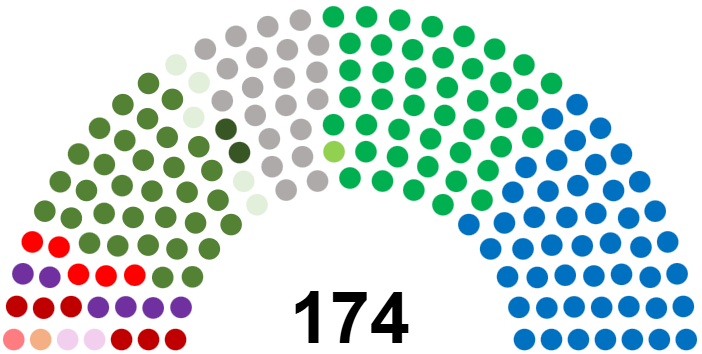
Seat totals
Fine Gael 48
Fianna Fáil 43
Sinn Féin 33
Independents 21
Social Democrats 6
PBP/Solidarity 6
Labour 5
Independent Ireland 5
Aontú 2
Independents4Change 2
Green Party 1
Right2Change 1
Workers & Unemployed 1
Changes since September 2024
Fine Gael nc
Fianna Fáil -3
Sinn Féin -5
Independents +2
Social Democrats nc
PBP/Solidarity nc
Labour +2
Independent Ireland +1
Aontú +1
Independents4Change +1
Green Party nc
Right2Change nc
Workers & Unemployed +1
Seat Map

It’s getting real now. With the 29th November confirmed as polling day, we are barely three weeks away from an election, and the government continues to be riding high going into the campaign period. Despite a handful of swaps and losses in this month’s projections, Fine Gael and Fianna Fáil are still on track for a narrow majority. There’s a lot of things to talk about below, so I will keep this introduction brief, save to provide two notes of caution:
Firstly, as I mentioned last month, we are about to get into the campaign period – historically the time where about half of voters make up their minds. There is no guarantee what way this goes – we could see trends continue, we could see trends reverse, we could see things stay static. But we must bear in mind that even if nothing does change when all is said and done, there is massive potential for polling movements over the next few weeks. I will be doing my best to find a way to track and reflect those, but please do consider that events between now and polling day could make this post redundant. Do not view this as definitive!
Secondly, there are an increasing number of races that the model views as being extremely close, volatile and otherwise hard to predict the outcome of. As the model just shows the most likely outcomes under its calculation, this closeness isn’t reflected in the numbers – though I do always try to emphasise it in the write-ups! Events like the entry of Clare Daly (Independents4Change), Alan Shatter (Independent) and Kate O’Connell (Independent) are extremely difficult to gague, as are the entry of new parties in areas where they did very well in the locals – for example, Independent Ireland’s Cllr Declan Geraghty in Galway East. Bear in mind when reading these that there is an increased degree of uncertainty around the projections for constituencies with situations like this.
Right, let’s get into it. If you would prefer to skip straight to the seat changes, click here.
This is a LOT of candidates
We are on track for a record number of candidates in this election, which is to be expected with additional Dáil seats. Something that is under-discussed, but might have an impact in the outcome in several constituencies is how incredibly aggressive parties are being with their candidate strategies, given where their polling numbers are. Fianna Fáil and Fine Gael, in particular, are selecting candidate numbers that, under the model, are pretty suboptimal in many places. Sinn Féin seem to have followed along and added additional candidates in a number of stronger areas (and Kerry???), and heavens only knows what Labour and the Soc Dems are cooking in Cork North-Central, or Independent Ireland in Dublin South-Central.
Running third or fourth candidates is often a risky proposition, and we have even seen recent examples where parties made a mess of things even by running two. Generally the model does not look kindly on over-running, though of course it cannot capture the specific local dynamics that do, in some cases, make this justifiable. But by and large running more candidates than you have votes to safely elect is hard to justify; at best it has no significant effect, at worst it can endanger a seat.
The principle behind it to have a wider spread of candidates – particularly in geographically divided constituencies – to sweep votes and then transfer. But geography can dilute or, as was the case with Michael Carrigy (FG)’s transfers in Longford-Westmeath last time round, actually overpower party loyalty when it comes to transfers.
Leakage of transfers is real, and parties have to balance how many votes they get from a broader sweep versus how many will transfer. This is even more of a headache when trying to elect multiple candidates, as you then are trying to engineer a split in those transfers to balance in such a way that it lets more than one person get over the line. In practice this is extremely difficult and transfers are highly unpredictable.
And this doesn’t even get into problems with resource division and so on. In short, running more candidates than your vote indicates you can reasonably get elected introduces a lot of risk, and while the rewards can be substantial, it can be very difficult to get right.
Of course, one of the big stories in the 2020 election was SF being caught on the hop by their own popularity and significantly under-running, but there were still cases of FF and FG running too many in some places. This may have got drowned out by the more widespread, obvious misallocation of candidates by SF, but parties botching constituencies by over-running is a constant factor in Irish elections.
So why is this happening? Initially we saw a wave of female 2nd and 3rd candidates added to ballots, so it appeared related to the gender quota. There is some truth to this, and it is unfortunate that some of these candidates will be left in impossible positions and end up getting little-to-no support as parties try to shore up the lead candidate(s). However, following this, we saw male candidates getting added as well (except Senator Eugene Murphy, for some reason), so I don’t think this fully explains it.
I believe the more important factor here is that Fianna Fáil, Fine Gael and Sinn Féin all believe they can win the campaign and boost their support over the next few weeks, to the point where their vote will be high enough to justify these extra candidates. It seems to me these selections are not based on where their polling is now, but where they believe they can get it to by polling day. This is, quite genuinely, unusually aggressive in the more modern, diffuse era of Irish politics.
And the end result of that is more than likely going to be problems for at least one of the parties – it is unlikely, though not impossible, that all three consolidate votes around them during the campaign. Whoever benefits most during the campaign period will look like a strategic genius, and whoever doesn’t will look really inept. For any of the big three parties that don’t see their support levels rise, there will be marginal constituencies where those additional candidates run a very real risk of costing them seats. The ultimate upshot of this is that whoever struggles during the campaign may end up underperforming more than the raw numbers indicate.
Small parties are going for it
Speaking of aggressive strategies, and setting aside whether or not you like their politics, I think it’s a smart thing for People Before Profit/Solidarity, Aontú and the Greens to be contesting every or nearly every seat in the country, even ones they have no hope in. The Greens nailed this, consistently doing it for several cycles even when their fortunes were bleak.
This was one of the factors that paid off in their relative success in 2020, and it set a benchmark for what smaller parties can achieve by giving as many people as possible a chance to vote for them. Now, subsequent decisions have obviously eroded their support and made it very difficult to build on their success, but at the time they achieved a number of upset wins and striking vote shares in places where nobody would have given them a chance. And unlike the bigger parties, smaller parties will not be pursuing multiple candidate strategies (except Cork North-Central, but everyone is doing very strange things there), so there is very little risk involved.
It seems that others have correctly heeded the lesson of this. Parties with limited geographical ambitions have a natural cap on their own success. In addition to this, given that PBP, Aontú and the Greens are all at core “movement” parties (albeit three extremely different movements), there isn’t a better way to grow a movement than being on the ground, campaigning and being on the ballot. The effects are not always immediate, but they also lay the grounds for future campaigns, be it for council or nationally. I do understand that this can be challenging when it comes to allocating limited resources, but the upsides are significant.
It should also be noted that this is the best strategy to leave no doubt about the state threshold and 2% funding – Aontú would have secured this if they had run everywhere in 2020, with the handfuls of votes from people who had no chance of winning likely closing the c.2,100 vote gap. Hell, even during the 2011 wipeout of the Greens, the party came a mere c.3,370 votes short of the threshold. Without running those no-hope candidates picking up a few hundred or thousand votes here and there, they would have never have come that close.
But finally, and most crucially, we have to talk about the upset wins. There are countless incidents of candidates from smaller parties managing to “bottle lightning” as it were and win seats that general trends indicate they have no buisness winning – incidentally something the projections from this model will certainly miss in one or two constituencies.
But in simple terms, if you run everywhere you maximise your chances of that happening. Be it their own brilliance, transfer friendliness, changes in the general environment, errors by opponents, or a combination of these, the more you run, the more chances of this you have. 2020 has a couple of good examples – Social Democrat leader Holly Cairns is the most obvious, along with like, half the Green Party, but also Labour pulled off some against-the-grain wins with people like Duncan Smith and Ged Nash in an election where the party as a whole lost a third of its support from the previous election.
Given this, it will be interesting to see is if the Social Democrats and Labour try to follow suit and get more candidates onto the ballot before the deadline. At time of writing, by my count, Labour are contesting just 29 constituencies, and the SDs only 23.
Improvements for Labour
Speaking of Labour, it’s worth making a brief note here as they are having their best time in a very long time under the model, with five projected seats – albeit a number of these are extremely fragile and at least one (Dublin Bay North) is likely to no longer be favoured shortly. For a long time – pretty much the entire period of Ivana Bacik’s leadership – their polling numbers were weaker than under Alan Kelly (though the usual caveats should apply to polling movements among smaller parties). That is no longer the case, and we have seen the numbers move to a point where the gap is basically insignificant. There is of course the caveat of the outlier 13% poll in Dublin, but overall their national figures have pretty much caught back up to where they once were.
Hence, the model will assign them a better chance of holding/keeping seats, and has them competitive in ones even where they aren’t favoured. As I have mentioned before, Labour have the biggest potential of any of the small parties to overperform in terms of seats with even a relatively small overperformance against polling. Now, that is far from guaranteed, but it is worth bearing in mind.
It’s also worth noting, although it’s not factored into the model, that they proved surprisingly resilient during the local elections. How this transfers to a general election is really not clear (and my general assessment is that the correlation between LEs and GEs in general isn’t great) but it does indicate that there’s some hope here with their position improving. If they can continue that during the campaign I would expect the model to move more seats into likely wins for them.
Seat Changes
There are eleven changes since September, spread across the country and not massively favouring any one party. Some of these, as was mentioned above, and will be flagged in more detail in each individual section, come with a significant warning about the confidence level.
Clicking on the linked name for each constituency should jump to the relevant section of this page. Changes on this page indicate changes from September 2024’s projections; changes on constituency pages indicate changes from current composition.
Note: The projections reflect, and always have reflected, most likely outcomes. So if a final seat is more likely for candidate X over Y, the model will show X winning the seat.
This does not mean the scenario where Y wins doesn’t exist, or even is necessarily unlikely (there’s a lot of marginal calls!). It also does not mean that every single “most likely” scenario will come true; statistically that in and of itself is probably not going to happen. This is true from from a simple probability point of view, even if we ignore deficiencies in underlying data. A projected result merely means that the model thinks X winning is the most likely outcome.
- Clare (II +1, SF -1)
- Dublin Bay North (IND +1, FF -1)
- Dublin Central (I4C +1, FF -1)
- Dublin West (AON +1, FG -1)
- Laois (IND +1, SF -1)
- Offaly (FG +1, SF -1)
- Roscommon-Galway (FG +1, FF -1)
- Tipperary North (LAB +1, IND -1)
- Tipperary South (WUA +1, SF -1)
- Waterford (IND +1, SF -1)
- Wexford (LAB +1, FG -1)
As discussed last month, with Michael McNamara’s (IND) move to Europe, there’s an awful lot of uncertainty here, with a huge number of votes up for grabs. With Sinn Féin continuing to struggle across Munster – remember when they were on course to double their vote across the province? – there’s a second seat potentially open here. With Fianna Fáil well poised to handily win one of these, it’s now Independent Ireland’s Eddie Punch who the model gives the best chance of success.
As I mentioned last month, Punch ran a chaotic European campaign that lagged well behind the other two II candidates’, so this should not be looked at with a great amount of certainty, but the fundamental direction of polling plus the McNamara votes is very much in his favour. On the flip side, if he’s able to run a stronger campaign based on his experience last time out, this may be less of an open question.
It’s worth noting that I suggested this would be a likely place for Fine Gael to consider adding a second candidate. They did, but then, in line with the party’s aggressive strategy added a third – something that at their current polling level will likely cause more problems for their second candidate than it will solve. They are still competitive for a second seat however.
Ah, old friend, every time I think I understand you, you throw another curveball my way. This has been a consistently volatile constituency where the probability margins are extremely fine, and is likely only going to continue to get more complex between now and polling day. Last month I flagged Independent Cllr Barry Heneghan as being an intriguing prospect but I did not expect the model to assign him a seat a month later, much less at the expense of Fianna Fáil.
This constituency is very difficult to call with great confidence, and has been for years, so I would advise caution here, but Heneghan is in a solid position to take advantage of the swing towards Independents in Dublin. There are others who may benefit – Cllr John Lyons, or any one of the five or six far-right candidates – but Heneghan’s position is the strongest. He had the best performance of any of them at the locals, has his entire LEA in the constituency (which can’t be said for Lyons or Kevin Coyle), and outside of the model has been fairly public in his role as councillor. If there is an Independent seat to be won here, which is currently likely although far from guaranteed, Heneghan has the best shot.
As for FF, the change here is mostly due to the model really disliking a two candidate strategy for them, but within that there are vote splits that would have them hold the seat even on current numbers. It should be noted that this scenario would still allocate Heneghan a seat, with Labour’s Shane Folan losing out. I actually expect the model to filter out the Labour seat here shortly regardless.
A note on the far-right, as this is an area targeted heavily by them. Via the National Alliance (which not every far-right group is part of), they have made a clear effort to divvy up constituencies and get out of eachother’s way. That uneasy peace appears to have totally collapsed in DBN, with four far-right Independents, the Irish Freedom Party, and an extremely right-wing member of Aontú (even by Aontú standards) all running here. This is the sort of thing that could seriously blunt any momentum they are trying to build. Just… thank God I didn’t have to work out what would have happened had Antoinette Keegan ran.
How do I explain this? Well let’s start by being very clear that even in an environment where there is more confidence issues with outputs, this is one of the least confident ones. I did flag last month that this was a constituency with potential for a strong Independent/Other candidate to consolidate votes, but I didn’t expect Daly to be the one to emerge.
Former TD and MEP Clare Daly (I4C) enters the race in a constituency she’s never contested before, and where we have minimal data. We have a vague idea of how she might have done here in the European elections, data that Independents/Others are polling very well in Dublin and, honestly while its very likely she is competitive one way or the other, I’m a bit surprised it’s enough for the model to suggest a win is likely. But would say that the margin for error in either direction for this is massive.
The impact Daly’s entry into the race will have on other candidates is hard to assess as well – will she pull votes from Sinn Féin and the Social Democrats, possibly imperling Gary Gannon? Will she blunt the efforts of Independent Malachy Steenson, who while politically very different is also looking for “anti-establishment” votes? Will there be any impact at all on Fianna Fáil? It feels Fine Gael’s Paschal Donohue is the only person unlikely to be affected by this at all.
Right now the model narrowly gives Daly the seat it previously assigned to FF, but this is now a very open race behind Donohue and SF leader Mary Lou McDonald. Any combination of Daly, FF, SDs, another Independent or even the Green Party is now on the table for the other two seats, and a strong campaign could put 2nd SF candidate Cllr Janice Boylan back into the mix. This is very hard to get a read on, there’s a huge number of questions that data doesn’t have the answer for.
The model projects a second seat for Aontú for I think the first time ever, and honestly I’m as surprised as you are that it isn’t in Cavan-Monaghan. Now, bear with me – Aontú will almost certainly do better in CNM than in Dublin West. They may even win a seat there. But in CNM, they are up against SF, FF and FG all very seriously competing for two seats each in a five seater. Even a strong performance won’t be enough, it will have to be exceptional, and beat polling trends.
Whereas Dublin West? Dublin West is a mess. The big three parties will all take one seat each unless something very strange happens. But beyond that? Oh boy. There are two seats that are open, and man it’s hard to call. Ruth Coppinger (PBP/Solidarity) is still favoured under the model for a seat, and has been for a while, but it is far from secure. Minister Roderic O’Gorman (GP) saw his local group decimated in the local elections, but is a strong campaigner and still in with a fighting chance. With a well managed vote split, Fine Gael could look at second candidate here (they haven’t announced one thus far). Labour have a mixed history here, and struggled in 2020, but had really good local performances in two of the three LEAs, with Cllr John Walsh beating the rest of the left in Castleknock LEA. Independent Cllr Tania Doyle emerged as the undisputed queen of Ongar LEA last year, but it’s unclear how she’ll do across the rest of the constituency.
From all this – and make no mistake, all of the above candidates are viable to a greater or lesser degree – emerges, for the moment, and by an extremely fine margin, Aontú Cllr Ellen Troy. This was Aontú’s second best Dublin constituency in 2020 (with a weaker candidate), and they won two council seats in this LEA, coming close to a third, and also picked up a ton of far-right transfers where those were available. But most crucially of all – they might not need that high of a first preference vote to win the final seat here. The model shows the vote here being extremely scattered, with narrow probability margins between candidates. And that’s fundamentally why the model sees Dublin West as the most likely place for an Aontú gain, even if it isn’t in their top five strongest constituencies.
Right off the bat, I want to urge a lot of caution about Laois. Séan Fleming (FF) and Willie Aird (FG) should have no problem being elected on current numbers, but after that? Oh boy. After Brian Stanley TD’s highly public and acrimonious departure from Sinn Féin, followed by his decision to run as an Independent, it’s very difficult to be sure about how this will go. The model favours an Independent seat here and thinks it is likely to be Stanley, but this is very far from clear cut.
Let’s start with what’s in Stanley’s favour. He’s obviously popular – three successful general elections, including in 2020 where he won nearly 18% of the vote in Offaly, as a Laois-based candidate. Indeed, looking at just Laois, he significantly outran Sinn Féin nationally in both 2016 and 2020. As to how that vote will break down between him and the party, there isn’t data to be certain, but SF are in a bad state in Laois at the moment. In the locals they only won two seats. One of these was won by Stanley’s partner Caroline Dwayne-Stanley, and the other by Aidan Mullins – who quit the party shortly afterwards once SF finally took disciplinary action against him. Cllr Mullins claimed he was being censored for his conservative views. You know the ones.
This left SF without a viable candidate among their elected reps, and have had to look to an unsuccessful local candidate in Maria McCormack – far from a fatal problem, but one that certainly makes for more of an uphill struggle.
So add all this to a generally positive environment for Independents, and there’s a reason the model favours Stanley. But, let’s consider the other side. How much the manner of his departure from the party impacts his appeal is a significant unknown, it could be nothing or it could be significant. There’s also two other Independent candidates with reasonable profiles who quit their parties – Elaine Mullally, who was former chair of Independent Ireland, and Cllr Aisling Moran, who left FG and went on to successfully defend her council seat as an Independent. So Stanley isn’t the only potentially strong Independent in the race, even if he should be favoured based on the maths, and this should be borne in mind.
Unlike the chaos in it’s former partner, Laois, the change in likely outcome in Offaly has a very simple explanation. Sinn Féin are going down in the polls, Fine Gael are improving, and we have hit a tipping point in the balance between the two. FG had a very rough go of it in 2020 here, with their Offaly candidate finishing behind the Laois-based one from SF in the Offaly EDs. Considering the weak starting position, that’s why so it’s taken over a year of polling change since the boundary redraw for this to reflect in the projections.
The other thing that has added some interest here since we last took a look is that I’ve done more work on what might happen with the votes of former candidates John Leahy and Ken Smollen (who combined for a very significant portion of the Offaly vote – around 15%). Incumbent TD Carol Nolan (IND) is an obvious likely candidate to benefit from their absence, and Leahy’s transfers have historically been pretty FG-friendly, but there’s also cross-pollination with other Independents. Independent Ireland Cllr Fergus McDonnell and Cllr Eddie Fitzpatrick (who quit Fianna Fáil after not getting selected) could benefit from this. I wouldn’t favour either on these numbers but they have potential to be competitive.
Also, Fianna Fáil will be pushing hard for two. It’s difficult to manage this in a two-seater, but this is historically a tremendously strong area for them, so it’s worth keeping an eye on if their polling does continue to improve.
This is an interesting one. Michael Fitzmaurice has finally stopped hedging and confirmed he will run here rather than Galway East, and that should be a comfortable win for him – and one that saves me an awful lot of recalculating. So thank you, Michael. It’s also a sensible choice because although he’s at the Galway end of the constituency, he still did extremely well in in the EDs that make up the new constituencies – tallies put him a little north of 20%. With Independents/Others polling well and Denis Naughten (IND) retiring, the question has always been who joins him.
It’s tight between Sinn Féin, Fianna Fáil and Fine Gael, and this month the model gives the former and latter a small edge. But this change is not just about polling. After failing to get selected for Fianna Fáil, Senator Eugene Murphy left the party and is running as an Independent. This is a massive, massive headache for FF. Murphy is a former TD, and in a constituency that is now more heavily weighted towards Roscommon, can do some serious damage to their vote there. There is a chance, honestly, that Murphy himself makes a serious run at a seat; the model doesn’t have him that far behind, but his vote share is extremely hard to project, so no outcome would surprise me on that front.
Fine Gael, by the way, are very fortunate that Murphy has entered the race. They are running two candidates, and following the tragic passing of John Naughten, opted replace him on the ballot rather than only run one. This is a difficult strategy on their current numbers, but is less likely to cost them with Murphy in the mix than with just one FF candidate. But the last two seats here remain a tricky one – Sinn Féin, it must be noted, are not far ahead of the rest of them in the model.
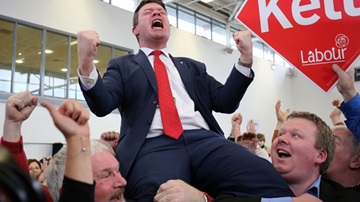
We haven’t had an Alan Kelly (Labour) holding his seat projection since January of 2022, so, here you go lads. With Labour looking in better shape than recent months, Kelly, who was usually shown as being competitive in the model, slips back into the top three in the newly re-split Tipperary North. That said, he was always a likely candidate to outperform polling and the model projections anyway given his resilient and highly concentrated support base.
Overall, this constituency has got a bit more interesting recently. It’s the stronger end of the county for Fianna Fáil, but the decision to run two candidates is a little hard to figure out, though overall unlikely to hurt them unless their polling starts to drop. Fine Gael and Sinn Féin can probably get respectable results (moreso the former), but are very much up against it at the moment. The real intrigue is with the Independents. Cllr Joe Hannigan hasn’t declared, but the model still factors him in until we get confirmation either way, and he’s got a strong support base in the north-west of the county. Cllr Jim Ryan however has declared – and he topped the poll in Thurles in the local election, which alone makes him an interesting prospect for an upset.
The good news for Ryan is that there’s only one other candidate likely to seriously challenge for a seat who is based in or around Thurles.
The bad news is that it’s Michael Lowry.
Will Sinn Féin actually come away from Tipperary without a seat? I’m not fully convinced, but the model seems to think so this month, and there’s reasons to believe it. County splits hurt them disproportionately when their vote drops, as it’s less geographically concentrated in one end or the other than many other parties or individuals. This means that when polling is good, they look much better than others to win on both sides, but when it’s bad, they look more likely to lose out in both.
Incumbent TD Martin Browne doesn’t gain a massive advantage from the redraw, his vote in the South Tipp EDs was about level with Fine Gael’s and only a couple points ahead of Fianna Fáil. With major changes in polling for Sinn Féin since we last looked at this, his position is difficult.
FF are certainly in play here, but the model right now favours former TD Séamus Healy (Workers & Unemployed Action) to get back into the Dáil ahead of both. Healy had a difficult election last time but in a more positive environment for Independents/Others, he looks good to do better this time. The redraw helps him a ton, as his support is highly concentrated around Clonmel and Carrick-on-Suir (the latter might be interesting, given that both FF and Labour are running councillors based near there). But right now the model sees it as very close between him, FF and SF for the final seat, with FG a little further clear.
One other person worth watching is Cllr John O’Heney, and Independent based in Cashel-Tipperary LEA. While it’s difficult for him given the other high-profile Independents/Others in the race and I don’t expect him to win a seat, it’ll be interesting to see if he pulls votes from other candidates who are strong in that area – Browne, but also likely poll-topper Mattie McGrath (IND).
This is a pretty straightforward one this month – continuation of the Sinn Féin decline kicks in in one of their strongest 2020 constituencies, giving an edge back to incumbent Independent TD Matt Shanahan.
It should be noted that the model is still very close between Fianna Fáil, Shanhan and the second Sinn Féin candidate, Cllr Conor McGuinness. There is one thing the model can’t account for well at this stage that might help SF – geography. With all the other big hitters based further east, the Dungarvan-based councillor does have a path to overperformance – though it should be noted that FF’s Mary Butler was strong in west Waterford in 2020. This is very much a place where the strength or weakness of their campaign could make all the difference for SF, FF or even FG, though the latter do look a bit more comfortable on these numbers, as long as they don’t attempt two candidates again.
As mentioned elsewhere, this has been a decent period for Labour’s polling, so it shouldn’t be too surprising to see Wexford as a place showing them holding. Cllr George Lawlor is not Brendan Howlin, but he is tremendously popular in Wexford town in his own right, and the northern end of the constituency being hived off has certainly boosted Labour’s chances here.
I’m not sure what Fine Gael are doing running two candidates – they’ll need polling improvements for this not to backfire. There could absolutely be something in the local dynamics that I am completely missing that makes this make sense, but from an outside view, I’m getting shades of Waterford 2020 from this decision.
Other notes
Quite a few of these this month – there are a lot of places that aren’t showing a change but are tightening, or have interesting things going on under the hood:
- Cork East: Then entry of Fermoy LEA poll-topper Cllr William O’Leary (IND) adds some interest here. I have no idea how he will stack up against Midleton-based Cllr Mary Linehan Foley in the push for an Independent seat. Their FPV in the locals was roughly even.
- Cork North-Central: Labour and the Social Democrats are both running two candidates here, and while I do to some extent understand the geographic reasons for the former, the latter is a bit of a head-scratcher. However, it is worth noting that there should be a lot of centre-left votes and transfers floating around here. There is a chance that whichever centre-left candidate survives the longest manages to accumulate those transfers and make a serious push for a seat, though it’s not a reliable strategy.
- Cork South-Central: A similar situation south of the Lee – there are a ton of centre-left and left votes going to be floating around here without a clear home, and if someone can accumulate those votes or transfers they might outperform. Labour, the SDs and Independent Mick Finn might be best placed to take advantage. This is especially so as the 2nd SF seat projected here looks incredibly fragile, and Fine Gael – who are also pushing for a 2nd seat – are running three candidates for no clear reason. Last seat here could get wild.
- Donegal: 100% Redress are right in this. Neither Thomas Pringle (IND), Fine Gael or Fianna Fáil look massively secure.
- Dublin Bay South: Ex-Fine Gael TD Kate O’Connell is running here as an Independent and honestly, I’m not sure what impact that will have. She certainly has a chance. Fine Gael have further muddied things by adding a 2nd candidate from the same LEA as their first, which is an odd move. The model doesn’t show a change but there is an enormous amount of uncertainty here, and the election will come down to factors that we simply don’t have data for, like the resilience of SF’s vote in SEIC LEA, how much of the FG vote O’Connell can take with no FG candidate in her area, how many of the Green to Labour by-election switchers will come back to Cllr Hazel Chu or stay with Ivan Bacik TD etc. Chaos.
- Dublin Fingal East: Labour looked dead and buried here after the redraw, but last month I said I wasn’t sure, and now I’m even less so. I think the model is overestimating Cllr Dean Mulligan (I4C) at this point, especially as Clare Daly is likely to pull away at least some of the group’s resources. This could swing back to Labour easily in future, which given the redraw would be a hell of an achievement.
- Dublin Fingal West: As mentioned last month, I think the model is excessively harsh on Sinn Féin incumbent TD Louise O’Reilly, and I would personally expect the model to be wrong here and for her to hold. One other thing pointed out to me today by Eoin Neylon was that Labour had an immense local election here; while I don’t currently factor LEs into the model (but do plan to use this election to see how viable it is in future), I don’t expect that I will show them a seat here at any point, but it’s worth considering.
- Dublin Mid-West: Just a note here to point out that both RTÉ and the Irish Times are projecting a potential seat here for former Green TD and current Independent Cllr Paul Gogarty. I could get literally every other seat wrong, but if I get this right, I’m still considering the model – which has indicated it as a possibility since February 2021 – to be vindicated. Oh also, Labour recruited popular Independent Cllr Francis Timmons to run for them. An outside chance, for sure, but interesting to see if he can keep his personal vote and expand Labour’s.
- Dublin North-West: Like for the Cork City constituencies, there’s a potential here for a vote accumulation to make a candidate competitive – this time, unfortunately, on the far-right. Anti-migrant Cllr Gavin Pepper (IND) is still a very long shot to win a seat but there is a path. Perhaps more relevantly though, the Social Democrat seat here looks wobbly, and Fianna Fáil and Fine Gael are very difficult to separate. Theres even a scenario, though less likely, that they both get in.
- Dublin Rathdown: Two big Independents have emerged late on here – former Justice Minister Alan Shatter (ex-FG) and Cllr Michael Fleming, the latter of whom won over two-and-a-half quotas in the Glencullen-Sandyford LEA. They might end up cancelling eachother out to some extent, but one or both could pose a serious threat to the ambitions of Catherine Martin TD (GP), Cllr Shay Brennan (FF) and Cllr Maeve O’Connell (FG), and Fleming in particular might put a serious dent in the prospect of a challenge for a seat for Cllr Lettie McCarthy (Labour). This is hard to unpick with limited data and I would not be surprised by any outcome here in the three seats behind incumbent TD Neale Richmond (FG).
- Dublin South-Central: It will be interesting to see what impact Cllr Philip Sutcliffe has for Independent Ireland (and giving him a running-mate, which on the face of it is very hard to understand). I am not convinced he’s on for a seat, but he could cause problems for pretty much everyone in the race depending on where he pulls votes from. The effect on Joan Collins TD will be particularly interesting.
- Dublin South-West: No change here, but the entry of Independent Cllr Alan Edge is interesting. Edge tripled his local vote in Firhouse-Bohernabreena LEA between 2019 and 2024. There’s some tenuous seats here, so on a very good day, it’s a possibility, albeit an outside one. I’ve also heard rumours Independent Cllr Paddy Holohan (ex-SF) will make a run, which I’m not looking forward to calculating. If he does enter it will, at minimum, make things very complicated.
- Galway East: Independent Ireland have declared here, and their candidate, Cllr Declan Geraghty will do very well. The model immediately puts them very close to a seat, and I would not be surprised if they win here. Despite what the model is showing this month, I think there’s a good chance that this might end up being more likely a pick-up than Clare.
- Louth: The gap between Cllr Kevin Callan (IND) and Ged Nash (Lab) is razor thin at the moment in the model. If Independent Cllr Maeve Yore enters the race as well, things get really messy in the north end of the constituency – one to watch.
- Meath East: It looks fairly likely that Cllr Joe Bonner (IND) will not run. If that’s confirmed, the final seat here flips from FG to Independent Cllr Gillian Toole, who is aligned with Senator Sharon Keogan. Honestly even if Bonner does run, an Independent seat here is extremely plauisble.
- Wicklow-Wexford: This should be a pretty simple FF-FG-SF seat allocation based on the 2020 election and current polls. But Arklow-based Independent Cllr Peir Leonard is intruguing, if a long shot. It’s often the case that people who are very popular locally fail to win votes outside of their area; the ability to do this or not is what will make or break a candidate like Leonard.
Thanks so much for reading! This website is done entirely in my spare time and run without ads, so if you want to donate, please do so via Patreon or Ko-Fi – any support is greatly appreciated and 100% of any donations received are invested into the costs of running and improving the site.
 Irish Election Projections