Seat totals
Sinn Féin 61
Fine Gael 37
Fianna Fáil 34
Independents 12
Social Democrats 6
PBP/Solidarity 5
Labour 2
Green Party 2
Aontú 1
R2C 0
Changes since April
Sinn Féin +1
Fine Gael -1
Fianna Fáil -1
Independents +1
Social Democrats nc
PBP/Solidarity nc
Labour nc
Green Party nc
Aontú nc
R2C nc
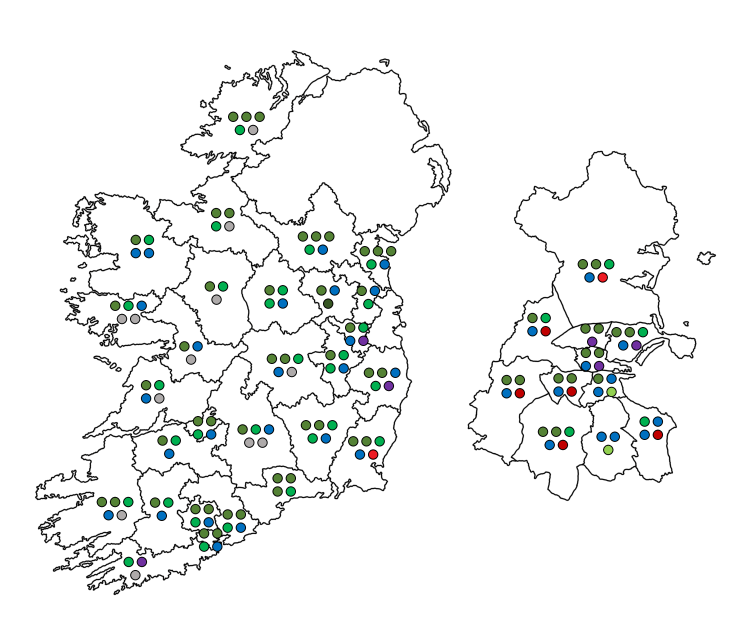
Seat Map
There were three polls in May – once again one from Ireland Thinks without breakdowns, plus B&A and Red C that have gone into the model. Once again there’s a significant gap between the two on Fianna Fáil, with B&A having them on 22% to Red C’s 15%. Given past patterns, this should come as no surprise, with Ireland Thinks sitting somewhere in the middle, but we are all used to that pattern by now.
What is a bit more interesting is that they are aligned on Sinn Féin support, which seems to be recovering at the expense of Fine Gael. Back in November ago I showed a chart showing that FG had slightly closed the gap to SF. Here’s what that looks like now:

As you can see, FG continued to close the gap for a little while longer, but now that has started to fade and we are trending towards the 15% difference opened up last summer. These trends can change quite a bit of course, and doesn’t necessarily predict the future, but it’s worth noting – especially since this is the first time since immediately after the election that we have seen FG’s average polling (by the RPA measurement) drop below 20%.
A couple of brief thoughts to follow, but if you would prefer to skip straight to the seat changes, click here.
Fine Gael Retirements
Something worth noting is that Fine Gael are now facing five retirements heading into the next election. This might not sound like much, but that’s 14% of the TDs they got elected at the last general election. Joe McHugh (Donegal) announced his intention a long time back, but he has been joined by John-Paul Phelan (Carlow-Kilkenny), Brendan Griffin (Kerry), Michael Creed (Cork North-West) and most recently, David Stanton (Cork East).
While this is obviously a problem for Fine Gael, it’s tough to assess how it fits into polling and the projection model, as incumbency effects may differ wildly from cycle to cycle and constituency to constituency – with a huge amount coming down to the quality of both the outgoing and replacement candidate, as well as things like changes in their geographical location within a constituency.
It’s also far from unheard of for incumbent TDs to lose their seats to non-incumbent running mates – in 2020, exactly that happened in no less than six constituencies.
All in all the impact makes this rather hard to measure, though I have been using historical data to put together a rough impact, it’s tough to say how reliable it is. I will note that other than in Donegal, accounting for this has not made a material difference to the outcomes, but again, this impact should not be viewed as particularly predictable.
I suppose the only positive here is, that with all four retirees being men, it gives them a little more room to hit gender quotas without being forced to run a sub-optimally high number of candidates. Fianna Fáil, who are in a truly awful position when it comes to making that quota, might want to start taking notes and giving some of their people a firm nudge.
Polling on refugees needs to stop
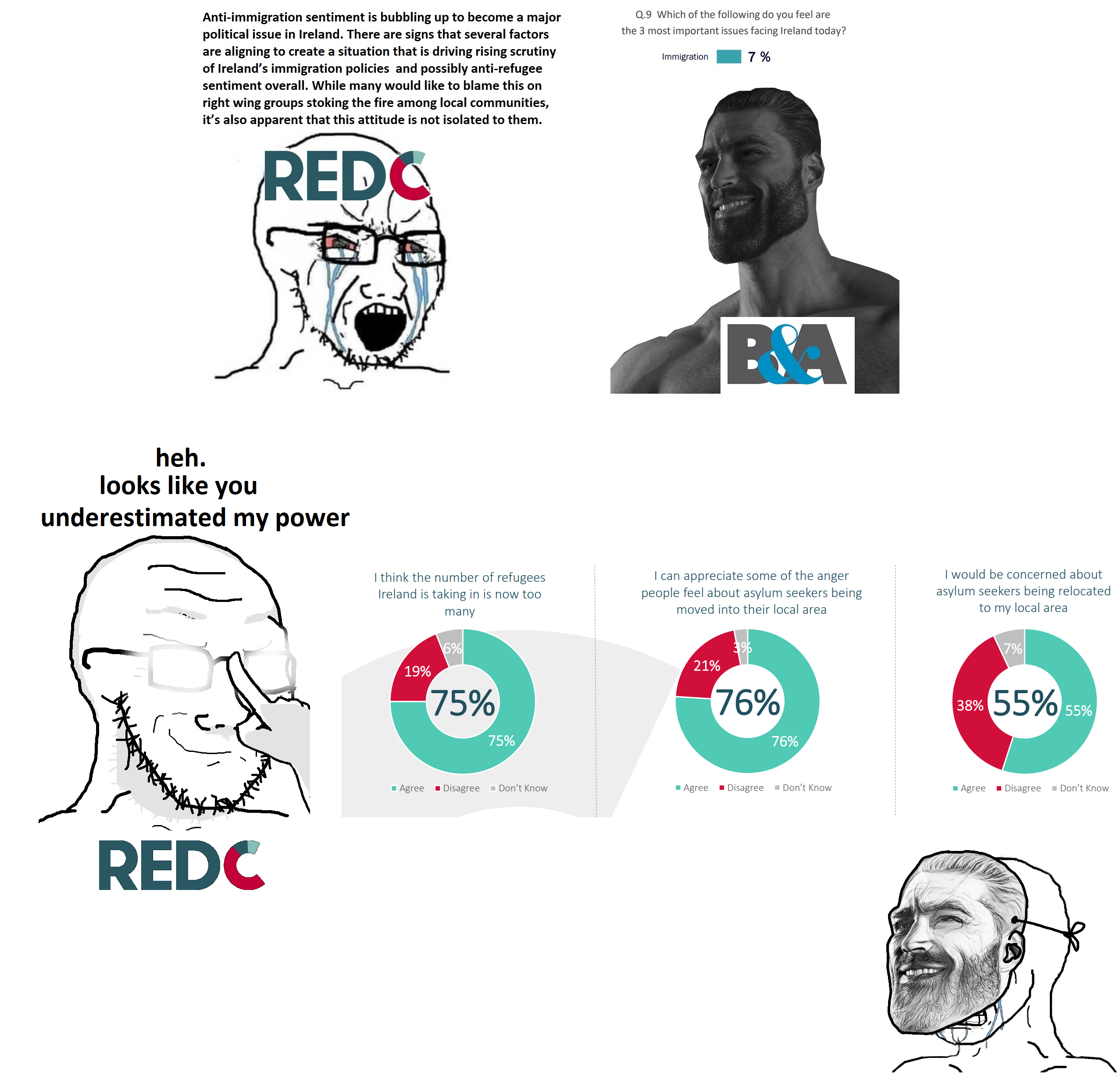
We’ve been here before, but after B&A put them back in their box last month, Red C have struck back with a new suite of polling around refugees; I feel this needs to be addressed again, which is beyond disappointing. While the blame on this fundamentally lies with the Sunday Business Post for commissioning these in the first place, Red C have again engaged in some really disappointing editorialising around the numbers themselves, casting it as a question of “sympathy” with “protests orchestrated or highjacked [sic] by far-right groups”.
Which is weird, because that’s, once again, not characterised in the questions they asked (none of which addressed protests), and also a frankly reckless line of interpretation. I mean, making this sound like this is a question of popular support for fascists – I don’t think there’s a worse way Red C could have addressed this very concerning data and I have to ask, once again, what the fuck they think they are doing.
Yes, the numbers show widespread concern around refugees, which could even be validly interpreted as the anti-refugee sentiment they tried so hard to find last time round. This is categorically not the same as support for the protesters, and again Red C have gone way beyond what the data shows in their interpretation of it. That’s a deeply worrying pattern.
And while it’s on some nebulous, academic level “good” that Red C have actually done in some way rigorous polling after the complete mess they made of things a while ago, we come back to the fundamental question – why on earth does this issue keep getting polled? Who benefits from this? What is the actual goal here? The issue honestly is that polling this stuff in and of itself is corrosive, especially with questions phrased such that the affirmative answer is the anti-refugee one.
The SBP is by and large a good, serious paper that employs good journalists. It isn’t in any way a publication with sympathy for the far-right. So why they keep trying to poll this way on this issue – and then carry Red C’s wildly inaccurate editorialising – is beyond me.
Remember, this isn’t an issue that exists in a theoretical ivory tower of psephology. This is a question of the lives, wellbeing and safety of one of the most vulnerable groups in society, who are currently coming under increasingly threatening attack by fascist elements. If there was ever a need to handle data in a sensitive, sober manner, with all appropriate checks and safeguards being made around the questions and their interpretation, this is it. Indeed, if there was ever a time to ask “can we even ask this question without putting people at risk”, this is it.
If this is how the questions are phrased, and how the analysis is spun, all they are doing is contributing to an increasingly threatening environment, something for which they will inevitably take zero responsibility when more people are inevitably hurt. Fundamentally, it is imperative this line of is stopped, ideally entirely, but if they are not capable of that, they must at the very least pause until the newspaper and polling company figure out how to handle the data ethically.
Seat Changes
This month there are still only a few changes – three in total, all of them involving Fianna Fáil, netting a small loss for the government overall.
Clicking on the linked name for each constituency should jump to the relevant section of this page. Changes on this page indicate changes from April 2023’s projections; changes on constituency pages indicate changes from current composition.
Note: The projections reflect, and always have reflected, most likely outcomes. So if a final seat is more likely for candidate X over Y, the model will show X winning the seat.
This does not mean the scenario where Y wins doesn’t exist, or even is necessarily unlikely (there’s a lot of marginal calls!). It also does not mean that every single “most likely” scenario will come true; statistically that in and of itself is probably not going to happen. This is true from from a simple probability point of view, even if we ignore deficiencies in underlying data. A projected result merely means that the model thinks X winning is the most likely outcome.
- Clare (IND +1, FF -1)
- Laois-Offaly (SF +1, FF -1)
- Waterford (FF +1, FG – 1)
It’s been a long time since the model has projected a change in Clare, but as I mentioned last month, there would probably be a change here if current trends continue. This was borne out, with Fianna Fáil sliding down and Independents moving up, giving Michael McNamara an edge. Munster is, on average, the strongest province for FF, and the only one where they are currently outpolling Fine Gael, but opportunities to gain seats, as opposed to merely not lose them, are few and far between. Clare still represents one of these, but if current polling is accurate, the chances of it happening are diminishing.
It’s also worth noting – as I’ve mentioned before – that modelling probably undervalues long-term incumbent Independents, so it would not come as a surprise if McNamara outperforms what it expects of him regardless. However, what happens with ex-Sinn Féin Independent Violet-Anne Wynne is a real wild-card; if she opts to run as an Independent, there’s a possibility that could hurt McNamara more than her former party. I currently don’t model such a scenario – and I’m not yet sure how I would – but that could significantly change the dynamics here if it does happen.
This is likely a constituency that won’t exist in its current format next time round, and all three big parties will be grateful for it, as all three would be looking to win two seats here, and that’s not possible before you even factor in Carol Nolan (IND). Yes, even Fine Gael – have a look at the transfers in 2020 if you want to see some comedically inept vote management in the face of geographical divides. So ultimately I don’t think much of this will be relevant, but while it’s all we have to work off, the model thinks Sinn Féin are now the party that will get two here.
A lot of this still comes down to assumptions about vote management and transfers so it’s difficult to be overly confident about the last seat; however it’s worth noting that geography seemed to be less of a factor for Brian Stanley (SF) than for most major party candidates in 2020. Also, I worry about Fine Gael running two candidates here if the constituency isn’t split. If their support keeps going the way it has, they might not even have a quota’s worth of FPV to work with.
Not much to note here – a reversion of last month. Despite Fianna Fáil looking weaker in Munster, Fine Gael are in even worse shape. A lot of their minor “revival” at the back half of 2022 was due to polling in Munster, and that’s now fading faster than FF’s support is dropping. As usual I’m still not convinced about that third SF seat, so both FF and FG may hold on here. Incumbent Matt Shanahan (IND), elected off the back of spare SF transfers and a monumentally incompetent strategy from FG, still has an extremely difficult path to holding on unless this constituency adds a seat.
Other notes
- Kerry: This is the closest in a long time the model has been to showing Danny Healy-Rae keeping his seat. I still personally think he will anyway, but from a modelling point of view there isn’t really a way to adjust for this short of declaring “Healy-Raes never lose elections”, which is true. If FG continue to slide I expect this will flip over, though in reality the model could be overestimating SF here.
- Limerick City: Similar to Laois-Offaly above, the model is raising flags about Fine Gael running two candidates here. Limerick City not having a Fine Gael TD is, frankly unthinkable – the party or its predecessors have always had at least one TD in a constituency containing the city since the foundation of the state. So it would need to be a huge screw-up, and I don’t think it’s likely, but interesting to see how many FG do run here. Also I think this is somewhere the Social Democrats will target hard, so what effect that might have remains to be seen.
Thanks so much for reading! This website is done entirely in my spare time and run without ads, so if you want to donate, please do so via Patreon or Ko-Fi – any support is greatly appreciated and 100% of any donations received are invested into the costs of running and improving the site.
 Irish Election Projections