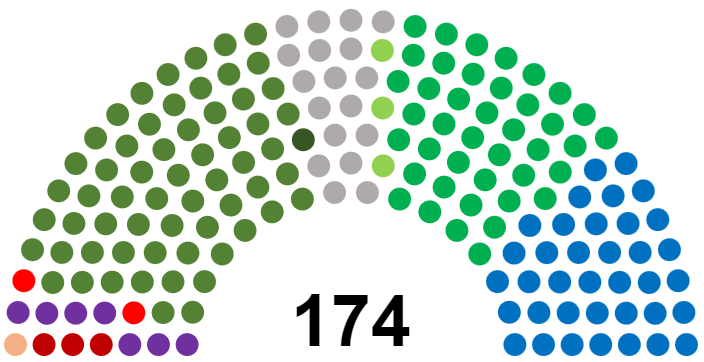
Seat totals
Sinn Féin 61
Fianna Fáil 41
Fine Gael 37
Independents 18
Social Democrats 7
PBP/Solidarity 3
Green Party 3
Labour 2
Aontú 1
Right2Change 1
Changes since October 2023
Sinn Féin -4
Fianna Fáil +1
Fine Gael +1
Independents +4
Social Democrats +1
PBP/Solidarity -3
Green Party nc
Labour nc
Aontú nc
Right2Change nc
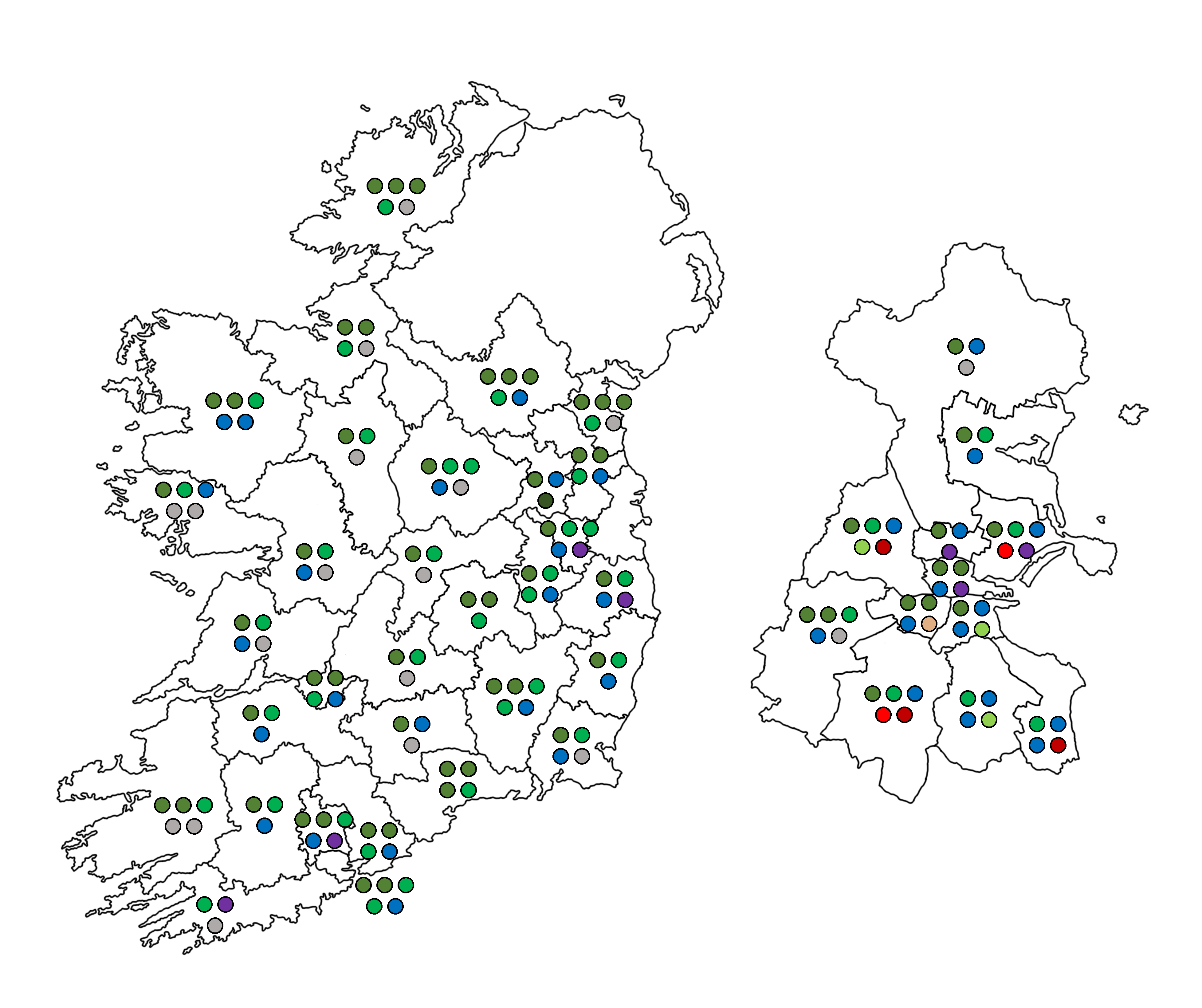
Seat Map
Since October 2023, we have only had two polls with regional breakdowns, hence the long gap between updates. Both these polls are from RedC, one in late November, the other this week in January – and the latter is a bit of a bombshell, so I will discuss this more in depth below.
There have also been three Ireland Thinks polls in the period (November, December and January) without breakdowns. While they don’t factor into the model, they are pretty close to the RedC ones, which lends support to RedC being broadly accurate. It’s worth noting that none of these polls are particularly good for Sinn Féin, all showing them at 31% or below – something that hasn’t happened in five consecutive polls since May 2021.
This is important to understand in the discussion of the RedC January poll – while it is certainly a surprising result, it is happening within the context of another downward trend in SF support. SF’s score on the RPA is 29.9%, the first time it has dropped below 30% since June 2021. For context, their average peaked at 35.9% in July of 2022. As I have talked about before, these down-and-up motions for SF tend to be cyclical, and while that is not necessarily itself predictive, overall the trend has been downward.
I’ve long advocated that the current government will see out its term, based on polling numbers. If we see this kind of trend continue, and the 25% support for SF replicated in future polling, I think that dynamic could change, and the government could see an early election as a more viable path to survival. That to me seems to be the most immediately impactful outcome of a poll like this, but I do not think any such decision will be made off the back of one poll.
On other notes, with the apparent demise of B&A (they have not put out a political poll since being acquired by IPSOS), I expect the projections to start to get worse for Fianna Fáil as we move forward, given that RedC tend to be much lower on them than B&A were. There may need to be adjustments made to the model to account for the house effects here, not to mention the number of polls included in the average if we do indeed drop to one poll a month. If that happens, as appears to be the case, I will change the update schedule of this site to quarterly.
A couple of not-so-brief thoughts to follow, but if you would prefer to skip straight to the seat changes, click here.
RedC January Poll and Sinn Féin
Let’s not mince words and get this out of the way, RedC’s January poll is bad for Sinn Féin. While we must always bear in mind not to overreact to single polls, this is a significant low point, and as above comes in the context of a depression in their polling numbers . It may be an outlier, but similar to when we saw Fine Gael start dipping below 20%, this warrants attention. 25% support is SF’s worst result since June 2020, and for a party that plans to lead the next government – and needs to do significantly better than FG and FF to do so. This is not a good sign, especially in context of the overall trend mentioned above.
The obvious question to ask is why this is happening and what is driving the decline in SF’s support, but I don’t think there’s a clear answer on it. I’ve seen two theories mostly touted, one about immigration that has some (flawed) data behind it, and is inadequate (not to mention deeply depressing). The secondary theory is about Palestine, and I believe this is flatly inaccurate, although I understand where it comes from. This post will mainly focus on the first, before briefly discussing the latter. Please be warned: the first section will be a very long piece.
Is immigration the problem for Sinn Féin?
I’m going to start this by saying two things: firstly I am completely sick of writing about this, I am sick of polling happening about this, I am sick of hearing the abuse directed at migrants and refugees, I am sick of the racist scapegoating of innocent people, I am sick of the platforms and influence the “mainstream” gleefully gives the worst actors on the issue, I would like nothing more than this completely confected nonsense to go back to being the fringe non-issue that it is and should be.
And secondly: it is confected, this is not some grassroots surge, this was a fringe view that has been advanced and facilitated every step of the way by media outlets consistently giving voice to anti-migrant voices, by newspapers desperate to create controversial copy constantly pushing the issue, by the polling companies editorialising around this until they all combined to manifest it as a problem. This is a narrative so desperate to tie Sinn Féin to the far-right that those pushing it are happy to blindly push far-right talking points. And there seems to be almost zero desire among any of these for introspection about their own role.
With that out of the way, here is the case, as presented by RedC again: Support for SF is down, support for “Others”, Independents and Aontú are up, and a question on refugees led to a broadly negative response – 66% of people saying that Ireland has taken in too many refugees, and that SF voters tend to be more anti-migrant than supporters of other large parties (something that is very well substantiated at this point). The through line does seem fairly clear when presented like that.
But of there are problems with this. Firstly, and I can’t believe we are doing this again – negatively phrased questions tend to engender negatively-biased answers, so while the “too many refugees” question shouldn’t be ignored, we once again have to question how different the response would be if it were phrased the other way around. We have plentiful examples from past polling where phrasing the same question in the same polling sample positively and negatively has resulted in two completely mutually incompatible results – this is a good example with detailed crosstabs, specifically on immigration, but we also have seen this on other issues, such as neutrality.
On that specific question about “too many refugees”, RedC have polled this exact question before, in May of 2023, and 75% of respondents said that Ireland was taking too many refugees. So we have a 9% drop in the number of people agreeing that Ireland has taken on too many refugees. That doesn’t really mesh with the narrative around increasing concern and more widespread anti-migrant sentiment. Considering that SF are down around 3% on the polling average since then, the through-line suddenly doesn’t seem super coherent. By RedC’s own numbers, even with a loaded question, Irish people are less anti-refugee than they were eight months ago, but SF’s numbers are still down.
Next, if we compare the numbers within the various voting cohort that said they believe Ireland is taking in too many refugees, we find something interesting. Sinn Féin’s number drops from 83% to 76%, which would support the idea that SF have shed a chunk of anti-migrant voters. However, the Independent number has also dropped from 88% to 81%. That doesn’t reconcile with a surge in Independent support being driven by anti-migrant voters abandoning SF – there is now clear data that Independent voters have got less anti-migrant since May (or at least have in terms of using this question as a proxy, which is what RedC are doing). It’s pretty clear that the migration-as-monocause explanation is inadequate.
Further to this, we must consider the timeframe of SF’s declining support. As mentioned above, this peaked in July 2022 and has been overall downward – with some upward swings within that – since then. But consider this – in April 2023, B&A established that immigration was not a priority issue for the majority of voters. SF’s polling decline began long before even that, in the period where immigration was a non-issue. It doesn’t track with issue polling around immigration. The upward trend in Independent/Other support does begin around this time, in May of 2023, but it also coincides with a small upswing in SF support between April and June. Below is a visual:
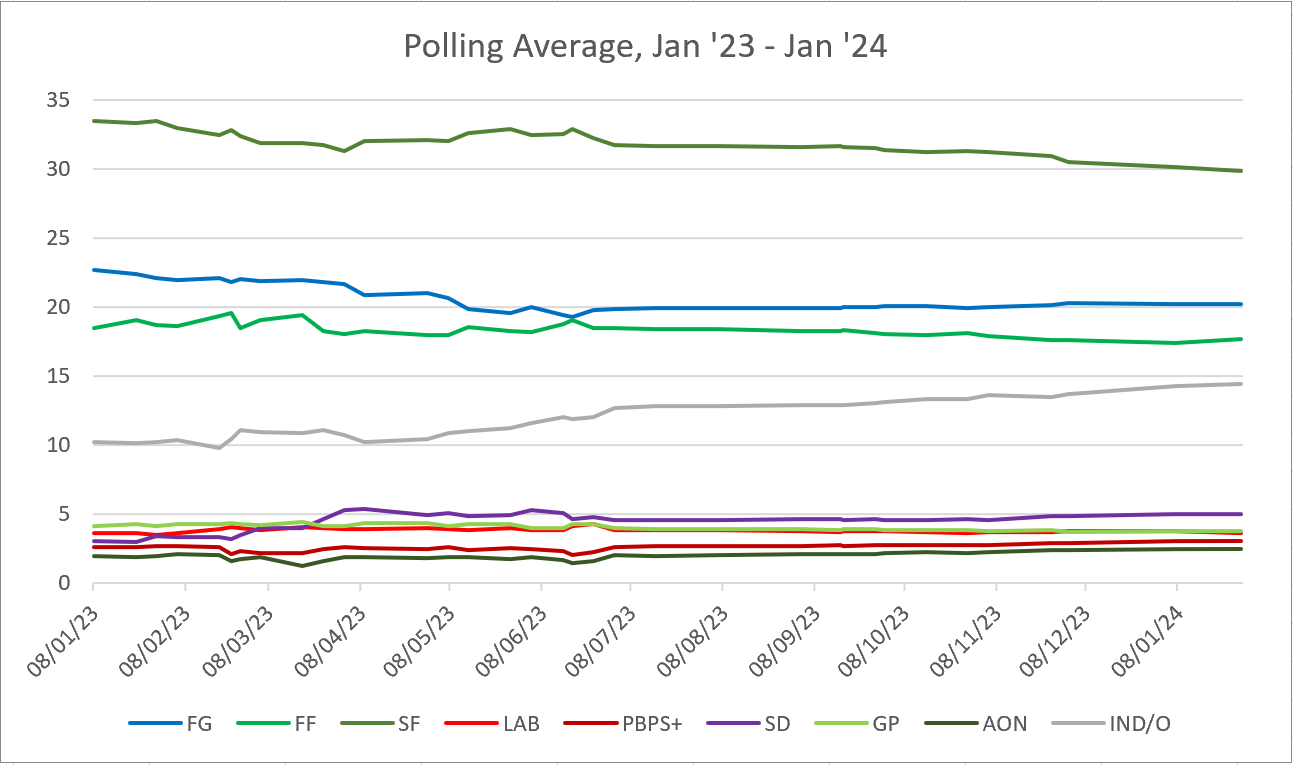
As you can see, while the trends in Sinn Féin and Independent support are pretty clear, the timeline doesn’t match up with the singular narrative that this is around migration as has been being presented by RedC for months now, or crucially, with the polling they have done around attitudes to migrants.
It’s also worth looking at the claims around “Other parties” and Aontú being used as proxies for anti-migrant sentiment. Support for “Others” is at 3%, per RedC, which does seem high. But they also explain that only a third of them mentioned a far-right party. That’s 1% support for parties that got 0.9% in the last general election. A 0.1% support increase is hardly an anti-immigrant, far-right surge.
And as for Aontú, their support is up 1%. 1% again! I am numb to newspaper columnists hyping minor changes to flog copy and stir controversy, but for a polling company to act like 1% movements are significant is the absolute height of irresponsibility – because there is no way they do know better. What we have here are tiny movements that are completely within the margin of error being reverse-engineered to provide explanations that they don’t really support. What are we even doing here anymore, man?
None of this is to say that Sinn Féin can’t or haven’t have dropped some portion of racist voters to other parties, but that the presentation of it as the singular cause is at best disingenuous, and the determination we see to make this the narrative is highly questionable. In the very same poll, there’s a question about the reintroduction of the higher level of VAT on the hospitality sector. It has similar levels of opposition as the refugees question (64% vs 66%).
This is a government policy that Sinn Féin do not oppose. Yet (rightly) nobody is proposing this as a the singular cause of a drop in their support, and no great narrative has been spread about people switching their votes to protest the price of pints and toasties – though this directly impacts far more people’s day-to-day lives than refugees do. One could even, if one wished to do so, use this as a proxy question around the cost of living. A choice has been made here.
Is Palestine the problem for Sinn Féin?
The other theory I have seen, mostly in a social media setting, is related to Palestine and the war in Gaza. I’ve seen variations of this stating either that Sinn Féin are too radical on the issue for the average Irish person, or that they are insufficiently radical for a left-wing support base. I don’t find either of these plausible, and the rationale is very straightforward: the decline in their vote isn’t being met with a commensurate rise in support for parties either more or less radical on the issue. If SF being too radical, one would expect support to go to Fine Gael or Fianna Fáil. If they were insufficiently radical, one would expect support to go to PBP. Neither of these have happened (more on PBP’s challenges in a later section).
There is no evidence that Palestine is a significant driver of vote-switching at the moment. My feeling is – and this is just my feeling, so take that for what it is – that SF aren’t massively out of line with how a lot of Irish people feel on the issue, and also have people with highly credible histories of pro-Palestine activity in their ranks – Aengus Ó Snodaigh and Chris Andrews are a good examples. SF are a known quantity on the issue; it’s unlikely there’s a vast swathe of voters are suddenly finding out they are pro-Palestine and abandoning them. On the other hand, people who feel SF are insufficiently radical on the issue, and feel deeply enough about it that it’s worth voting for another party over, probably already vote for other parties with more radical positions, and we have seen no uptick in support for PBP. There may be some people who are doing this, but if it is happening, it’s not in significant enough numbers to have an impact on polling. This isn’t a new issue, after all.
Ok, so what the hell is going on?
Ultimately, I think looking for monolithic explanations is really insufficient. While Sinn Féin supporters are indisputably more reactionary on immigration than FG or FF voters, the centre-right parties also have vast swathes of support that hold those views, and they are the ones currently controlling the country’s immigration policy. It is also worth noting that SF are not a radical-left party on the question of migrants, that’s a confected narrative too. Look at page 70 of their 2020 manifesto; they barely have a policy at all, but the stub there is explicitly anti-open-borders and market driven.
There is no doubt that recently a significant group of people have been moving towards supporting Independent candidates over political parties, but trying to point to a singular cause for this apparent disillusionment is not substantiated by evidence. I think something interesting is to look at the January poll in contrast to the last General Election, rather than the last poll:
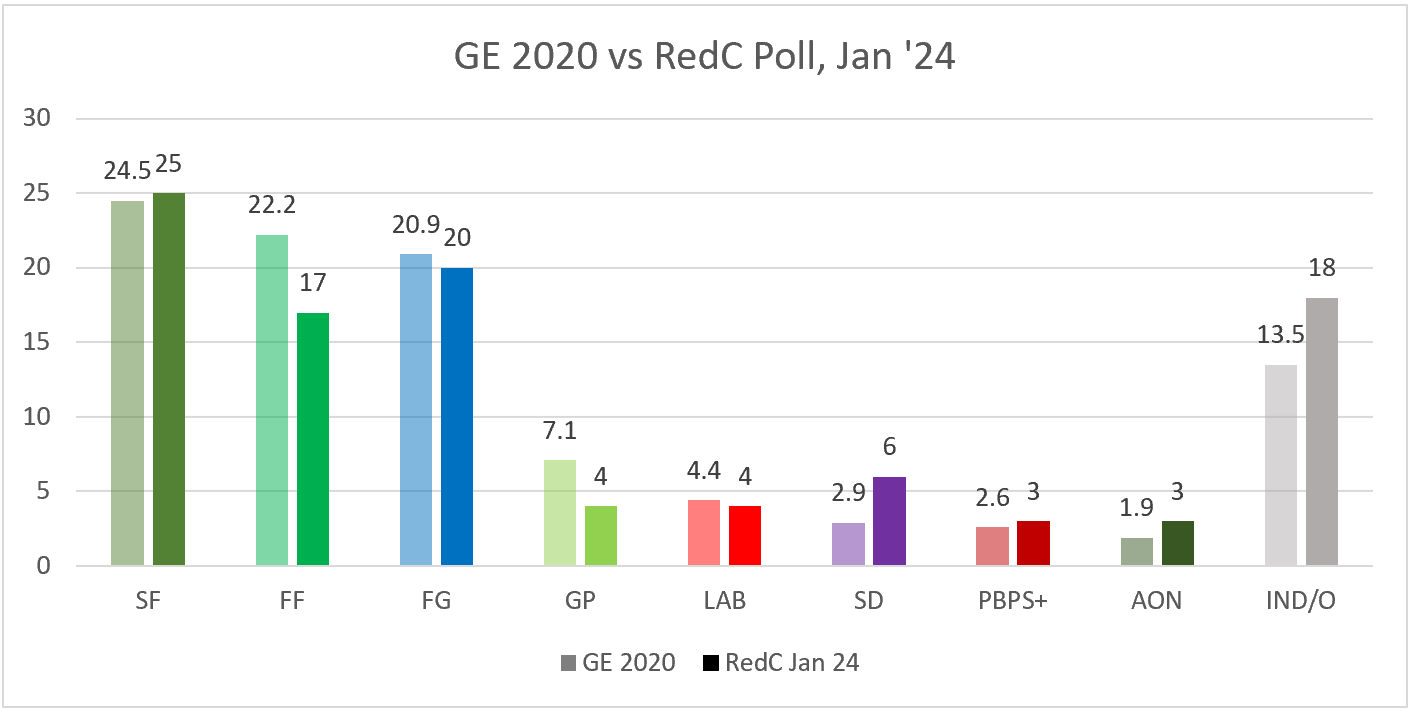
If we interpret SF’s GE result as a kind of “core” vote, it is more or less intact. The big downward changes since the election have been for Fianna Fáil and the Greens. I have a theory here, and it is only a theory, athough here that I believe is worth considering – we have seen a lot of ex-FF voters move their party support around since the GE, and it is these, rather than long-term SF supporters, who make up the majority of the Independent surge. This isn’t good for SF by any stretch – they need to win over and hold these people if they want to lead the next government, of course. But I find it a plausible factor and something that should at least be considered when considering who would be switching support from SF to Independents. And this should also be considered when assessing the narrative around immigration.
Furthermore, it is broadly implausible that SF are the only ones who would suffer from shedding a chunk of racist voters. And that’s not just an assertion; I have data to back this up, which I hinted at last month and I will finally discuss on this site further down below.
As to what is the cause behind this, I am going to say something that I wish people with far more reach and influence than I have would be comfortable saying – I don’t know. There is clearly a pattern of disillusion with the major parties playing out at the moment, but the arguments that there’s a single factor are completely unconvincing and are not supported by the current data. There’s a multitude of things going on and only a very small number are being focused on at the moment – we haven’t seen polling around housing, health or education in a while. Without this information, conclusions are being drawn from an incredibly partial picture.
And also, I must repeat again – another poll could come out in a month showing this to have been a statistical outlier, making everyone discussing this, including me, look foolish for wasting their time chasing ghosts.
Problems Before Profit
This is the worst projection for People Before Profit/Solidarity in a while. I will caveat this by saying that their support tends to be very geographically condensed and often underpolled in those areas (which the model does try to adjust for), so their polling should probably be viewed as a bit less accurate than other parties, but there’s an overall problem for them here: a drop in Sinn Féin polling should benefit PBP, but the effect is the opposite.
Firstly and most obviously, the poll numbers themselves – PBP have had a pretty clear strategy of attacking SF from the left, but this does not seem to have had any impact in peeling off support, even during the biggest polling drop we’ve seen for Sinn Féin in a very long time. Consider their polling among 18-34 year olds this month – which tends to be PBP’s strongest age demographic. They are on 6%, whereas the Soc Dems are on 13%; this is a significant gap.
That does raise concerns, given that a lot of their seats aren’t held by huge margins, they have one of their biggest names leaving the Dáil and not a huge number of obvious breakthrough opportunities to gain seats – although local elections may reveal more on the latter.
But secondly, as we saw in 2020, PBP were in many areas contingent on SF transfers to get over the line, as first-preference dynamics swung against them. A contraction of the SF vote without a commensurate increase in their own hurts them in several constituencies, with smaller surpluses available. Similarly, SF would be less likely to run expansive candidate numbers, potentially reducing the overall number of transfers available. This has immediately had impacts in the model this month – three seats they were favoured to hold are now more likely to go elsewhere, although they remain close.
There are of course some exceptions to this – Ruth Coppinger in Dublin West in particular has better odds of reclaiming her old seat the more the SF vote drops – but overall it creates more challenges for PBP than it resolves. If SF are indeed slipping backwards, PBP needs to start pulling more first-preference votes off them, as right now they look vulnerable.
Where do Far-Right votes come from?
Alright. I’ve been sitting on this since February 2021, and while I’m still in two minds about publishing it, I think its now important to counter some of the utterly misconceived perceptions circulating in the mainstream about support for far-right parties. I did talk about this on the Tortoise Shack a little while ago so I’m putting it here as well. I will preface this by saying that the far-right, while certainly eager to demonstrate the widespread violence and terror a small group can cause, remain utterly electorally insignificant, polling a combined 1% base on RedC’s figures.
In brief, this analysis looked at transfers to and from far-right candidates during the 2020 election. The scope of this was the Irish Freedom Party, the National Party, Renua and far-right-aligned Independents. This latter part required a deep dive on every single Independent candidate who ran in 2020, which would have been impossible without the Irish Election Literature archive, so I am deeply indebted to Alan Kinsella and his stellar work. Even with that, I acknowledge that interpreting this for Independents is a fuzzy line so bear that in mind.
There were two parts. The first was a look at how many votes from surpluses went to far-right candidates. Unfortunately this was of limited utility as only Sinn Féin managed this with any consistency. While this did reveal that, on average, where a far-right candidate was available (this is an incredibly important caveat), 4.9% of surplus SF votes went to them, this figure is meaningless without having other parties to contrast against it. It is fair to say it feels high, but again, without context from other parties, it’s difficult to draw any firm conclusions.
What is more revealing is looking at the reverse – i.e. where did far-right voters transfers go when they were eliminated? This should give us a decent idea of where those voters’ sympathies broadly lie. The below does not include elected candidates (no transfers) simultaneous eliminations (unable to disambiguate) or non-transferrable votes, and is normalised to 100%.
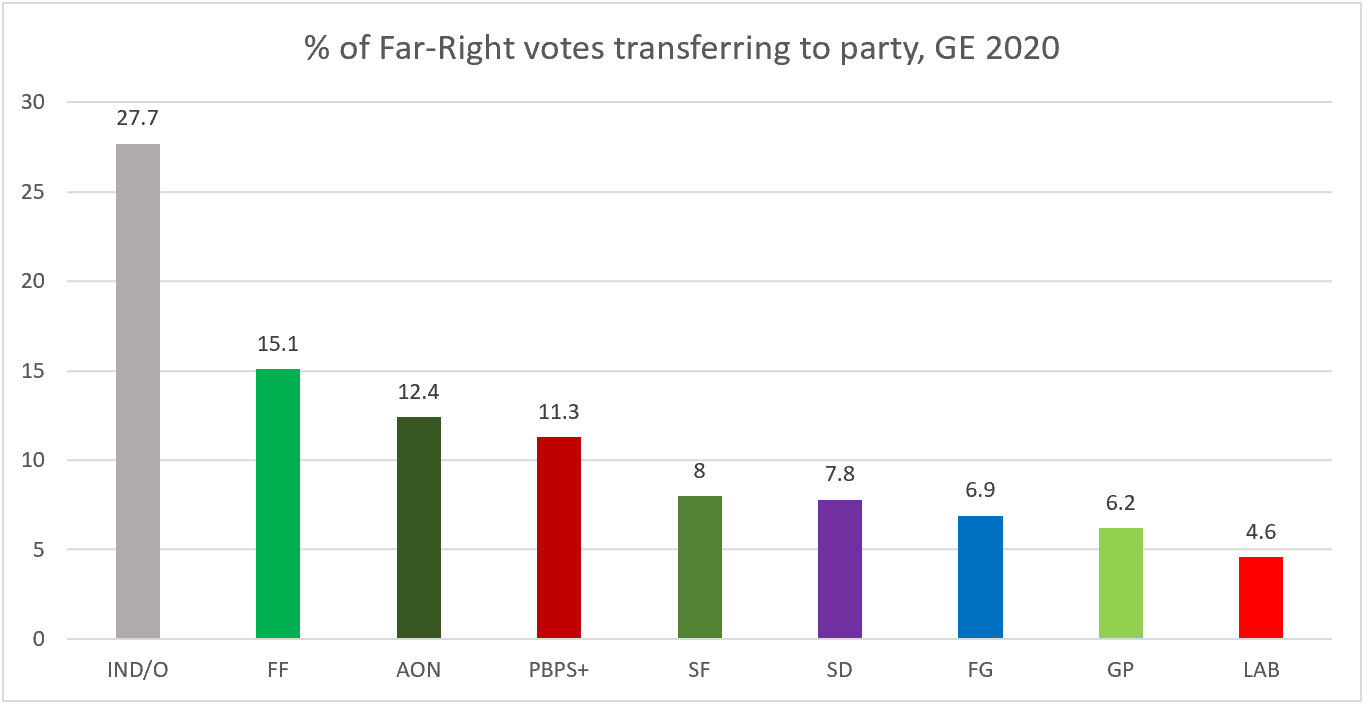
Independents being at the top should not be a surprise at all, given the general antipathy of the far-right to the “political establishment” as a unit, nor should the position of Aontú (some people would argue that they are themselves far-right). Similarly, the low position of Labour and the Greens makes sense, given that the far-right spend a bizarre amount of time screaming deranged abuse at them relative to the influence they have because, I dunno, Eamon Ryan and Ivana Bacik are Chinese Jewish communist illuminati capitalist globalists or whatever laughable conspiracy nonsense the fash are going on about.
Fine Gael being relatively low makes sense as well, the far-right are obsessed with Leo Varadkar because of his sexuality and parentage, and there is residual malice towards Fine Gael from the repeal of the 8th amendment and marriage equality referenda.
The rest of it, however, defies a lot of the conventional wisdom we see in coverage of these groups. Outside of Independents, Fianna Fáil are the biggest beneficiaries of far-right parties vote transfers. Sinn Féin are in fifth, barely ahead of the Soc Dems. Yet we see constant conversation about the links between SF and the far-right and how it is SF support bleeding into it, not FF, despite this evidence that the far-right’s votes actually far more aligned to FF than SF. Not only does the polling data not really support the discussion of SF as some kind of unique case, as discussed extensively above, neither does the actual voting data from 2020.
To illustrate this a bit more: if the Soc Dems are, based on this data, roughly as palatable to the average far-right voter as SF are, why do we never hear about that? Possibly because the SDs aren’t a meaningful threat to the centre-right, so there is no need to try to tie them to the far-right, but also because it just sounds silly. There’s a widespread perception of Sinn Féin as “shady” plus their long history of being tied to paramilitaries and operating outside of democratic structures. That’s a much easier sell than pretty much any other party, no matter what one feels about it. The idea that either SF or the SDs have some special affinity to the far-right is not correct, but only one of these claims would be perceived as prima facie ridiculous.
Now, to be fair, SF have not helped by failing to deal with party members, including elected reps, who have dabbled in this area, but that is far from a unique problem; Fianna Fáil and Fine Gael have exactly the same issues, and even Labour and the Greens have run into it on occasion. This is not a unique SF issue, although perhaps it is reasonable to expect a higher standard from the party that claims it wants to lead the left.
As for PBP – and I can hear the distant screams of “horsehoe theory undefeated!” emanating from Merrion Street – that I think can be explained to a large degree by incoherent anti-establishment sentiment. I’d also suggest that given that a number of far-right-aligned Independents talk about having been party of the anti-water charges movement in their literature, that association is a possible factor as well, despite the vast political gulf that exists in reality (particularly on immigration!).
The main conclusion to this should be is that finger-pointing and point-scoring over the far-right, trying to use them as a tool to attack political rivals does not help deal with it. Although the overall amounts are small, the problems exist all over the spectrum, and any party trying to wash its own hands of it or pin it on others are being, at best, extremely naive as to how all this works. The numbers reflect this when we look at where the secondary sympathies of far-right voters lie. Nobody is immune and the juvenile attempts in media and politics to make this a Sinn Féin-only problem are utterly fatuous.
Seat Changes
There are nine changes this month, which is the most we have had in a while. A couple of these are reversions, and we can see the impact of the changes in votes for Sinn Féin and Independents – and the knock-on effects on PBP, as discussed above. Most of the changes are in Dublin and Leinster, with only one outside of there.
Clicking on the linked name for each constituency should jump to the relevant section of this page. Changes on this page indicate changes from October 2023’s projections; changes on constituency pages indicate changes from current composition.
Note: The projections reflect, and always have reflected, most likely outcomes. So if a final seat is more likely for candidate X over Y, the model will show X winning the seat.
This does not mean the scenario where Y wins doesn’t exist, or even is necessarily unlikely (there’s a lot of marginal calls!). It also does not mean that every single “most likely” scenario will come true; statistically that in and of itself is probably not going to happen. This is true from from a simple probability point of view, even if we ignore deficiencies in underlying data. A projected result merely means that the model thinks X winning is the most likely outcome.
- Cork North-Central (SD +1, PBP -1)
- Dublin Bay South (FG +1, LAB -1)
- Dublin Mid-West (IND +1, PBP -1)
- Dublin South-Central (FG +1, PBP -1)
- Dublin South-West (LAB +1, SF -1)
- Longford-Westmeath (IND +1, SF -1)
- Louth (IND +1, FG -1)
- Wexford (IND +1, SF -1)
- Wicklow (FF +1, SF – 1)
When Cork North-Central was redrawn, I noted that Fine Gael, People Before Profit/Solidarity (Mick Barry is in Solidarity, but is categorised here as PBP for consistency), the Social Democrats and Labour were all pretty tight for the final seats, with Independent Kenneth O’Flynn not far behind. That’s still the case, although FG have pulled clear a bit, so some shuffling here should not be too surprising, although I think an SD seat here would be a bit of a surprise.
So why is the model showing this? As discussed during the redraw, Ballincollig makes up a big chunk of the new constituency, and was an SD stronghold in 2020 when it was in Cork North-West. The nuance here is that in 2020, neither PBP or SF ran there, so there is a significant margin for error in the calculations in adding it to the constituency and trying to work out what the SF/PBP vote will be there. In addition to this, SD polling in Munster is relatively strong. As ever, it’s hard to say exactly how this will map in areas where support is highly geographically concentrated, and small polling fluctuations impact small parties disproportionately. The last seat here remains very interesting.
Fine Gael’s polling in Dublin has been improving since we last looked here, and this continues to be a volatile, competitive constituency, so now two seats is very much back on – though they were never in a position where running two candidates was a bad idea. So far Fine Gael have only nominated one candidate, Cllr James Geoghegan, who had a very disappointing outing in the Dublin Bay South by-election. I do feel that FG will end up adding another candidate here, but if they do only run one, that means two things (a) FG have given up any ambitions of leading the next government entirely and (b) the dynamic in the constituency will change massively as on current numbers, FG will end up with a substantial surplus.
I still think this is a hard one to have certainty on and that Labour will overperform their numbers here based on Bacik’s personal vote. This will almost certainly, and I know I am repeating myself here, be extremely messy between her, a second FG candidate (if they run one), Fianna Fáil and the Greens, and the margins on the model are extremely fine – a couple of tenths of a percent either way. Even without a second FG, little is clear here beyond the first two seats (FG and Sinn Féin).
Find you a partner that looks at you like this model looks at Paul Gogarty. Once again the model favours the ex-Green TD to regain the seat he lost in 2011 and has been trying to win back ever since. There has been a significant upswing in support for Independents in Dublin, and that is part of it, but it’s not the whole story. With the Sinn Féin vote contracting, a smaller amount of transfers are available than the model accounted for before – and this hurts Gino Kenny (PBP) disproportionately.
Now, with that said the model is still operating under an optimal scenario for SF where they run three candidates – if their polling average continues to drop, this may no longer be the case; I’m not sure what impact that would have on everyone else at that point, but it’s worth noting. Also, Fianna Fáil’s vote here doesn’t look great and I suspect will drop as we get more RedC data, so the projection that they win back the seat they lost in 2020 could also be one that changes soon – and that would put Kenny back ahead of them.
With the current downward trend in Sinn Féin votes, the presumed surplus here becomes very tight, and that hurts People Before Profit more than anyone else – and sees them slipping behind Fine Gael, who are holding steady in Dublin at a figure above their GE 2020 result. As a result of the SF decline, I have reduced their optimal number of candidates from three to two, which also reduces the theoretical number of transfer open to PBP.
There’s still a fair amount of uncertainty here about how the PBP vote will hold up with a new candidate, but it is likely going to be more difficult to hold than it was when assuming Bríd Smith would run again. Further changes to the SF vote again could have a lot of knock-on impacts here.
This was a surprise to me initially. I thought the Labour vote here was always reasonable under the model, but never had them in the running for a seat, but then I looked back at October and I saw I had overlooked something – they were extremely close then, and weren’t miles off in the redraw calculations either. This is something I should have spotted but didn’t – so let’s talk about it now. (I am never beating the anti-Labour bias allegations, am I?)
Labour are doing okay in Dublin overall, somewhat up on their GE 2020 performance, but down a little from their mid-2022 peak. But the key factor here isn’t actually Labour’s support itself. Firstly, and most importantly, they stand to gain quite a bit from the decline in Green Party support, if they get ahead of the Greens, that’s likely to throw a bunch of transfers their way. Secondly, the downswing in Sinn Féin support has now reached a level where a second SF candidate is likely to be catchable, although as ever this will depend a lot on how the vote is split (the model thinks SF are likely to accumulate ~1.5 quotas, which is an extremely tricky number). Thirdly, there are assumptions made around the former Zappone vote based on a number of factors; this is potentially problematic but that chunk has to be accounted for, and Labour do fairly well in that calculation.
So based on this the model does favour Labour, but it’s also worth keeping an eye on the Soc Dems, who are pretty close here, and of course it will not take much of a reversal in SF’s fortunes to have them favoured for a second seat here again.
A reversal of last month’s projections, hardly a huge surprise in the context of a decline for Sinn Féin and an increase for Independents. The caveat to bear in mind – assuming of course that SF to attempt to win two seats here – is that the split between their two candidates could change this outcome without the vote totals moving. Right now the assumption is based on historical data, as I have discussed before elsewhere, but there’s certainly potential that extremely precise vote management could still win them a second seat on these numbers.
Transfers are also an issue here as ever, with the geographic split between the two counties having outsize impact; there’s a lot going on here underneath the headline figures and this remains a tricky one to be greatly confident in the projections.
Interestingly, this change is less to do with increases in Independent polling and more to do with the planned retirement of Fine Gael TD Fergus O’Dowd, which leads to a projected downgrade in their FPV based on a generic candidate. However, this could change substantially because while Fine Gael only hold five seats on the council, they have two ex-councillors with high profiles – MEP Colm Markey and Senator John McGahon.
Now, if I’m Fine Gael I’m not letting someone with McGahon’s chequered past anywhere near a Dáil seat, but I’m not Fine Gael, and clearly the party has plans for him – he was their lead FG candidate on his panel in the Seanad elections, he’s been appointed a spokesperson and has been put forward for plenty of media appearances. Markey, on the other hand, is significantly older, represents a lower-population town (Ardee vs Dundalk) was a substitute into the European Parliament and, unlike McGahon, has never contested a Dáil election. I would expect either one of these to outperform the current generic number for FG (I expect McGahon to be the candidate).
The beneficiary of this at the moment is former Fine Gael man Peter Fitzpatrick, a three-term TD currently sitting as an Independent. Given his background he seems a natural fit for voters who might move away from Fine Gael, and he pulled in transfers from all over the place in 2020. On the other hand, his FPV performance wasn’t stellar and he is very much a Dundalk candidate – which is exactly where McGahon, if he is the candidate, will have his support base. But with that said, Fitzpatrick did comfortably beat McGahon in 2020. There’s a lot of different dynamics at play here with a Dundalk-based candidate that weren’t a factor with the Drogheda-based O’Dowd.
If I wanted to cherry-pick something that would support the narrative around Sinn Féin losing ground to anti-migrant independents, this would be the constituency I’d focus on. As they trend in opposite directions, the model now very slightly favours anti-migrant Independent TD Verona Murphy holding her seat instead of losing it to second Sinn Féin candidate. Murphy came seventh in FPV in a five-seater in 2020, and got enough transfers to push her into the third seat; the model sees something similar happening in the new four-seater, which has retained most of her strongest areas.
There are still a lot of questions here since the redraw and Labour’s Brendan Howlin announcing his retirement, but the new boundaries do favour Murphy, and she’s poised to take advantage if SF and Labour struggle, though it should be noted that SF’s vote management could turn out better than the historical data used in the model suggests. It’s also worth noting that Fine Gael’s numbers here do not look great, but that is a lot to do with where their candidates in 2020 were based and how the redraw affects them, a different candidate may have a very different outcome. And finally, the model assumes Independent Cllr Ger Carty runs again, until proven otherwise. Any or all of those changing could have significant impact.
Stephen Donnelly returns in the model, albeit by a margin that is almost non-existent, so the last seat here should be considered a coin-flip on current numbers, and there are many ways that Sinn Féin could vote-manage their way a second seat with these numbers. Still, it’s a sign of how things are going that what were very close edges to SF a few months ago are now going against them, though it would take minimal movement to reverse something like this.
Fianna Fáil, for what it’s worth, are running ahead of Fine Gael in Leinster on current polling; Fine Gael are absolutely nowhere near threatening for a second seat here. While the model still assumes two candidates, if they do only opt to run one, that could have some interesting knock-on effects, and would probably hurt FF by reducing the amount of transfers available.
Other notes
- European Elections: A couple of notes here following last month’s post, where the leaked poll predicted the wrong candidates: PBP are running Bríd Smith, not Paul Murphy. Smith a good candidate, but has a very significant overlap geographically with one of SF’s candidates, Daithí Doolan, which could hamper one or both of them. Also, Labour did ultimately select Aodhán Ó Ríordáin, as I suspected they would – so it seems they are taking this seriously by putting forward as a strong a candidate as they can, although it will be difficult for them to challenge for a seat.
- Dublin Fingal East: I don’t think I have mentioned this before but Dean Mulligan (Independents4Change) does have a path to a seat. It’s very marginal and I wouldn’t be super confident in the numbers pointing this way, but I do think it’s worth pointing out in case it does come up later if Independent polling improves in Dublin.
- Roscommon-Galway: Looking at the numbers here – Fianna Fáil and Fine Gael don’t look great – there’s a lot of space for another Independent to emerge to push for a seat alongside Michael Fitzmaurice. Now, it would need to be the right person, but I think we could see this constituency heavily targeted by Independents and some of the newer right-wing groupings like the
AstroturfAllianceFarmer’s Alliance.
Thanks so much for reading! This website is done entirely in my spare time and run without ads, so if you want to donate, please do so via Patreon or Ko-Fi – any support is greatly appreciated and 100% of any donations received are invested into the costs of running and improving the site.

