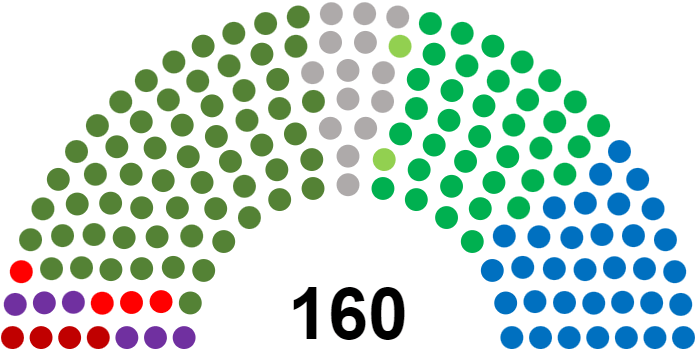
Seat totals
Sinn Féin 60
Fianna Fáil 36
Fine Gael 34
Independents 14
Social Democrats 6
PBP/Solidarity 4
Labour 4
Green Party 2
Aontú 0
R2C 0
Changes since May
Sinn Féin -1
Fianna Fáil +2
Fine Gael -3
Independents +2
Social Democrats nc
PBP/Solidarity -1
Labour +2
Green Party nc
Aontú -1
R2C nc
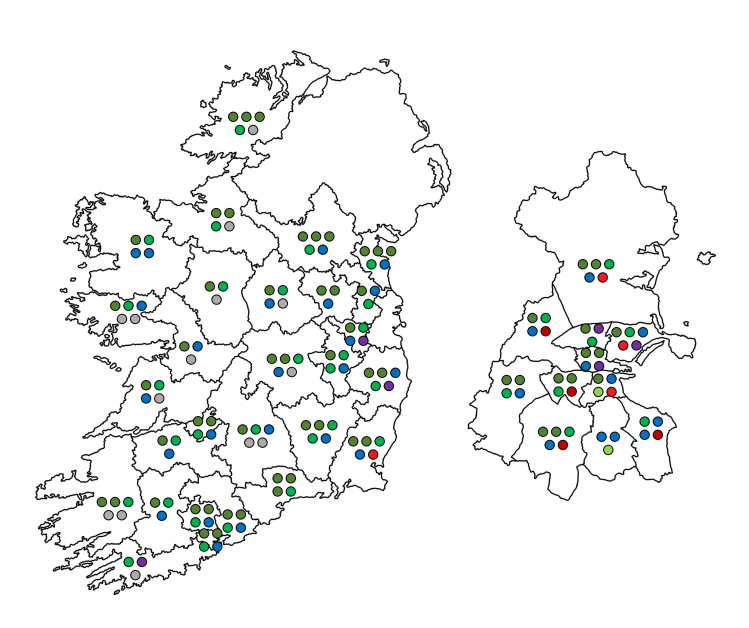
Seat Map
There were four polls in May – once again one from Ireland Thinks without breakdowns, plus IPSOS, B&A and Red C that have gone into the model. The polling is on a national level, closer than usual, with the only big difference being Sinn Féin, who followed a 34% in B&A with 29% in RedC, both causing over the top reactions. Realistically, what’s happened here is we got a poll at the top of their range followed by one at the bottom, which made it look like something bigger had happened. In reality it feels like normal polling variance though.
The reason this post is late coming out is because B&A didn’t publish their crosstabs for a while, meaning I assumed they wouldn’t and had a post ready to go. I then had to re-do everything once they did publish them – and then had to write a lot in light of their issue polling. More on this below.
Despite what I said above, things aren’t good for Sinn Féin at the moment. Their support has been slowly trending downwards since July, and although the gap bewteen them and FG has opened up again after it closed a little bit, they seem stuck. Their main saving grace is that FG are also in a similar rut – the main beneficiary at the moment are Independents. But SF have a much, much bigger problem. We’ll come to that.
As for other parties, Fianna Fáil had a great month in Dublin and remain dangerously close to overtaking FG on polling averages, but aren’t showing any strong movement overall. The Soc Dems remain the biggest small party, but their little bump hasn’t turned into any kind of meaningful surge pointing at a wider breakthrough. Labour and the Greens still flirt with oblivion, with good polling this month in Dublin for both offsetting their bigger, long-running problems. People Before Profit/Solidarity is the same as ever – likely to do well in its strongholds, but with no indications of broadening or deepening support. And Aontú, I have decided, aren’t real.
A couple of brief thoughts to follow, but if you would prefer to skip straight to the seat changes, click here.
Polling on NATO/neutrality
I want to discuss two areas where we have seen a lot of issue polling recently – the first of these is around Ireland’s neutrality and NATO. The government has been flirting for a while with the idea of ending Ireland’s neutrality and/or joining the military alliance. This has been driven by weird commentary from failed politicians as much as it has been by actual ministerss, but it did give the Green Party another opportunity to row back on yet another core principle, so that’s nice for them.
The backdrop to this, other than the Russian invasion of Ukraine (which listening to some people you’d think Ireland was an active participant in), is the elegantly named Consultative Forum on International Security Policy. This itself has been controversial, as opponents said it was a one-sided, unrepresentative stitch-up that disproportionately platformed pro-NATO views and moved away from the Citizens Assembly model in order to ignore popular sentiment. On the other hand, proponents of the Consultative Forum said actually shut up no it isn’t and if you disagree you are a communist saboteur who should be kicked out of the event.
While all this was going on, there was some polling around the issue that got, predictably, misinterpreted. Firstly, the Irish Times got overexcited and reported that 56% of people wanted to join NATO, when the IPSOS poll they commissioned actually indicated it was around 14% (56% of the 26% who wanted to change Ireland’s neutrality).
Later in the month, the Red C poll asked a straight question on NATO membership. This was 34% in favour, 38% opposed and 28% unsure. This got pro-NATO people very excited! It looks really close! In Ireland of all places. But how do we reconcile this with the IPSOS poll showing 61% support for neutrality, 26% against it and 13% with no opinion, and just 14% in favour of joining NATO?
Very easily actually. There’s a simple bridge here – once people are asked about the actual effects of joining NATO (i.e. the necessary abandonment of neutrality), the idea is way less popular. Once the idea is taken from the abstract and a real effect is presented, public opinion becomes clear.
Something very worrying for Sinn Féin
There’s been a lot of talk this month about the Red C poll, which was very bad for Sinn Féin. As mentioned above, I think this is overblown in one sense, although SF certainly are continuing to slowly trend down at this point, and their performance of late in Dublin ought be of concern to them. However, I don’t think this is the biggest problem they face this month. That comes from B&A’s issue polling.
Despite establishing a few months ago that immigration isn’t a priority political issue for over 90% of Irish people, the Sunday Times picked up where Red C and the SBP left off last month, desperately trying to find a question that would make Irish people admit that they are racist.
I didn’t really want to cover this because my view on this should be clear by now – it’s irresponsible to even ask, the issue is being unduly elevated, and real people are getting hurt because of this media obsession, and the polling on it should end. However, there is something in there that I think does need to be addressed.
On every single question asked – and there were a lot – Sinn Féin voters were the most anti-immigrant, anti-refugee and anti-asylum-seeker cohort by political party support. This is really worrying. SF have developed an unfortunate habit of generating xenophobic rhetoric from a small group of their councillors, of which Aidan Mullins is the latest – going so far as to join a far-right Twitter space to espouse his views. As of the time of writing it does not appear Cllr Mullins, who has been espousing these views for months, has suffered any consequences. And let’s not even get into what it said in their 2020 manifesto…
Sinn Féin have some superb activists – including elected reps – on this issue, but they are failing as a party on this issue right now. We have seen them be ponderous in their response to anti-migrant violence, haven’t addressed it in their own ranks, and this polling drives home that aren’t leading their supporters the right way on the issue.
SF want to lead a government of the left – and it does not bode well that they are struggling to lead on this issue, most of all where the calls are coming from inside the house. A government of the left has a moral imperative to stand up for all marginalised people, and that is doubly incumbent on the only party that can plausibly lead that government. Because if it does not, who will?
Seat Changes
This month there are more changes than we have seen recently – eight constituencies, mostly driven by poor polling for Sinn Féin and Fine Gael and improvements for Independents, as well as Fianna Fáil and Labour scoring a number of strong showings in Dublin in recent months. Interestingly, none of them are reversions from last month.
Clicking on the linked name for each constituency should jump to the relevant section of this page. Changes on this page indicate changes from May 2023’s projections; changes on constituency pages indicate changes from current composition.
Note: The projections reflect, and always have reflected, most likely outcomes. So if a final seat is more likely for candidate X over Y, the model will show X winning the seat.
This does not mean the scenario where Y wins doesn’t exist, or even is necessarily unlikely (there’s a lot of marginal calls!). It also does not mean that every single “most likely” scenario will come true; statistically that in and of itself is probably not going to happen. This is true from from a simple probability point of view, even if we ignore deficiencies in underlying data. A projected result merely means that the model thinks X winning is the most likely outcome.
- Dublin Bay North (LAB +1, SF -1)
- Dublin Bay South (LAB +1, FG -1)
- Dublin Mid-West (FF +1, PBP -1)
- Dublin North-West (FF +1, SF -1)
- Dublin South-Central (FF +1, FG -1)
- Kerry (IND +1, FG – 1)
- Longford-Westmeath (IND +1, FF -1)
- Meath West (SF +1, AON – 1)
Bad month in Dublin for Sinn Féin, good month for Labour. With Fianna Fáil and the Soc Dems also doing well in the capital, this change shouldn’t be surprising in a constituency that remains really hard to predict and consistently throws up fine margins for the final three seats.
It is worth noting of course that the model has to make assumptions about SF vote management where they run two candidates, and there are scenarios where a split is managed well enough to bring both home on current numbers, but it would be very tricky to engineer that on the ground, so right now the model does not favour them gaining a second seat.
This, for the first time in a while, is where I think we will actually end up in Dublin Bay South – one each for Sinn Féin, Fine Gael, Labour and the Greens. Now, I wouldn’t put any stock in what I personally think will happen either, but it is interesting to see the model end up in the same place, even if I suspect it will change again soon.
Right now, Fine Gael aren’t in a position to be favoured to win multiple seats here – hovering marginally above their 2020 polling, facing opponents who we have seen can pull away their voters in Ryan (GP) and Bacik (LAB), and with barely one clear candidate, let alone two. Fianna Fáil aren’t far behind the rest either, so this is a tough ask for them in what should be easily in their top five constituencies. This constituency is going to end up disappointing someone, and it’s very plausible that that is FG.
An interesting one here. Fianna Fáil, whose polling Dublin has been bad for a while, have had a good month and move ahead of Gino Kenny (PBP) here. This is, unsurprisingly very marginal, and as we have said before, it’s tough to write Kenny off, especially after he declared his own seat lost in 2020 before pulling off a remarkable comeback on transfers. But I don’t think anyone is under any illusions that this seat isn’t very vulnerable as long as DMW remains a four seater.
There’s as ever two variables here – firstly, the model still assumes SF will run three candidates, because frankly, they might as well. If they only run two – which while not optimal, is probably more plausible – things look better for Kenny immediately.
The second variable is Paul Gogarty (IND) who, with Independents polling quite well at the moment, is starting to creep back up the model again. If he does better than expected – even if he doesn’t end up challenging a seat – that could have ramifications for pretty much everyone.
Bit of a surprise this, given how dominant Sinn Féin were in North-West in 2020, but with them polling barely above their total from that year in the capital and Fianna Fáil enjoying an improvement, this now switches to show Paul McAuliffe favoured to hold onto his seat – albeit by an extremely slim probability that relies heavily on Fine Gael transfers.
Speaking of which – transfers are key to a right-wing seat existing in this constituency, as FF and FG cannot both hold a seat. Rather, one will be reliant on the transfers of the other. And while I have low confidence in projecting transfers, it is worth noting that it seems that FF would get more of FG’s transfers than vice-versa. This means that if FF are eliminated first, SF are more likely to win a second seat than if FG were eliminated first. But that is highly speculative.
I also have consistently forgotten that in 2016, SF did run two candidates here and made an uncharacteristic dog’s dinner of managing the votes. It didn’t matter then because they simply did not have the votes to win two seats – which likely will not be the case next time. If they can’t improve on what they did in 2016 this time round, it makes a second seat a lot harder for them.
Fianna Fáil move marginally ahead of Fine Gael here, although it’s very close. There definitely seems to be one right-wing seat in a constituency that in 2020 returned four TDs who ran as left-wing candidates. The Green seat here looks very difficult to hold on current numbers, and Joan Collins (R2C) faces an uphill struggle without Sinn Féin transfers. Could one of the incumbents hold on, or could SF even manage to get three in? None of these are impossible, but all are less likely than a seat for FF or FG.
One thing to note again is that the model isn’t quite sure what to do with Collins; currently she’s treated as an Independent and her FPV did collapse in 2020 in the face of Sinn Féin’s surge. The model sort of has to assume the same dynamics, but this is one of those ones where there’s certainly potential for it to be wrong.
I mentioned in last month’s post that Danny Healy-Rae (IND) was looking in a better position than the model had put him in for a while and hey, what do you know? Here he is a month later, favoured to hold his seat as Fine Gael continue to struggle to move and Independents improve.
That said, as I have said before I think the model might overestimate Sinn Féin in Kerry. I wouldn’t view the second seat here as a sure thing. But then again I wouldn’t view this constituency still existing by the next election as a sure thing either. If it gets split in two, God knows what happens – and a lot of that will be, I think, dictated by what the Healy-Raes do.
You know it’s a good spell for Independent candidates when Kevin “Boxer” Moran (IND) is projected to win back the seat he lost in 2020. Since I started tracking, I think this is only the second change in this constituency, which is remarkable.
The way geography impacts this constituency is notable however – and much more powerful than party bonds, based on transfers and FPV. So while “Boxer” has advantages in a pure mathematical sense based on current polling, how the other parties approach running here will have a serious effect on him – and everyone else. Ultimately that makes this less predictable than it might seem until we know who the candidates are and where they are based.
I’ll be honest about this one – this isn’t a polling shift, really. I found an error in how I was calculating Aontú votes, resulting in a fairly small overinflation. Removing that, however, makes enough of a difference to say they’ll lose their only seat.
However, as I have said before, Tóibín is very difficult to poll with any great confidence as he’s such an enormous outlier relative to any other candidate from his party, or indeed to his party’s general support levels. Write him off at your peril.
Other notes
- Wexford: Not a lot extra to note this month with so much movement, but the model is very close to showing Verona Murphy (IND) keeping her seat. If she does, that will have serious knock-on effects in terms of transfers from who gets eliminated before her, so the ramifications here might be more significant than just swapping one candiate for another.
Thanks so much for reading! This website is done entirely in my spare time and run without ads, so if you want to donate, please do so via Patreon or Ko-Fi – any support is greatly appreciated and 100% of any donations received are invested into the costs of running and improving the site.
 Irish Election Projections