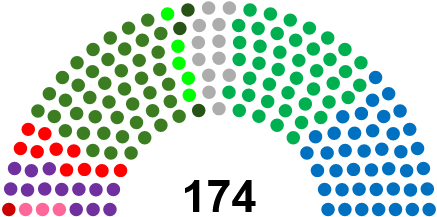
December 2025 Projection
Sinn Féin 43
Fianna Fáil 42
Fine Gael 39
Independents 12
Social Democrats 15
Labour 10
Independent Ireland 6
PBP/Solidarity 3
Aontú 3
100% Redress 1
Green Party 0
Current Projection (changes from Dec ’25)
Sinn Féin 44 (+1)
Fianna Fáil 42 (nc)
Fine Gael 41 (+2)
Independents 12 (nc)
Social Democrats 13 (-2)
Labour 10 (nc)
Independent Ireland 5 (-1)
PBP/Solidarity 3 (nc)
Aontú 3 (nc)
100% Redress 1 (nc)
Green Party 0 (nc)
Seat Map
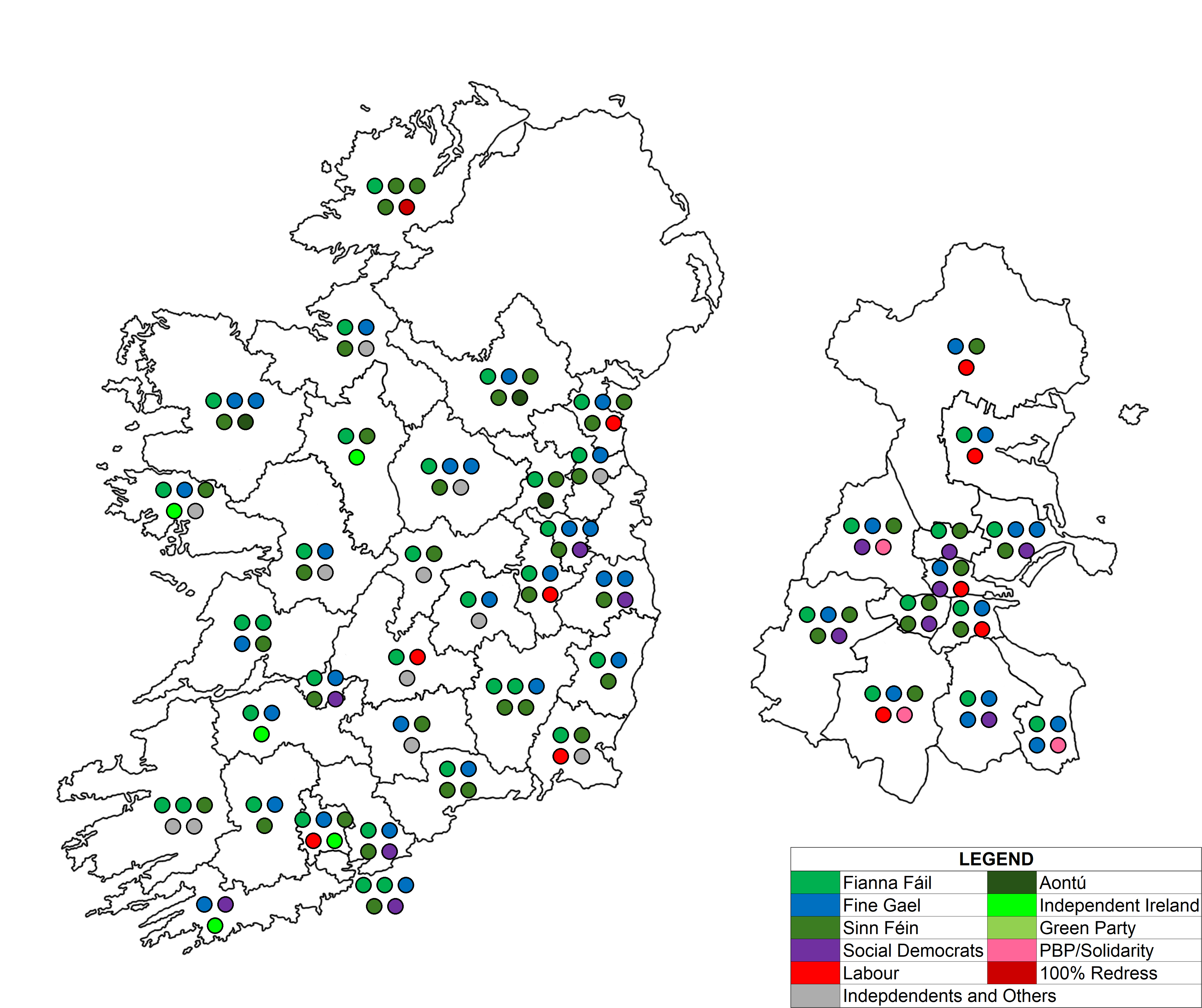
Hello all. In the last post at the end of 2025, I mentioned that part of the reason I was going to, in the immediate term, switch to quarterly posts is because there simply isn’t a lot happening in the polls. This has really come true – three months later and we have almost nothing changing. There’s been a slow decline for the government group (Fianna Fáil, Fine Gael, Independents) and a rise for the opposition both on the left (Sinn Féin, Social Democrats) and right (Aontú, Independent Ireland) but all of these are by relatively small amounts.
Overall it feels like there isn’t much exciting the electorate and causing a lot of people to adjust their preferences; while there is a trend against the government, it’s extremely marginal and on current numbers the government could continue in the same configuration, albeit with a slightly reduced majority. One could ask why we should expect voters to be excited so far from an election, and that is fair and carries a lot of truth, but equally I think expectations changed following 2020, where there were huge support swings – initially against, then in favour of the government – when we were a long way from an election.
Indeed, a number of the changes here are at least partially attributable to a slight change made in the model. Given that only RedC now publish regional breakdowns, trying to work out how other polls fit into this is a challenge. This is very much patchy still, I thought I had something that worked until I sat down to do these projections and realised the numbers being given were completely skewed. So I made a change, which had the knock-on of reducing some of the numbers for the Social Democrats and Independent Ireland in marginal seats. But this will need to be re-evaluated anyway.
Ultimately this may force, by necessity, a move to only using national figures if I can’t make it work. That will, I suspect, increase the room for error in projections so I don’t want to, but the question will eventually be whether or not I have any choice at all.
One small note: this doesn’t include the Ireland Thinks poll from April 4th, as it was published after I had done the projections and was in the process of writing this post. I don’t think it would have changed much anyway, it was very much in line with where we are at the moment, though given how tight the model shows it, it may have swung the final Sligo-Leitrim seat back to Independent Ireland.
A few things to discuss below; if you would prefer to skip straight to the seat changes, click here.
This isn’t great for anyone
I think the main takeaway from this is that nobody is going to be happy with polling the way it is. Fine Gael and Fianna Fáil are still in pole position, sure, but neither party has polled above 20% nationally since October 2025, and since then, both have averaged sub-18 points. This isn’t a decline from the election that points to significant losses (indeed, because of how things balance out, FG are favoured to net a few seats) but it is a decline nonetheless, at best one could spin as stagnation. And it’s not particularly clear where the potential to grow is, given the general relcacitrance of the government to change course on anything. Being locked into some kind of perma-alliance, their power held at the whim of Independents, is not where either of these parties want to be at all, and right now this is the best case. It’s notable how much politics has shifted in the last decade that some would consider this positive for these parties; it is not.
On the other hand, while Sinn Féin have been creeping up in the polls and are on track to be the largest party, things are not moving towards them at any great pace and it is clear that the anti-government support they once coagulated has broken both to their left and right. Myself and others have written a lot about how SF have failed to react to this change (and in some cases arguably made it worse) so I won’t rehash it. But its sufficient to say that not only are they not in a position to lead the next government, and that there isn’t a viable configuration for a government they could lead anyway. It’s not the disaster some commenters are talking about, but it’s not good either.
On the smaller parties: while the Social Democrats have been having some relatively great polling, hitting 10% for the first time, this is still a number that leaves them as very much a minority grouping, plus they are pulling most of their support from other opposition parties. Labour are holding steady but not showing growth, the Greens are avoiding oblivion but have no clear path back to grow their Dáil contingent, and PBP/Solidarity are also going nowhere at the moment. Aontú and Independent Ireland are showing growth but their support is geographically limited and its unclear how they turn these small changes into significant seat gains; we’ve seen plenty of their hype trains crash off the rails before.
Independents/Others have also seen their support decline fairly broadly; while national polling is of limited utility given the local dynamics by which Independents win seats, it is still notable that sentiment has turned against them somewhat. It would be easy to attribute this to them supporting the government, but this is hardly anything new. Either way it does imply that we will see more pressure on Independents, particularly ones with less established machines, to hold their seats.
None of this is to say things can or won’t change, however. While we’ve not seen much movement, if trends do continue in the direction they are going, we will start seeing many more places tip over into likely change. Part of this is mitigated because the bigger parties don’t have that many vulnerable second seats, and we could very well see results where of government and opposition parties winning seats off their colleagues rather than the other side. But if we see, for example, Sinn Féin moving into the upper 20s that will have a big impact. Similarly, if FF and FG recover to north of 20, or drop further into the mid teens, things will change – though as above, a lot of what that looks like will depend on the movement of parties relative to eachother rather than in a vaccum.
Upcoming by-elections and fake polls
I’ll do a separate post on the upcoming by-elections in Dublin Central and Galway West once (if?) we get specific polls for those constituencies, trying to assess by-elections off general polling trends is extremely difficult. I did it for Dublin Bay South a while ago and while it was broadly okay, it couldn’t capture the impact of a strong Labour candidate versus a weak Fine Gael one. So I think it would be better to exercise caution here until we have better data.
Speaking of lacking quality data, there was an attempt by a person or persons who have some form in misrepresenting polling figures, spreading misinformation and just generally making things up to present “polls” of the by-elections. Fortunately these attempts were extremely amateurish and immediately identifiable as complete nonsense, only appearing to fool a handful of people on Twitter, before being deleted. While very little has come of this particular effort, this might be a worrying sign if a more competent group were to attempt it; there are other countries that have serious problems with this. It’s why its important that people should have some understanding of how polling works!
But back to the elections themselves, assuming we do get polls at some point, I think these will be the key things to look out for. In Dublin Central, the relative polling of Sinn Féin against the Social Democrats seems pretty important; one would expect these to be the lead two left-wing candidates with the SDs likely the more transfer-friendly of the two. How the SF vote holds up without Mary Lou McDonald on the ballot will be fascinating, they’ll probably want to be decently ahead on the first round. Hutch and Steenson are a bit of a wildcard, while it’s unlikely the former can win in a by-election format, and the latter definitely won’t, it will be interesting to see how that vote has changed since the GE.
In Galway West, one would expect the government parties to be in the strongest position, and which of Fianna Fáil or Fine Gael start out ahead could settle the entire thing. However, with neither Catherine Connolly nor Noel Grealish on the ballot, theres a huge amount of votes that are very difficult to pin down, assuming their voters show up at all. Independent Ireland’s Noel Thomas has an opportunity to collect right-leaning anti-Government votes, but Thomas Welby could eat into that. The left-wing candidates have arranged a transfer pact, the impact of which will be interesting to track, but absent data indicating a leftward swing, it’s not clear that the left have a path to win a one-seat election here. But there’s more questions here at this point than in Dublin, I feel. Let’s see what emerges if and when we get a poll before reaching any conclusions.
Seat Changes
There are four changes since December,
Clicking on the linked name for each constituency should jump to the relevant section of this page. Changes on this page indicate changes from December 2025’s projections; changes on constituency pages indicate changes from current composition.
Note: The projections reflect, and always have reflected, most likely outcomes. So if a final seat is more likely for candidate X over Y, the model will show X winning the seat.
This does not mean the scenario where Y wins doesn’t exist, or even is necessarily unlikely (there’s a lot of marginal calls!). It also does not mean that every single “most likely” scenario will come true; statistically that in and of itself is probably not going to happen. This is true from from a simple probability point of view, even if we ignore deficiencies in underlying data. A projected result merely means that the model thinks X winning is the most likely outcome.
- Carlow-Kilkenny (SF +1, SD -1)
- Dublin Bay North (FG +1, IND -1)
- Dublin Fingal East (FG +1, SD -1)
- Sligo-Leitrim (IND +1, II -1)
2024 RESULT: 3 FF, 1 FG, 1 SF
CURRENT PROJECTION: 2 FF, 1 FG, 2 SF
PROJECTED GAINS vs DEC 2025: SF +1
PROJECTED LOSSES vs DEC 2025: SD -1
This is an interesting one. Sinn Féin were relatively compeititve for two seats here in 2024, but ultimately there were just way too many Fianna Fáil and Fine Gael transfers – including surpluses – sloshing around at the tail end of the count for them to close the gap. This surplus part is actually pretty important; the final gap SF needed to bridge was about 2,800 votes, of which about net 1,700 was from surpluses. If the FF and FG vote drops by enough to reduce or eliminate surpluses, you are looking at a relatively very small swing required; this is an interesting multiplier effect.
That said this is still as clear as mud. While the model now favours SF over the SDs to take that final seat (which I believe would be a Kilkenny seat, which I’ll come back to in a second), it’s not like FF and FG are imploding; FF’s position to hold the final seat, or FG’s position to take it, is still very decent. And there’s a ton of variables given geography that are hard to account for – particularly the outsize impact the county split has on the affinity for transfers across parties. So the scenario where a Carlow candidate – particularly from FF or FG – gets eliminated could end up very different from one where it’s a Kilkenny candidate, and also depends a lot who is still in the race at that point.
2024 RESULT: 1 FF, 1 FG, 1 SF, 1 SD, 1 IND
CURRENT PROJECTION: 1 FF, 2 FG, 1 SF, 1 SD
PROJECTED GAINS vs DEC 2025: FG +1
PROJECTED LOSSES vs DEC 2025: IND -1
Stop me if this sounds familiar, but we are once again looking at Dublin Bay North being highly competitive. I’ve repeatedly talked about the challenges facing Independent TD Barry Heneghan on paper around transfers, so I won’t bore you all by going over it again, but with Independent polling flagging, the model has him disfavoured in what looks like a three-way race for the final seat between him, Fianna Fáil and Fine Gael. The latter have a very small edge at the moment – FG’s numbers in Dublin are slightly up on the 2024 General Election – but this is a seat with an extremely small edge that I expect will oscillate back and forth for the next while.
Sinn Féin are not too far off still, but face a problem when it comes to transfers. Labour of course have had recent success here, so if there was a scenario in which Aodhán Ó Ríordáin decided to come back from Europe and run for the Dáil again, I’d expect him to be at least highly competitive if not outright favoured to take a seat. That is of course an idle thought – I have zero information or indication that this could be the case. I also expect Aontú to target this place heavily – maybe this time with a more respectable candidate who spends less time tweeting abuse at other politicians – and if they can unite disaffected right-wing votes behind them, they could be a factor; the combined Aontú and far-right vote here was over 10% in 2024.
2024 RESULT: 1 FF, 1 SF, 1 LAB
CURRENT PROJECTION: 1 FF, 1 FG, 1 LAB
PROJECTED GAINS vs DEC 2025: FG +1
PROJECTED LOSSES vs DEC 2025: SD -1
This feels a bit more like a reversion to the mean. Fine Gael lost their seat here in 2024 in the midst of a comedic underperformance, where they got squeezed hard by Labour and Fianna Fáil in the new constituency, doing significantly worse than their pre-redraw support base in the constituency should have indicated. In my view this was one of the biggest upsets of 2024; there was no strategic botch, no vicious cut to their geographic support, they just straight up could not hold onto their voters. This let Sinn Féin pick up the final seat, but it’s certainly one where they are vulnerable moving forward and the model reflects this.
While last time round the model thought the Social Democrats were best placed to displace Sinn Féin, the corrections to local support levels mentioned in the intro of this piece push their vote down slightly, and with Fine Gael looking solid in Dublin, the pendulum swings back their way. Of course, there’s a lot of questions still. Does ex-TD Alan Farrell runs it back, or do FG go for a new face? How well will the Soc Dems and Sinn Féin transfer to eachother is also important – with Labour likely to not hit quota before one of them goes out. Interestingly this scenario favours the SDs quite a bit – I would expect them to get more SF transfers than SF would get from the SDs if Labour are still in the race. Anyway, this is all fairly marginal and there’s very clearly three viable contenders for the last seat.
2024 RESULT: 1 FF, 1 FG, 1 SF, 1 IND
CURRENT PROJECTION: 1 FF, 1 FG, 1 SF, 1 IND
PROJECTED GAINS vs DEC 2025: IND +1
PROJECTED LOSSES vs DEC 2025: II -1
Similar to Dublin Fingal East, this is at least partially attributable to a tweak into how we were assessing regional figures, and that causes the Independent Ireland projection to drop slightly below Independent TD Marian Harkin. It’s still rather close of course, and this is definitely somewhere Sinn Féin and Fianna Fáil, will be looking at a second seat. That said I think the changes are perhaps overly down on Independent Ireland here given how close Cllr. Michael Clarke was to a seat last time round, as said in the main post, this will I think require further examination.
Of course, there is also the fact that Harkin is going to be around 77 by the time we have the next election, and the 2024 campaign was difficult. Similar to a lot of her Independent colleagues, there’s a cohort representing a generation that will realistically be aging out either this cycle or the next. Retirement is certainly not impossible, in which case, if current numbers hold, I would fully expect Independent Ireland to be the main beneficiary.
Other notes
- Cork North-Central: There’s an interesting dynamic at play here. Polls point to Munster as being an area of contined advancement for the Social Democrats, and CNC should be a target, especially after the curious multi-candidate strategy in 2024. But who would lose out? The obvious call is Labour, but I believe that with the benefit of incumbency, Eoghan Kenny will be stronger without a running mate next time. One thing that’s interesting here is Independent Ireland and how many far-right transfers Ken O’Flynn got, and how that changes in an environment where they are somehow even less organised than last time. There’s no change yet in the model but it’s quite close between these three at the moment.
- Dublin Mid-West: The model still favours the Social Democrats here even after adjustment, but Paul Gogarty is an insignificant amount off at this point; this could end up being very close. There’s plenty of right-wing transfers to go around here, and both centre- and far-right transfers heavily favoured Gogarty over the SDs last time out.
- Dublin South-West: PBP/Solidarity’s polling has been stagnant in Dublin recently, and Paul Murphy is the most vulnerable of their TDs. In 2024 this got widely overhyped by people with personal animus for Murphy, but it’s worth noting that even a relatively small downtick in support could have an impact here and the model is trending towards a mess for the final seat here, particularly with the SDs and Aontú trending upward.
- Speaking of Aontú, this isn’t a specific constituency observation but polls point to significant growth for them in Munster. If that continues – and assuming it’s accurate – I expect them to start popping up in a couple of seats in future projections.
- Kildare North: The projected margin for Fine Gael to take a second seat off Fianna Fáil is one of the narrowest I’ve ever seen. This one will go back and forth I suspect, at least unless their directions diverge in polling.
- Louth: Something interesting here – the model shows that the optimal action for both FF and FG is to run one candidate, else both could be vulnerable to Sinn Féin picking up a third. This is not as simple as in many places given that Louth splits heavily between north and south, and both parties only contesting one end could be a disaster for both. This is one of those things that just can’t be truly modelled, but I always think it’s worth pointing out where these specific dynamics reduce confidence in the modelling.
- Wicklow: I mentioned this last time but after more thought, I don’t think this will ever show a Fianna Fáil seat again as long as 2024 is used as the base. I do wonder how to address that, and how much can be clawed back by a better candidate? The second Fine Gael seat here ought to be vulnerable and was won off of Stephen Donnelly’s weakness to a large extent. Something to consider.
***********
Thanks so much for reading! This website is done entirely in my spare time and run without ads, so if you want to donate, please do so via Patreon or Ko-Fi – any support is greatly appreciated and 100% of any donations received are invested into the costs of running and improving the site.
 Irish Election Projections