Hello. It’s been a while. Barring one set of projections – that I have as yet been unable to find the time to do a full post for – I know things have been quiet here. This is a combination of background work that has taken longer than anticipated, and also been influenced by events away from this website. But we do have an election in a couple of days, for Uachtarán na hÉireann, so I think it’s worth discussing.
First and foremost, this isn’t a projection as such – firstly because Presidential elections are infrequent, idiosyncratic and sensitive to the persons of individual candidates in such a way that other national elections aggregate out, and secondly, because you don’t need me to tell you that, based on polling right now, Independent candidate Catherine Connolly is heavily favoured to win.
What I do want to do here is talk about the polling a bit, and then about some of the broader implications for politics in Ireland that could arise depending on the outcome of the election. This, I recognise, is more speculative and opinion-based than my normal work, so I advise taking more of a pinch of salt than usual in those sections.
One disclaimer: this post works under the assumption that the reader is reasonably familiar with the Presidential nomination process, and has some knowledge of the campaign and thus far; I will refer to some things without fully explaining them. If you are not, I apologise, but covering everything that has happened in this election would make this post, which is already hardly brief, incredibly long.
Oh, and since disclosure has been an important theme of this election, before I get into this: I intend to vote for Catherine Connolly. If that colours your interpretation of what I write subsequently, that’s reasonable. However, I strongly believe that it is better to be open about your opinion, and then do your best to present an objective case, than to pretend not to have one.
The Polls
There were some issues with the polling for this election. Firstly, the value of polls that include loads of candidates who are not running is questionable, and then having polls that include a half-dozen Fianna Fáil candidates and three Sinn Féin candidates is actively confounding. Despite having polls going back to December of last year, it wasn’t until September we started getting a better picture. But even after this, polls continued to include candidates who were not running or would clearly not be able to get access to the ballot. This results in a support graph that, even after consolidating dozens of prospective candidates, looks like this:
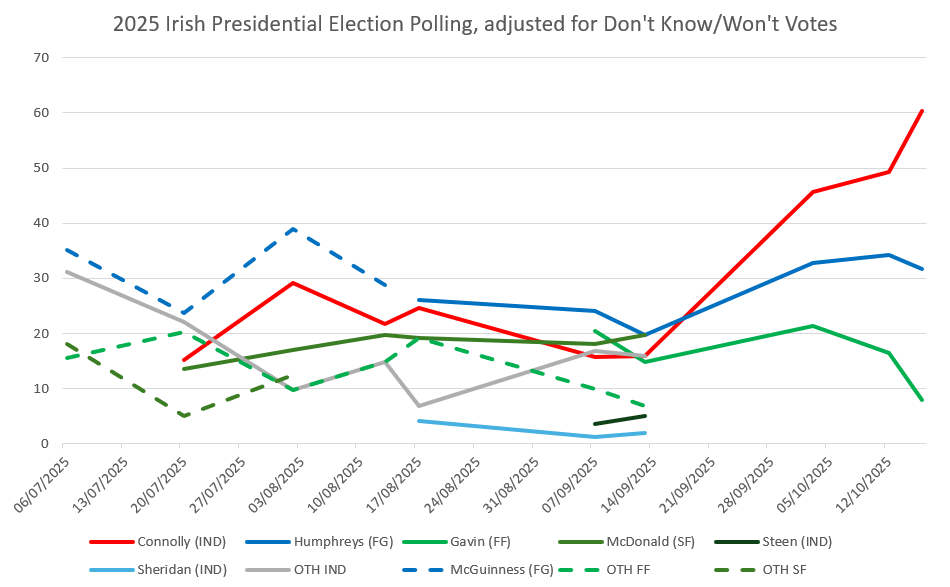
Messy as it may look, there are some things we can take from this. The most obvious thing is that Connolly’s support shoots up once Sinn Féin confirmed they will not be running a candidate, and once it became apparent there would be no other Independent on the ballot. This represented a total of around 43 points in the last poll to include those options; 30 points – 70% of what was available – went to Connolly.
This is of course something of an oversimplification, as some voters may have moved in and out of the Don’t Know/Won’t Vote bucket, but it does show that SF’s decision to withdraw and back Connolly was indeed the game-changer Mary Lou McDonald suggested it would be, and the derision from some quarters of the Irish media proved out-of-touch. Furthermore, even if every single SF voter from the prior went to Connolly – unlikely – she was still picking up at least 43% of the available Independent vote. Given that the Independents in this poll were primarily right-wing, that’s pretty remarkable. I’ve written before about incoherent anti-establishment sentiment, and that is a constant factor in elections – but rarely if ever on this level. But being able to win over this high a proportion of people who are not politically aligned with a candidate is unusual.
Worth noting as well that between Fine Gael’s Heather Humphreys and the ill-fated Jim Gavin (Fianna Fáil), Humphreys did much better out of the remainder. There may, however. have been another factor with impact between the polls in September and October, outside of finalising the candidates
Generally, I am skeptical of the impact of debates in Irish politics, but Presidential campaigns have proven to be a significant exception in recent cycles, and this year was no different. While subsequent debates and interviews have kind of settled into a fairly steady pattern, the first debate on Virgin Media was a complete disaster for both Humphreys and Gavin. While Gavin’s meltdown got most of the coverage, a disengaged, uninterested performance from the Fine Gael candidate was picked up on by voters. Polling by Ireland Thinks revealed that 44% of viewers thought Connolly won, compared to 6% for Humphreys and 5% for Gavin.
While there wasn’t an explosive moment comparable to Seán Gallagher’s infamous 2011 debate incident, where his inability to give a clear answer to a false accusation probably did him as much damage as the accusation itself, it’s very difficult to discount the impact of this debate. It’s also difficult to prove it had an impact, but looking at the huge jump Connolly’s numbers underwent, I would very much consider it as a factor. Indeed, I think the takeaway from this and past events is that having a good debate performance is nice, but doesn’t do much, but a bad performance can absolutely cripple a campaign. Jim Gavin never recovered, and after another very rough outing where he was unable to answer convincingly on his rent scandal in the RTÉ debate, suspended his campaign.
Finally, let’s talk about what these numbers mean in the context of Don’t Know/Won’t Vote answers. The above chart eliminates these entirely, and while the number has been quite high in most polls, it’s also reported together. The final IPSOS/B&A poll did break this down, with around half of DK/WVs genuinely undecided. Of these, not all will vote, but this gives us a guideline to work with. Looking at the last 3 polls, one from each of IPSOS/B&A, RedC and Ireland Thinks, we can work out what proportion of this Connolly and Humphreys would need.

This chart shows two scenarios, both assuming all undecideds turn up and all of Gavin’s votes transfer – which structurally favours Humphreys as the candidate with more to gain. Neither of these will happen of course, but this is designed to be illustrative as we have little information to indicate the actual rates. The first scenario “50/50 FF” is where Gavin’s transfers splits 50/50 between Connolly and Humphreys. I don’t think this is super likely, but it’s what the last IPSOS/B&A poll indicated. Under this scenario, Humphreys would need to win over 90% of undecideds.
The second scenario “FF>FG 100” is a scenario under which Humphreys wins 100% of Gavin’s transfers. In this scenario, she needs to win just over 57% of undecideds – not an implausible amount, but still a big ask, and as above predicated on several theoretical assumptions. This is very difficult to see happening; although not off the cards entirely, it does show how much ground Humphreys has to make up even in the best-case scenario.
A further caveat here is that the last poll showed much, much lower numbers for Gavin. If that poll’s distribution bears out in the election, Connolly will win in the first round.
In short, Connolly is not only favoured by raw polling, but looking deeper into the figures shows us that Humphreys paths to victory are limited. Based on the numbers we have, she in all likelihood needs her own turnout to be stronger than indicated, Connolly voters to show up at much lower rates than polling numbers indicate, have nearly all of Jim Gavin’s votes transfer, overwhelmingly win those, then have almost all undecided voters actually show up to vote in the first place, and then win a substantial majority of those. It could happen, and if skewed enough, the first two scenarios alone could make a difference, but it’s not very likely.
Whereas conversely, Connolly’s campaign has a much more straightforward, albeit still not easy, task of actually making sure their voters get to the polls on polling day. There’s a risk that her commanding position makes some people take the result for granted and not show up; but it would take a lot of people to stay home for this to be the case.
I am, however, put in mind of this article from 2011 by a young Gavan Reilly. This article was well researched, made reasonable claims backed up by evidence and was completely correct on the facts, yet – and this is no knock on Gavan – ended up being utterly wrong. Sometimes things happen that we can’t account for, that past data won’t show us. So, while everything points in one direction right now, things can still happen that we will only be apparent in retrospect. We can only analyse what we know about!
All of this has been to re-emphasise the case that Connolly is a strong favourite at this stage, which I think you already knew, but I hope the above has given a bit of insight into some of the possible scenarios on polling day, and how some of the finer details stack up. Now we will get a bit more into the speculative stuff, so as said up top, bear that in mind.
What might a Connolly win mean?
Obviously, it would be a very significant achievement for Connolly to win the Presidency on its own terms, and her campaign team’s strategy will be rightly analysed to death to understand how it built such a success, but look, there are people far better placed than I to do that if she does win. What I want to talk about is something she and her team achieved during the campaign: uniting Ireland’s oft-fractious left behind her campaign.
Perhaps unsurprisingly, there were some members of left-wing parties who couldn’t abide this. Labour TD Alan Kelly is hardly surprising, nor is former Green TD Brian Leddin, at least to the dozen or so people who still remember him. There were a few other dissenting voices at local level, but by and large the parties committed to the campaign – seeing Sinn Féin, the Social Democrats, Labour, PBP/Solidarity and the Greens sharing a united platform (in an electoral context – we must not forget the Equality and Repeal referendums) that has held together this well is quite something. Their leaders have all come out to bat for Connolly very strongly at various points in the campaign, even those facing dissent in their own ranks, and there are more photos of cross-party canvasses and activists from different parties working together than you can count. It’s been a remarkably committed campaign.
If the polls are right and there are no major shocks in the next few days, and Connolly wins this as she is on course to do, it will be very interesting to see what influence this has in future. While have been joint endorsements of candidates by left-wing parties in the past – Mary Robinson, Adi Roche and (with a million asterisks) Patrick McCartan – this is the broadest alliance ever put together for electoral purposes.
If it succeeds, the question is, will we see this change the approach parties take going into Dáil, local and European elections? That’s something I find really interesting – if this demonstrates that a united left, co-ordinating at a strategic level and pooling resources can succeed under certain circumstances, can those be replicated? As I discussed on the Echo Chamber podcast a week or so back, it isn’t a surefire thing, and there’s no guarantee that parties will want to go down that route, but it opens a door to something that has never really been fully explored in this country. There’s potential here for this to lead to a paradigm shift in Irish politics that has long-term effects far beyond this election. For now, however, we can only speculate on if it will happen, and if it does, what impact it might have.
What if Humphreys manages a comeback?
If Humphreys were able to overcome all of the above, it would genuinely be an astonishing comeback – not quite on the mathematical scale of Michael D. Higgins’ victory in 2011, but not a million miles off. This would however be more surprising in my view, as there was a very clear and public incident in 2011 in the closing stages of the campaign that sunk Seán Gallagher; this campaign has not had anything like yet, despite Fine Gael’s best efforts to tie various millstones to their opponent.
It’s possible that, in the intervening days between publishing this and the vote, that something truly devastating emerges that flips the election around, but we should absolutely not operate under such an outlying assumption. That leaves two possibilities – either a massive polling error, or the Humphrey’s campaign, through its own diligence, rallying voters en masse in the final days.
The former is also unlikely, though I suppose not impossible. It would require a systematic error in the same direction among all three major pollsters, the scale and scope of which would be basically unprecedented. As I have said many times, political polling for elections in Ireland is generally very good, and while Presidential elections are weird, I think that holds true. The misses in 2011 and 2018 are very much attributable to things that happened after polling concluded, rather than polls missing something when they were actually doing fieldwork.
So, this leaves the campaign itself pulling something out on its merits. And while that would be impressive if it were to happen, I think such an outcome could have very divisive consequences beyond this election. Fine Gael have engaged in an extremely negative campaign; they have struggled to make a positive case for their candidate and instead attempted to turn this into a referendum on their opponent. This has resulted in a series of bizarre attacks on the justice system, with things like prisoner rehabilitation and professional ethics of barristers coming under fire to the point where both the Bar of Ireland and the Minister for Justice felt compelled to intervene.
This certainly isn’t Fine Gael’s first foray into US-style negative campaigning, but generally they have also made a positive case for voting for them, whereas this campaign has been almost entirely negative. For what it’s worth, there’s very little evidence it’s worked for them (or other parties that have dabbled with it) in the past, and polling indicates it has also failed in this election. However, if they turn it around and it succeeds here, I would be worried about the influence this will have on how political parties communicate in future elections. I am firmly of the opinion that this stuff is bad for democracy and how people engage with politics as citizens; vindicating this strategy runs a real risk of further degrading our political discourse.
Democracy and ballot access?
One thing that’s come up a lot in the media coverage of this election – to an honestly disproportionate extent – is the question of access to the ballot and whether or not Presidential elections are truly democratic. Now, I sincerely believe that a lot of this has come about because there simply isn’t much else to talk about, and also because some prominent figures have a really odd obsession with a certain unsuccessful aspirant and her husband. But it has raised a broader question that is not superficially unreasonable – is it too hard to get on the ballot for the President?
To which the answer is, honestly, that any answer is arbitrary. We place all kinds of restrictions around who is and isn’t allowed to be on the ballot – or to vote – around nebulous concepts all the time. It is an extremely superficial understanding of democracy to suggest that this is not the case, and it is concerning how many politicians and commentators have pretended to have that understanding in the last few weeks. What has not happened however, is an actual discussion of what restrictions are and are not appropriate for this specific role.
Ultimately, it’s very hard to take this as serious objective commentary on the fate of Irish democracy given the utter indifference in the media to, and thumping rejection by voters of, the proposed 35th Amendment in 2015. This would have lowered the minimum candidate age from 35 for 21, and there’s nary been a peep about this during the whole wailing and gnashing of teeth about who can and can’t run for the Presidency. It seems that there is, after all, an understanding that some restrictions on ballot access are acceptable. But instead of that, we have had a conversation of absolutes, whereby the nomination system is treated as the sum total of both access restriction and democratic function. This deliberate elision is insulting.
In sum, this whole thing has been, in my view, bad faith, and based on people wanting specific candidates on the ballot. The prominent voices tearing their hair out are not doing so on behalf of Cllr Kieran McCarthy (who actually got a council endorsement!), Gerben Uunk, Keith McGrory, or, since this is allegedly about democracy and not character or beliefs, Conor McGregor. A proper conversation about this is worthwhile, but that is not what we have got at all – just a thinly veiled campaign on behalf of certain candidates, and it is not worth engagement until arguments are made for why this restriction must be ended but the other ones remain in place, and exactly what that system looks like.
Okay but could someone else have won?
Yeah. Billy Kelleher.
But surely the people would have rallied behind Ma-
She maxed out at 5% support. She was outpolled by Peter Casey, who barely even bothered to run a campaign. Be serious.
***********
Thanks so much for reading! This website is done entirely in my spare time and run without ads, so if you want to donate, please do so via Patreon or Ko-Fi – any support is greatly appreciated and 100% of any donations received are invested into the costs of running and improving the site.
 Irish Election Projections